 CompanyGraph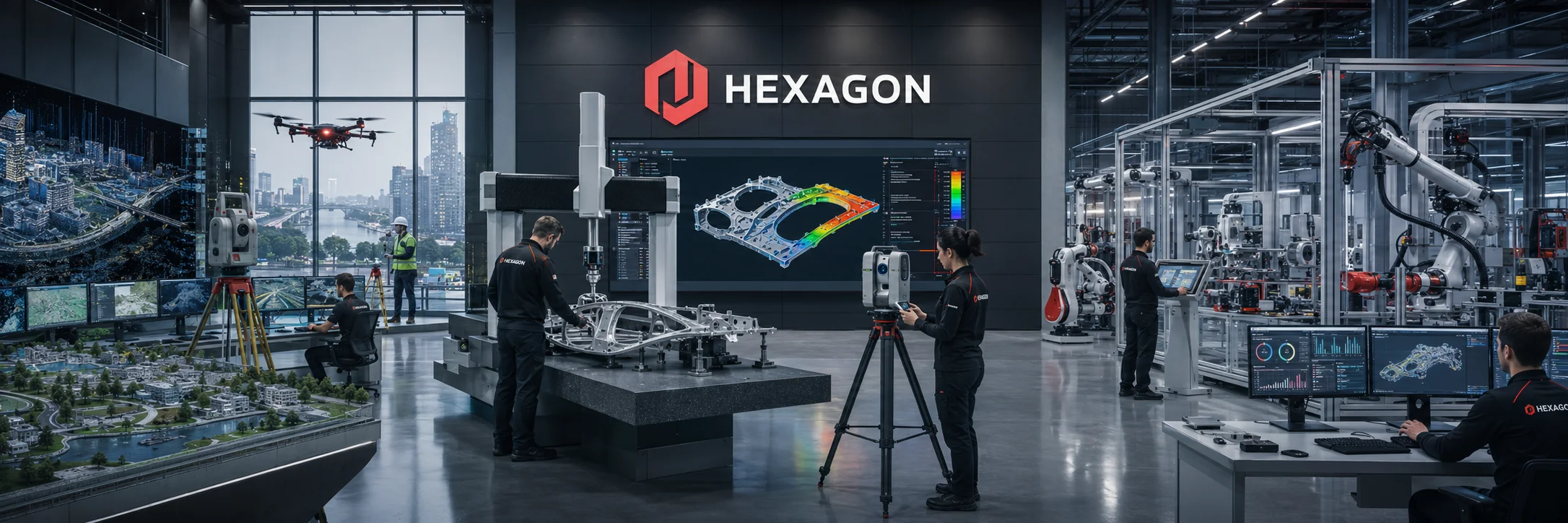
A measurement becomes useful when a calibrated sensor, a reference model, software, and an authorized decision remain connected to the object or machine being measured.
A measurement is a decision input, not the finished result
A manufacturer may need to know whether a machined surface is within tolerance, whether a bridge element sits where the design places it, or whether a mining vehicle knows its position. The required service is not a number on a screen. It is enough confidence to accept, adjust, stop, route, or repair something.
Hexagon supplies parts of that route: coordinate-measuring machines, scanners, positioning systems, software, asset-lifecycle tools, and autonomy technologies. Its business-area description separates Manufacturing Intelligence, Infrastructure & Geospatial, and Autonomy & Positioning. The technologies differ, but each connects an observation to a model, a workflow, and an action.
From part to report, every boundary adds a condition
A coordinate-measuring machine touches selected features. A scanner produces points or surfaces. A positioning receiver estimates location. Software compares those observations with a CAD model, map, tolerance, or operating rule. A report then states whether the sampled result meets a defined criterion.
Each step has a different failure mode. The instrument can be out of calibration. The fixture can distort the part. The wrong model revision can be loaded. A measurement routine can omit a feature. A report can be correct for the sample while the rest of a production run remains unknown. Hexagon's PC-DMIS documentation shows how routines, CAD changes, collision-free paths, execution, and reporting are linked; that software connection does not replace calibration, sampling design, or engineering judgement.
The distinction matters commercially. A calibration certificate establishes a condition at a time and under a method. A scan establishes captured geometry. A compliance report establishes comparison against a stated reference. None alone establishes that the reference is correct, the unmeasured areas are acceptable, or the product will perform safely in service.
Industrial precision changes rather than moving in one direction
Some industries tighten tolerances as products become smaller, lighter, more complex, or more automated. Other applications change the property being measured, replace a manual inspection with a continuous sensor, or accept a different accuracy at lower cost. The durable demand is therefore broader than a simple claim that tolerances never loosen. Manufacturers and infrastructure operators repeatedly need better knowledge of shape, position, condition, and process capability as their products and risks change.
That demand is not automatically a purchase. Measurement equipment is capital equipment. A factory may continue to need quality evidence while postponing a new machine during a downturn. The customer can extend an existing system, outsource inspection, or accept slower throughput. Hexagon must fund engineering, inventory, software development, training, and support before a delayed order arrives. Money determines which measurement route can enter the plant now, not whether the underlying requirement exists.
Acquisitions add domains, not instant integration
Hexagon expanded its scope through acquisitions, including Leica Geosystems, and later built coverage across manufacturing, geospatial work, infrastructure, and autonomy. The logic is stronger than collecting unrelated brands: a survey instrument can feed a model, a model can guide construction, and a production sensor can connect quality data to a machine process.
But domain knowledge does not become interchangeable because a parent company owns it. Measuring an aircraft panel, mapping a mine, and verifying a construction site involve different reference frames, environmental conditions, standards, and customer workflows. Hexagon's 2025 report describes approximately 24,500 employees and €5.4 billion in net sales; those totals show group scale, not that every division can support every application or move every data model across a boundary without work.
Digital threads keep observations usable
Hexagon's Manufacturing Intelligence division describes a path from design and engineering through production, quality management, service life, and digital twins. The division's description is a useful statement of the intended route: data captured from physical work should remain available to the next decision rather than disappearing into an isolated inspection file.
A digital thread is only as reliable as its identifiers, versions, timestamps, calibration status, and permissions. If the part number changes without the inspection routine changing, the report can be precise and still answer the wrong question. If a model is correct but the sensor has drifted, the comparison can be wrong. If the record exists but the operator cannot change the process, information has arrived without corrective authority.
Autonomy moves the decision closer to the machine
In autonomous mining, construction, agriculture, or transport, positioning and perception do not end in a quality report. Software must estimate state, detect obstacles, plan a path, and decide whether the machine may proceed. Hexagon identifies autonomy and positioning as a business area for land, sea, and air, while its manufacturing products also describe increasingly automated measurement routines.
The physical requirement becomes stricter as the response time shortens. A survey can be checked later; a vehicle must act while the environment changes. A positioning signal, map, sensor fusion model, and safety rule can each be valid in isolation while the combined decision remains unsafe. Human supervisors, geofences, maintenance, communications, and fallback modes remain part of the system even when the marketing language says “autonomous.”
Installed systems acquire a service history
Once a measurement system is embedded in a quality or compliance process, replacing it is more than unplugging hardware. Operators know its routines, customer specifications are written around its output, and historical data is compared across its versions. The installed system becomes operational infrastructure. That creates switching costs, but it also creates obligations: calibration, software support, spare parts, cybersecurity, training, and a route for correcting a recurring measurement error.
Records can help locate a problem. A maintenance log records an intervention; a software release records a change; a quality report records a result; a customer complaint records a field signal. None proves the present condition of every instrument or every product measured with it. Feedback improves the next result only when it reaches a team with the money, technical access, and authority to change the routine, equipment, model, or process.
The platform remains conditional
Hexagon's durable position comes from connecting measurement science to domain workflows rather than selling isolated sensors. The company can broaden that connection through acquisitions, software, and autonomy, but the customer still has to install and maintain the route. Capital cycles can delay equipment, integration can leave products disconnected, and a tighter requirement can be real without being immediately fundable.
The useful question is therefore not whether Hexagon has a platform or whether industry always wants more precision. It is whether a particular observation can remain calibrated, identifiable, comparable, and actionable until the person or machine able to change the physical process receives it. That is where measurement becomes industrial capability.
Inside CompanyGraph
The screen below shows the balance-sheet shape acquisition-built companies tend to carry: intangibles, goodwill, and goodwill-to-equity all elevated together.
Intangible Concentration
Intangibles are a large share of total assets, goodwill is a large share of total assets, and goodwill is large relative to shareholders equity
A match records what past acquisitions left on the balance sheet, not whether the acquired capabilities still work as this story describes.