 CompanyGraph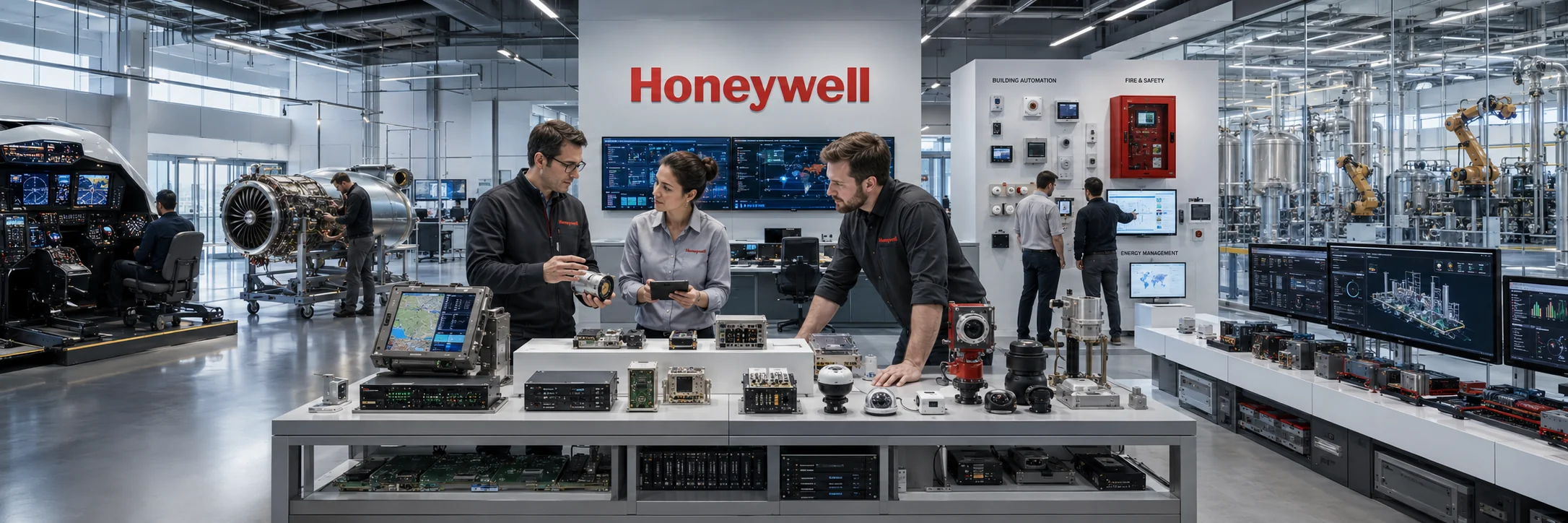
Honeywell supplies operable infrastructure when sensors, controllers, software, people, and service remain connected to the building or process they are meant to control.
The current company is a control business
A refinery, warehouse, hospital, data centre, or office building needs more than a controller in a cabinet. Operators must know what is happening, decide what should change, and make that change without creating a larger hazard. Sensors, control logic, alarms, networks, power, procedures, maintenance, and trained people form the operating path.
Honeywell Technologies now describes itself as connecting intelligence across millions of assets. Its company overview presents building, process, and industrial technologies alongside software and an enterprise operating system. That is a different scope from the older Honeywell conglomerate. Honeywell completed the spin-off of Advanced Materials in October 2025, and the June 2026 filing records the completed Aerospace Technologies spin-off. The legal boundary changed; customers still needed their installed systems to work through the separation.
A sensor reading becomes useful through a control path
Honeywell's control systems combine process controllers, safety functions, analytics, SCADA or PLC architectures, and cloud or edge connections. The company's description explains the intended chain: field devices produce signals, a control system interprets them, and people or automated logic respond.
Every boundary adds a condition. A sensor can drift or be installed in the wrong place. A controller can run an old configuration. A network can delay or lose a message. An alarm can be technically correct but arrive at a console no one is watching. A remote dashboard can show a normal value while a valve is stuck, a cable has failed, or a local operator has placed equipment in manual mode.
Records help make those failures reachable. A calibration certificate describes an instrument at a time. A configuration file states the logic that should run. An alarm history records an event. A work order records an intervention. None alone establishes the present condition of every sensor, valve, network, or human procedure. A control-room display is an observation, not the whole facility.
Accelerator standardizes work without making sites identical
Honeywell calls its enterprise method Accelerator. The company describes it as an operating system built on Lean Six Sigma, shared processes, training, and standards that can be applied across products, aftermarket services, projects, and software.
A common method can improve how teams identify defects, manage projects, and transfer lessons. It can also make a large organization easier to steer. But the method cannot standardize the physical conditions of every customer. A chemical plant, a hospital, and a warehouse have different hazards, control loops, regulations, network architectures, and shutdown windows. The enterprise can supply procedures and tools; local teams still have to configure, test, maintain, and operate them.
Money arrives before the system produces savings. A customer may need engineering, sensors, controllers, cabling, software licenses, cybersecurity review, training, and a planned outage. Even when an old system wastes energy or increases risk, the customer may postpone replacement because downtime, approvals, and capital compete with current production. Honeywell must maintain engineers, support, inventory, and development while the purchase decision remains delayed.
Software adds a layer to the installed base
Honeywell Forge and related connected-building tools add analytics and cloud or edge services to physical controls. The aim is to use operating data to improve comfort, asset health, uptime, energy use, or maintenance. Honeywell's integrated-operations description shows how building management, security, fire and life safety, and maintenance can be brought into a common interface while older systems remain in place.
That creates a possible feedback loop. Installed controls generate data; the software identifies a pattern; a technician or operator changes a setpoint, schedule, component, or maintenance plan; the resulting condition produces new data. The loop fails if the data is incomplete, the model is wrong, the recommendation cannot be executed, or the person who sees the issue lacks permission and budget.
Portfolio changes move liabilities as well as products
Honeywell's long history included aerospace, chemicals, materials, building controls, and industrial automation. Portfolio reshaping can make a company easier to manage, but a spin-off is not a simple deletion from a product list. Contracts, intellectual property, employees, pensions, environmental obligations, warranties, data, and transition services need their own agreements.
Honeywell's 2025 Form 10-K records the Advanced Materials separation, environmental reimbursement arrangements, and the transfer of asbestos liabilities. The Aerospace filing records separation, tax, intellectual-property, employee, and transition agreements. Those records establish how legal obligations were allocated; they do not prove that every customer experienced a seamless service transition.
Installed systems keep a service history
Once a control platform is embedded in a facility, its history becomes part of the asset. Operators learn its screens and alarms. Maintenance teams stock its components. Safety procedures reference its interlocks. A software version can change how a sensor is interpreted. Replacing the system may require a new hazard review, validation, training, and downtime.
This installed base can create recurring service work and customer stickiness. It can also preserve obsolete dependencies. A customer may remain on an older platform because migration is risky or because budget has not arrived. Honeywell can offer remote monitoring, upgrades, and new analytics, but the customer still decides whether the physical and organizational route is reachable.
Control is not the same as responsibility
Honeywell can design a controller, supply a sensor, update software, or support a customer. The facility owner controls the process, maintenance schedule, staffing, and emergency response. A systems integrator may configure the installation. A contractor may replace a device. A regulator may define the required safety case. If a field failure appears, the useful question is where the information, authority, and money separate.
A complaint, incident report, or performance metric becomes corrective action only when someone can inspect the relevant equipment and change the next step. A central dashboard may identify a pattern; a local technician may need a ladder, a spare part, a permit, and a shutdown window. The measured issue and the physically available response are different things.
The operating system remains conditional
Honeywell's current advantage is not a catalogue of thermostats, controllers, or software subscriptions. It is the ability to keep control knowledge, installed hardware, data, service, and operating decisions connected across long-lived facilities. Accelerator can spread methods, and Forge can shorten the distance between signal and recommendation, but neither removes local configuration, capital timing, cybersecurity, or human judgement.
The durable question is whether a customer can still see the condition, trust the evidence, authorize the intervention, and finance the work before a small control problem becomes an outage or safety event. That is where a software-industrial promise becomes operable infrastructure.