 CompanyGraph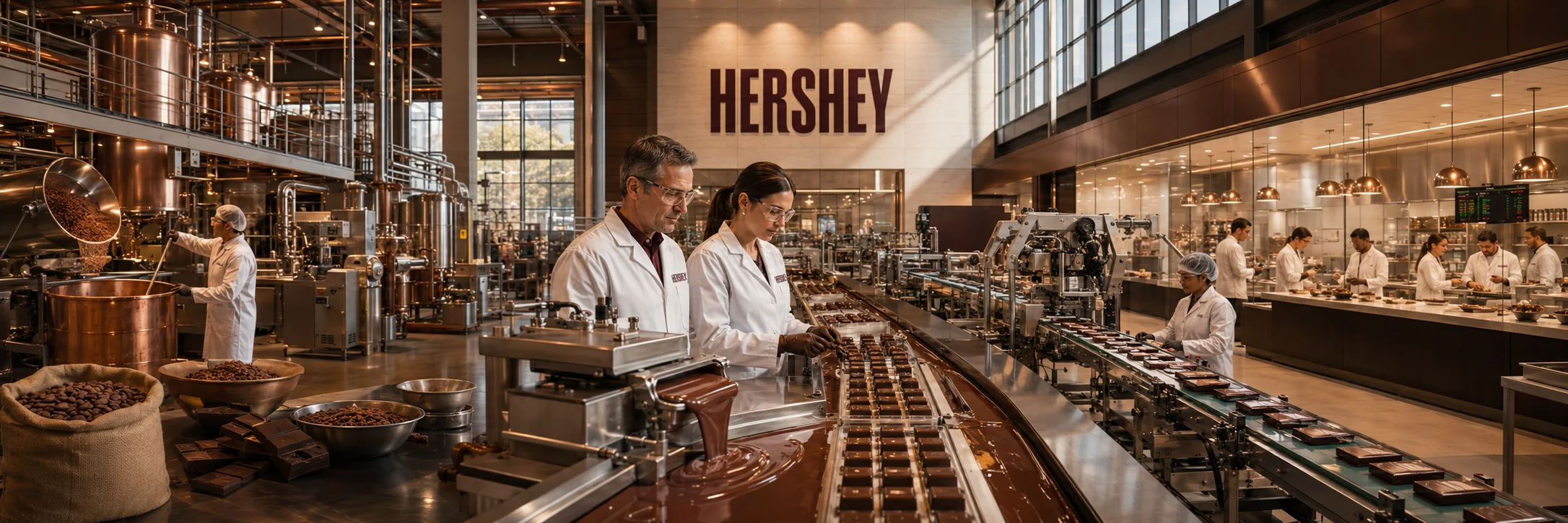
A confectionery brand becomes durable when a familiar taste is manufactured consistently, reaches the buying point, fits the customer's budget, and can be replenished through every seasonal peak.
The product is a repeatable eating occasion
Milton Hershey founded the chocolate business in 1894. The company's history describes a move from caramel into affordable milk chocolate and the first Hershey bar at the end of the nineteenth century. The important transformation was not only a recipe. It was a repeatable product: a known size, flavour, wrapper, price range, and shelf life that could be made and sold far beyond one confectioner's shop.
Cocoa, sugar, dairy ingredients, fats, flavourings, packaging materials, heat, cooling, and food-safety controls all enter that product. Their condition matters. Cocoa quality and flavour vary; sugar and dairy must meet a formula; tempering and cooling affect texture; packaging must protect the bar from heat, moisture, and contamination. A finished bar can carry a powerful name while still being unavailable if a plant, warehouse, retailer, or payment decision has failed.
Manufacturing turns ingredients into a recognizable signal
Confectionery manufacturing makes small physical differences commercially important. A change in cocoa liquor, milk solids, particle size, roasting, or conching can change taste and texture. A change in moulding, cooling, or wrapping can change breakage and shelf life. Quality records and lot codes help identify where a problem entered, but a test of one sample does not establish every bar in a shipment's present condition.
The formula also determines what the company can substitute. If cocoa prices rise or a supplier fails, an alternative ingredient may be physically available but still require trials, sensory approval, labelling changes, and customer acceptance. The company can hedge or contract for inputs, but financial protection does not create cocoa, factory time, or retail capacity. It changes which responses are affordable before the next production run.
Distribution is part of the product
A chocolate bar is often chosen in seconds at a checkout, convenience store, vending machine, cinema, or seasonal display. The shopper may have a preference, but the retailer decides what is stocked, where it is placed, and how often it is replenished. Hershey's dense distribution therefore does more than move finished goods. It places the brand where an impulse decision can occur.
This reach costs money before the sale. Plants and warehouses must build inventory, distributors must finance transport and receivables, and retailers must reserve shelf space and handle shrink, promotions, and returns. Seasonal peaks such as Halloween, Valentine's Day, Easter, and Christmas compress those decisions into short windows. A company can have product in a factory and still miss the occasion if packaging, trucking, allocation, or retailer payment terms delay the shelf arrival.
Distribution density can reinforce brand memory: repeated visibility makes the product easier to recognize, and recognition makes a quick choice more likely. That is a feedback mechanism, not a law of psychology. A competitor can win attention with a better promotion, a different price, or a changing health preference. Shelf presence is necessary for many impulse sales but does not guarantee them.
Raw-material shocks arrive through the wrapper
Cocoa and sugar are not background inputs. Crop conditions, disease, weather, labour, shipping, and trading markets can change the cost and availability of chocolate ingredients. Hershey can hedge, contract, reformulate, change pack sizes, raise prices, or absorb part of the increase. Each response moves the pressure somewhere else.
Low absolute prices make the trade-off visible. A small increase in the price of a bar may be manageable for one purchase, but repeated increases can change what a shopper buys or how much is bought. Smaller packages can preserve a familiar price while reducing quantity. A premium format can protect margin but change the occasion. The correct question is not whether Hershey can pass through a commodity cost, but which combination of price, size, recipe, and retailer support keeps the intended purchase physically and financially reachable.
The Trust protects a different kind of continuity
Milton Hershey placed company assets into a trust whose mission supports the Milton Hershey School. Hershey Trust Company describes the school trust as a perpetual charitable trust. The trust's voting position gives it a role in corporate control that ordinary consumer companies do not have. Its 2022 release states that Class B shares carry ten votes each and that the school trust retained approximately 80.5% of total voting control after a share sale. That release describes the sale as part of asset diversification while preserving voting control.
This structure can protect decisions whose returns arrive slowly: factories, brands, distribution relationships, and product development. It can also prevent shareholders from receiving a normal takeover premium and concentrates authority in a trust with its own educational mission. Voting control is a documented fact; the claim that it always improves business decisions is an interpretation.
Snacks widen the route and change the constraints
Hershey's current portfolio includes chocolate and non-chocolate confectionery, gum and mints, protein bars, popcorn, pretzels, spreads, and pantry items. Its 2025 Form 10-K also records the 2023 acquisition of assets that added popcorn manufacturing capacity.
Expansion can reuse capabilities in branding, retail relationships, packaging, and seasonal merchandising. It does not make popcorn or a protein bar physically identical to chocolate. Ingredients, equipment, shelf life, competitors, and consumer reasons for purchase differ. The acquired route must earn its own quality, supply, and distribution reliability. A broader snack portfolio can reduce dependence on cocoa while adding unfamiliar input and integration risks.
Records describe a route, not a consumer result
A recipe and batch record describe how a product was made. A lot code links a package to production. A shipment record shows that goods left a facility. A retailer scan records a sale. A market-share estimate aggregates those sales. None establishes that a particular customer liked the taste, could afford a replacement, or received a product at the intended temperature and shelf life.
The same limits apply to brand measures. Awareness can show that people recognize a name; it cannot show why they selected it. A repeat purchase can indicate habit, price fit, or lack of alternatives. A trust structure can establish who controls votes; it cannot establish whether every factory, supplier, or retailer is operating well. Feedback becomes useful when complaints, returns, quality signals, and sales changes reach the people able to alter ingredients, production, price, allocation, or distribution.
The durable system is conditional
Hershey's position rests on several connections: a repeatable formula, dependable manufacturing, affordable packaging, dense retail access, learned taste, seasonal planning, and governance that can protect long-term investment. Remove any one and the brand may still exist, but the eating occasion becomes less reliable.
Cocoa shocks, health concerns, retailer bargaining power, changing taste, counterfeit products, and international differences can all weaken the route. The company can respond through sourcing, price, format, promotion, or acquisition, but each response has a physical and financial cost. Brand permanence is not a permanent property of a wrapper. It is the result of continuing to make the right product, put it in the right place, and keep the next purchase possible.