 CompanyGraph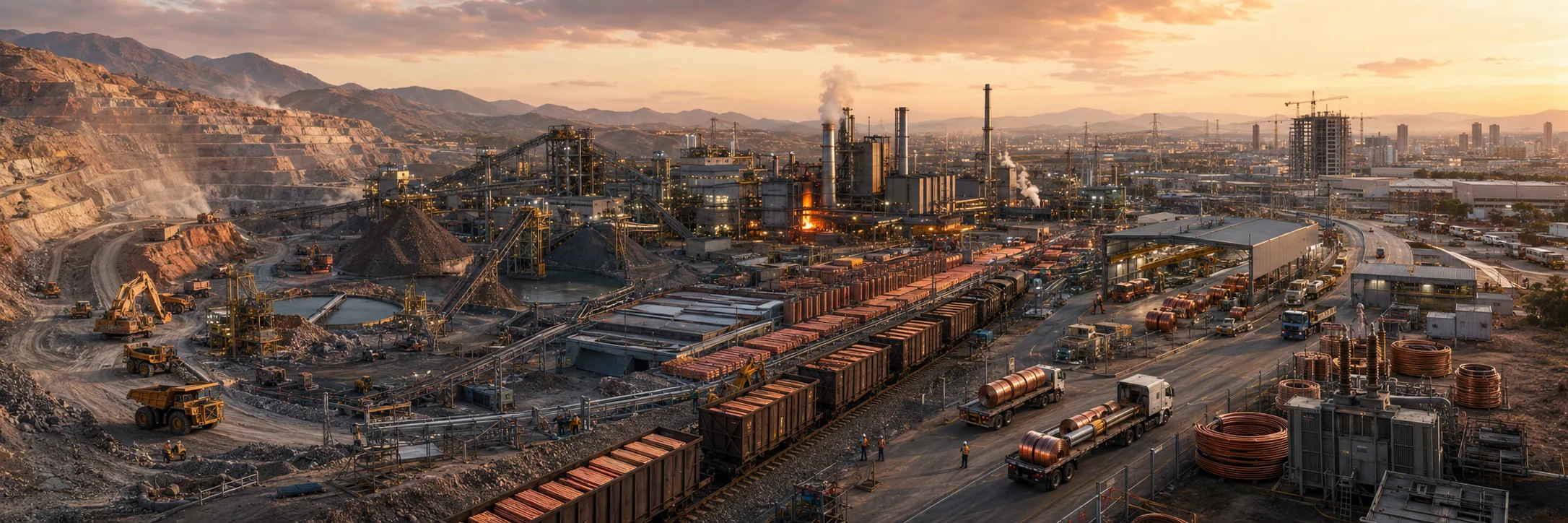
How mineralized rock becomes a qualified conductor, enters long-lived equipment, and returns only gradually as scrap.
Copper begins as a required function
A copper wire in a building, a tube carrying water, a winding in a motor, and a trace in a circuit are not the same object. They use related properties - high electrical and thermal conductivity, ductility, corrosion resistance, and the ability to be formed and joined - but each requires a particular geometry, alloy, temper, insulation, and connection. Copper is one way to supply those functions. Aluminium, fibre, plastics, steel, and different system designs can substitute in some applications, while weight, space, heat, corrosion, safety, and standards constrain the alternatives.
The physical journey starts in mineralized rock. Mining removes ore and waste; crushing, grinding, flotation, or leaching separates a copper-bearing stream; smelting and electrolytic refining may turn a sulfide concentrate into cathode, while solvent extraction and electrowinning can produce cathode from some oxide-bearing solutions. Fabricators then cast, roll, draw, anneal, alloy, coat, and join the metal into wire rod, cable, tube, sheet, foil, connectors, motors, transformers, and other products. Those products may remain in buildings, grids, vehicles, machines, and electronics for years or decades before demolition, replacement, or repair makes some of the metal recoverable.
At every boundary, the word copper hides a changed physical condition. Ore grade is not cathode purity. Cathode is not wire. Wire is not an energized circuit. A stock of copper in a building is not scrap available today. A scrap shipment is not automatically the alloy, cleanliness, geometry, or quantity required for the next product.
For electricity, copper's low resistivity allows a required current to pass with a defined conductor size and loss. Its thermal conductivity also helps move heat, and its ductility allows wire drawing, bending, and reliable joining. These properties explain why copper appears in building wire, motors, generators, transformers, data equipment, power cables, plumbing, heat exchangers, and many electronic components. The U.S. Geological Survey copper summary describes copper as the highest-conductivity non-precious metal and lists its broad electrical and industrial uses.
That list does not make every copper product biologically or technically inevitable. The required service might be moving electricity, heat, water, or information. An engineer can sometimes change cross-section, voltage, cooling, routing, material, or architecture instead of specifying copper. The International Energy Agency's materials analysis notes that aluminium is commonly used for overhead lines and can substitute for copper in some underground and subsea applications, while high-voltage direct current and material efficiency can reduce total metal demand.
Present copper demand therefore combines several things: the physical functions that a design must provide, growth in the stock of buildings and equipment, replacement of worn or damaged systems, losses and inaccessible scrap, and choices about material, redundancy, distance, and electrification. Electrification can enlarge demand for conductors, motors, transformers, and grid connections, but the resulting copper volume depends on how those services are designed and how much existing metal returns to use.
From mineralized rock to a separable feed
Copper ore is rock containing copper minerals along with gangue, water, and other elements. A mine's head grade is the measured copper content of material sent toward processing; it is not the amount ultimately recovered. Recovery depends on mineralogy, particle size, liberation, reagent conditions, equipment, water, and the route selected. A sulfide ore may be crushed and ground, then concentrated by flotation. An oxide-bearing ore may instead be placed in leach facilities, where a solution dissolves copper for later recovery.
Flotation does not make impurities disappear. It divides a feed into a copper-bearing concentrate and tailings that retain most of the original rock mass, water, and some residual copper. Leaching also leaves spent ore, solution, precipitates, and other streams that require containment, water management, or further treatment. A mine can therefore report tonnes of ore and a concentration grade while the surrounding watershed, tailings facility, roads, energy system, and workers carry conditions that the saleable copper number does not show.
Lower grade can require more ore to be mined and processed for the same contained copper if recovery and route are held constant. In practice, depth, hardness, mineralogy, recovery improvements, mine design, water recycling, and energy sources change the relationship. The IEA's 2025 copper analysis reports a long-run decline in average mine grades and connects new projects with rising capital needs and complexity; it does not establish that every mine or every global year follows one fixed trajectory.
Mining decisions are made before the copper is sold. Drilling, feasibility work, environmental studies, water access, power, roads, ports, equipment, labour, closure security, and community agreements all require time and money before production can begin. A mine operator may be able to improve recovery or expand a plant, but cannot create an ore body, a water source, or a permitted haul road by changing a short-term price.
Why concentrate is not metal
A concentrate is a transportable intermediate, not a finished conductor. Its assay records copper and other payable or penalized elements, moisture, and sometimes valuable by-products. A mine can blend material to meet a smelter's feed limits, dry it for shipment, load it into containers or bulk vessels, and transfer custody to a trader or smelter. The concentrate still contains sulfur, iron, gangue, and trace elements that must be separated or managed.
For sulfide concentrates, a smelter dries and heats the feed with flux and oxygen. The operation produces a copper-rich matte, an iron-bearing slag, sulfur-bearing gases, dust, and other streams. Converters oxidize additional sulfur and iron to make blister copper or anodes. The U.S. Environmental Protection Agency's primary-copper process description explains that sulfur dioxide from smelting and converting can be captured in a sulfuric-acid plant, while slag and dust still require their own handling and recovery routes. Capturing sulfur as acid changes the output; it does not erase the material that entered the gas system.
Electrolytic refining dissolves copper anodes and deposits high-purity copper at cathodes. The USGS describes cast anodes at about 99.8% copper and cathodes above 99.99%. Impurities can collect in anode slime or other refinery streams, some of which may contain recoverable metals and some of which require controlled treatment. A cathode certificate establishes a defined lot's chemical and physical specification; it does not establish the condition of a cable made from that cathode, the quality of an installation, or the fate of the refinery's residues.
Mining and refining are geographically separated. The IEA estimates that China has around 40% of global copper refining, while the three largest refining countries together account for about 59% in its 2024 outlook. This concentration means that concentrate availability, smelter maintenance, energy, acid markets, shipping, trade rules, and treatment-and-refining charges can affect miners and fabricators on different continents. A treatment charge is a contract term for processing concentrate, not a direct measurement of copper in the ground or cathode ready for a customer.
Cathode is an intermediate form
Cathode is a refined input for another manufacturing process. A rod mill may cast and roll it into wire rod; drawing reduces the rod to wire; annealing changes softness and ductility; insulation and shielding create a cable; rolling and heat treatment create sheet or foil; alloying changes strength, machinability, corrosion behaviour, or wear resistance. Tube, busbar, connector, winding, and electronic parts each add dimensions, surfaces, joints, coatings, and process history.
These transformations make copper useful in a particular system and also narrow the next available use. A high-conductivity wire, a brass fitting, a tin-plated connector, and a copper-nickel tube are not interchangeable merely because each contains copper. A product specification describes the required composition, dimensions, and performance. A process record and test result connect a lot to its manufacturing history; neither is a substitute for inspecting the installed object when failure depends on routing, joints, corrosion, overheating, vibration, or loading.
Fabricators need more than cathode tonnage. They need the right cathode grade, melt schedule, rolling or drawing equipment, dies, insulation, skilled work, testing, orders, and working money at the time production must occur. A wire mill can have metal in storage and still lack the tooling, approved design, or customer schedule needed to make a particular cable. Conversely, a plant can have nominal capacity while a power outage, furnace repair, labour shortage, or missing additive makes that capacity unavailable.
The useful stock is embedded in place
Once installed, copper performs as part of a larger configuration. Conductor cross-section, length, insulation, connectors, grounding, cooling, routing, and load determine whether a circuit delivers the required service. A warehouse inventory of cathodes or cable is not the same as an energized feeder. A building may contain a large copper stock while demolition, ownership, access, contamination, and collection equipment determine whether any of it can return to a recycler.
In-use copper therefore creates a time delay between demand and secondary supply. A new grid, building, vehicle, or data centre adds metal to the stock; replacement or demolition may release it years later. The timing is not fixed: repair can preserve a component, refurbishment can extend service, and early replacement can release functioning metal. The physical stock exists, but its location and continued use make it unavailable for another product until a decision and a recovery route connect it.
Money governs which of those actions is reachable. A mine needs finance before drilling, permitting, equipment, water infrastructure, and closure work; a smelter needs feed contracts, energy, maintenance, acid handling, and environmental controls; a fabricator needs working capital, tooling, qualified process windows, and a customer willing to carry inventory; a collector needs access, labour, transport, sorting equipment, and a buyer for the separated grades. As possible mechanisms, a smelter's treatment charge can make a marginal concentrate worth stockpiling or blending rather than processing immediately, while a collector without credit for a dismantling crew may leave recoverable cable embedded in a building. The metal is physically present in both cases, but the next action is not financeable. A low copper price can make recovery or maintenance infeasible; a high price can make difficult extraction or dismantling reachable without proving that it preserves the surrounding site or the next function.
Return is selective, not immediate
New manufacturing scrap often remains identifiable and clean enough to return quickly. Old scrap is different. Cable may be insulated, mixed with steel, buried in concrete, or cut into short lengths. Demolition and electronic scrap can combine copper with solder, plastics, coatings, other alloys, and hazardous components. Collection, dismantling, sorting, sampling, and refining determine whether the recovered metal can become a specified product or only a less demanding one.
Copper's elemental properties do not disappear when the metal is remelted, but that does not make every scrap stream a ready substitute for every cathode or component. Contamination can be diluted, separated, or carried into a new alloy; some copper remains in slag, dust, dross, wastewater solids, or unrecovered mixed material. Directly reusing an identified cable, tube, or connector can preserve geometry and completed work that remelting intentionally destroys. The International Copper Study Group describes copper recycling as a complement to primary production and tracks both scrap use and secondary refined production.
Secondary supply is constrained by the copper stock's age, location, ownership, and collection system. The IEA's recycling analysis says recycling reduces reliance on new mines but does not eliminate the need for mining investment, especially while demand and in-use stocks grow. That is a statement about current demand, stock turnover, and infrastructure - not a law that primary copper must always dominate. Better design, longer service, repair, material efficiency, substitution, and collection can change how much new extraction is required.
What do the numbers establish?
A head-grade assay measures copper in a sampled feed; a resource or reserve estimate models what could be recovered under stated assumptions; a concentrate assay and moisture result help set a smelter contract; cathode purity and a lot number describe a defined refined product; and a wire specification describes dimensions and properties under its test method. An exchange warehouse record covers registered lots under that exchange's rules, not copper embedded in buildings or scrap awaiting collection.
A recycling-input rate describes a defined production stream, while a price records transaction terms. These observations are useful when their boundaries are named, but none describes installed condition, all future availability, or the feasibility of the next fabrication and recovery route.
When a mine's output disappears
The closure of Cobre Panama shows how a large physical stream can stop while the copper already extracted remains in a different state. The mine halted production in November 2023 after Panama's Supreme Court declared the concession law unconstitutional. A filing with the U.S. Securities and Exchange Commission records that the mine had produced 330,863 tonnes of copper in 2023 and represented about 1.5% of world copper production before closure. Concentrate stockpiled at the site did not become cathode merely because it existed; it still required custody, transport, processing, and a permitted route.
A disruption can be absorbed partly by inventories, slower demand, substitution, secondary supply, restarts, or higher output elsewhere. It cannot usually be replaced immediately by a new greenfield mine. The IEA's lead-time analysis found that major mines entering production in 2010-2019 took more than 16 years on average from discovery to first production, with the exact duration varying by mineral, location, and mine type. Brownfield expansions and restarts can be faster, but they still need equipment, water, labour, approvals, and money.
Water and permission are part of the physical route, not an external footnote. The IEA's 2024 copper assessment found that 52% of copper mines were located in areas of high water stress. A mine may respond with recycling, brackish-water treatment, desalination, a different process route, reduced throughput, or closure. Each option changes energy use, capital needs, discharge, local access, and the amount of metal that can be produced. A production forecast that omits those conditions is a claim about a model, not proof that the site can deliver.
What complete copper supply connects
Dependable copper supply links the required electrical, thermal, plumbing, or electronic function to a material with the right composition, form, geometry, connection, and evidence. That link must cross mines, concentrators or leach plants, smelters, refineries, fabricators, installers, users, collectors, and recyclers while resources and authority remain available to act.
The same account follows material displaced in mining, tailings and water left at concentration, sulfur and residues managed at refining, process history that qualifies a fabricated part, installed stock that cannot return immediately, and scrap and by-products that need their own routes. A cathode shortage, a qualified-cable shortage, and an idle circuit are different states; the correction depends on where material, evidence, money, or authority has stopped moving.
Inside CompanyGraph
Explore the geological surveys, mine operators, concentrators, leach and solvent-extraction plants, smelters, refineries, sulfuric-acid plants, traders, wire-rod and tube mills, cable and equipment makers, construction and grid installers, demolition and collection firms, secondary smelters, refiners, and regulators that connect copper from rock to service and back. The graph shows where assay, contract, inventory, installed condition, scrap route, and corrective authority separate - and whether feedback and resources can reach the participant able to change the next outcome.