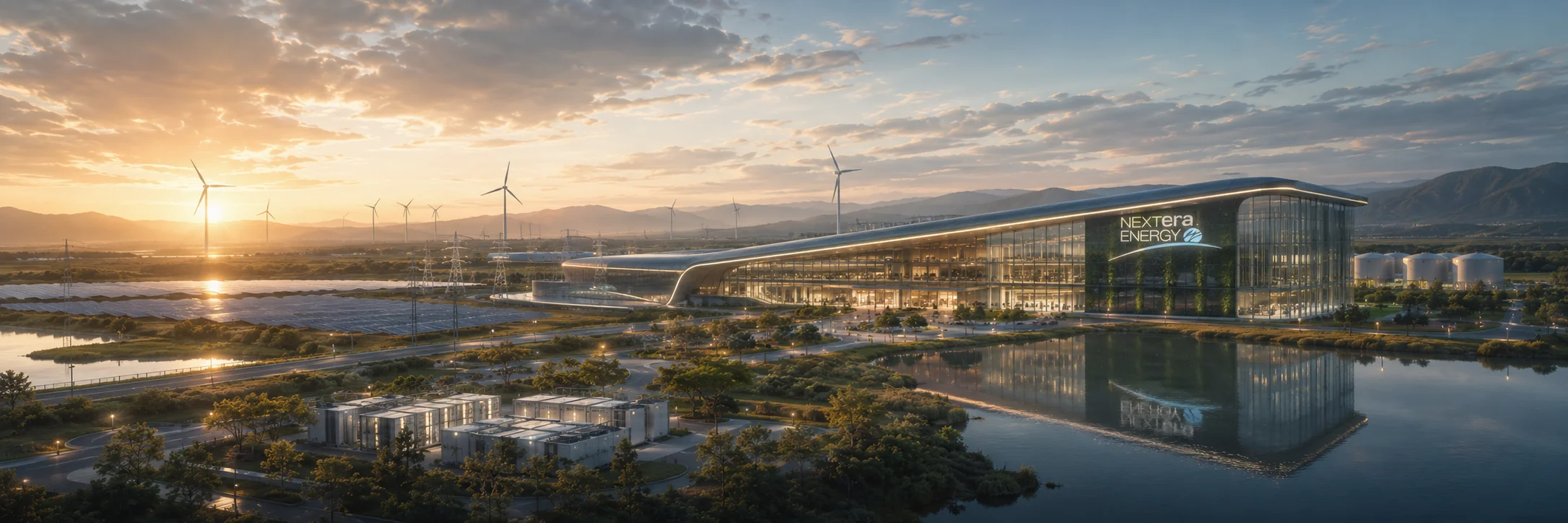
A regulated Florida utility generates predictable cash flows that fund renewable energy development at scale, creating a flywheel where scale drives down procurement costs, contracted revenues reduce risk, and tax credits accelerate returns.
A structural look at how a regulated utility and a renewable energy platform fused into a dual-engine system where predictable cash flows fund aggressive capacity expansion, tax credit monetization compounds returns, and scale itself becomes the competitive advantage in the transition from fossil fuels to renewables-as-infrastructure.
The Regulated-Renewable System
NextEra Energy (nee) occupies an unusual position in the American utility landscape. It simultaneously operates Florida Power & Light, the largest rate-regulated electric utility in the United States, and NextEra Energy Resources, the world’s largest generator of electricity from wind and solar. The interaction between them is more important than either one alone — capital, expertise, and credibility flowing from one to the other in a system that distinguishes NextEra from both traditional utilities and pure-play renewable developers.
Most utilities are studied as yield instruments — stable, slow-growing, dividend-paying. NextEra has operated within the utility sector while producing equity returns that more closely resemble technology or industrial compounders over the past two decades. The mechanism is structural: a regulated base that provides low-cost capital and predictable cash flows, deployed into a competitive renewable energy business where scale advantages compound over time.
The production tax credit and investment tax credit regimes — PTC and ITC — serve as additional amplifiers, converting tax-advantaged project economics into accelerated returns that fund the next round of capacity deployment. The story is not about government subsidy. It is about how a particular corporate architecture captures policy incentives more efficiently than any competitor, because scale and creditworthiness interact with tax equity structures in non-linear ways.
Understanding NextEra requires seeing the two halves as a single system — not a utility that happens to own some wind farms, but an integrated capital deployment machine where each side funds, de-risks, and accelerates the other. The regulated utility provides the balance sheet strength. The renewable platform provides the growth trajectory. The tax credit monetization apparatus converts government policy into project-level returns. And the capital recycling mechanism through NextEra Energy Partners — the publicly traded yieldco — accelerates the velocity at which capital moves through the system. Each component is comprehensible in isolation, but the system's behavior emerges from how they interact.
The Long-Term Arc
How did Florida Power & Light build NextEra's regulated foundation (1925 – 1990s)?
NextEra Energy's origins trace to the founding of Florida Power & Light Company in 1925, during Florida's first great land boom. The utility grew alongside the state itself. Florida's sustained population growth — driven by migration from northern states, retirement demographics, and favorable tax policies — created a rate base that expanded almost continuously. Unlike utilities in regions with stagnant or declining populations, FPL operated in a market where customer growth was a structural tailwind rather than an assumption requiring justification.
The regulated utility model is straightforward in principle: the company invests in infrastructure — power plants, transmission lines, distribution networks — and earns a regulated return on that invested capital, approved by the Florida Public Service Commission. The simplicity of this arrangement obscures its power as a compounding mechanism. Each dollar of capital investment earns an allowed return. Population growth demands additional investment. Additional investment earns additional returns. The loop is slow but remarkably persistent, and Florida's demographics made it more reliable than the same loop operating in Ohio or Michigan. Where Southern Company (so) manages a service territory across multiple southeastern states with mixed growth profiles, and Duke Energy (duk) operates across the Carolinas and the Midwest with slower demographic expansion, FPL enjoyed a concentration of growth in a single, high-growth state that simplified the regulatory narrative and amplified the compounding mechanism.
Through the mid-twentieth century, FPL was a conventional regional utility — building coal and gas plants, expanding transmission infrastructure, managing the seasonal demand patterns of a subtropical climate where summer air conditioning load drives peak demand. The corporate parent, FPL Group, operated as a holding company without particular distinction. The regulated business generated reliable earnings, paid steady dividends, and reinvested in infrastructure to serve a growing population. What changed was not the regulated business itself but the strategic ambition that would eventually be layered on top of it — an ambition that required the stable cash flows of a regulated utility to fund something far more aggressive.
FPL's position as a cash flow anchor is central. Regulated utilities earn modest returns — typically nine to eleven percent on equity — but those returns arrive with a predictability that competitive businesses cannot match. The Florida Public Service Commission sets the rates. Customers must pay for electricity. This predictability is not just a financial characteristic — it is a structural resource that can be leveraged. When FPL Group began investing in wind energy in the late 1990s, it was this regulated cash flow that provided the creditworthiness, the low cost of capital, and the institutional stability that made aggressive renewable investment possible.
Why did FPL Group bet on wind energy early (Late 1990s — 2009)?
The structural pivot began in the late 1990s when FPL Group started investing in wind energy through what would become NextEra Energy Resources. At the time, wind power was a niche technology — expensive, intermittent, and dependent on federal production tax credits (PTCs) that Congress renewed unpredictably. Most utilities viewed wind as a regulatory compliance tool at best, something to be tolerated in small quantities to satisfy renewable portfolio standards. FPL Group treated it as an operating business with scale economics waiting to be unlocked.
The federal production tax credit — originally established in the Energy Policy Act of 1992 — provided a per-kilowatt-hour tax credit for electricity generated by wind turbines during their first ten years of operation. The PTC was essential to wind project economics in the early years, when turbine costs were high and capacity factors were lower than they would later become. But the PTC came with a structural problem: Congress allowed it to expire repeatedly, renewing it only at the last minute — or after a gap — creating boom-and-bust cycles in development activity. Developers could not plan multi-year capital programs when the policy foundation might vanish at any moment.
FPL Group invested through this uncertainty. Where smaller developers paused during PTC expiration gaps, unable to finance projects without the tax credit, FPL Group's balance sheet — anchored by FPL's regulated earnings — allowed continued development activity. The company maintained procurement relationships with turbine manufacturers during periods when other buyers disappeared. It retained development staff and continued site assessment and permitting work during policy gaps. These decisions, unremarkable in hindsight, built organizational capability and supplier relationships that would become decisive advantages once the market matured and the policy environment stabilized.
The economics of wind energy at the time rewarded scale in ways that were not obvious to casual observers. Wind turbines were purchased from a small number of global manufacturers — primarily Vestas, Siemens (later Siemens Gamesa), and General Electric. Turbine pricing was sensitive to order volume. A developer ordering two hundred turbines for a large wind farm received per-unit pricing that a developer ordering twenty could not access. The cost advantage extended beyond the turbines themselves to transportation, installation, and balance-of-plant costs, all of which benefited from the logistics efficiencies of larger projects. FPL Group, as the largest buyer of wind turbines in North America, captured these scale efficiencies earlier and more fully than any competitor.
The PTC monetization process itself rewarded scale and creditworthiness. Wind developers typically could not use the production tax credits directly — they did not have sufficient taxable income to absorb the credits. Instead, they entered tax equity partnerships with financial institutions and large corporations that could use the credits. These tax equity structures were complex, required sophisticated legal and financial structuring, and were available primarily to developers with investment-grade credit and a track record of successful project completion. FPL Group's regulated utility parent provided exactly this creditworthiness, allowing it to execute tax equity transactions at more favorable terms than independent developers. The tax credit was nominally available to all wind developers, but the ability to monetize it efficiently — to convert the credit into project-level cash flow at minimal friction — was a structural advantage that accrued disproportionately to large, creditworthy operators.
By the mid-2000s, NextEra Energy Resources had become the largest wind energy generator in North America — a position it would continue to extend over the following decades. The organizational learning accumulated through hundreds of projects — site selection methodology, permitting navigation, grid interconnection management, construction oversight, long-term operations and maintenance — created institutional knowledge that could not be purchased or quickly replicated. Each new project taught the organization something, and the cumulative weight of those lessons created a development capability that functioned as a durable competitive advantage.
What did the 2009 rebranding to NextEra signal (2009 – 2014)?
The 2009 rebranding from FPL Group to NextEra Energy signaled that the corporate identity had shifted. The company was no longer a Florida utility that happened to own wind farms. It was an energy company whose strategy centered on the structural transition from fossil fuels to renewables, with a regulated utility providing the stable foundation. This was not merely a cosmetic change. Corporate identity shapes resource allocation, talent acquisition, and investor framing. By declaring itself NextEra — the name itself encoding a forward orientation — the company attracted engineers, developers, and executives who identified with the energy transition rather than traditional utility management. It positioned the equity in investor frameworks that valued growth alongside yield, expanding the potential shareholder base beyond pure income-seeking utility investors.
The period from 2009 to 2014 saw NextEra accelerate its renewable development while simultaneously refining the financial architecture that supported it. The American Recovery and Reinvestment Act of 2009 — the stimulus legislation passed in response to the financial crisis — temporarily converted the PTC into an investment tax credit (ITC) option and provided a cash grant alternative, allowing developers to choose the most advantageous tax treatment for each project. NextEra, with its large development pipeline, was among the biggest beneficiaries of these expanded options. The flexibility to choose between PTC and ITC depending on project characteristics — wind speed, capacity factor, capital cost — allowed NextEra to optimize tax credit capture on a project-by-project basis, an advantage that required both scale and analytical sophistication to exploit fully.
During this period, NextEra also began expanding into solar energy. The investment tax credit for solar — a 30% credit on project capital costs — had a different structure than the production-based wind PTC, but the same principles of scale and creditworthiness applied. Larger solar procurement orders yielded better panel pricing. Investment-grade credit enabled more favorable tax equity terms. Experienced development teams executed more efficiently. The playbook that NextEra had refined in wind energy translated directly to solar, and the company's entry into solar at industrial scale added a second growth vector alongside wind.
NextEra also pursued growth through acquisition during this period. The 2012 acquisition of a large Canadian wind portfolio expanded the geographic footprint. In 2016, NextEra made an unsuccessful bid to acquire Hawaiian Electric Industries, which would have added another regulated utility to the portfolio. More controversially, NextEra explored acquiring JEA — the Jacksonville, Florida municipal utility — in a transaction that would have consolidated another large Florida customer base. The JEA deal collapsed amid political opposition and investigations into the process, illustrating the limits of the growth-through-acquisition strategy when it intersected with local political dynamics. The failed JEA bid was a reminder that even a well-capitalized, operationally excellent company cannot always overcome the non-economic constraints — political resistance, community identity, regulatory skepticism — that surround utility acquisitions.
What did NextEra Energy Partners add to the flywheel (2014 – 2022)?
The creation of NextEra Energy Partners (NEP) in 2014 added the final structural element to the system architecture: a publicly traded yieldco designed to own contracted renewable energy assets. The mechanics were straightforward in concept. NextEra Energy Resources developed wind and solar projects, operated them through their initial phase, and then sold or dropped them down into NEP. NEP, as a publicly traded partnership, was valued by investors for its stable, contracted cash distributions. The spread between NextEra's development returns and NEP's lower yield requirements created value at the point of transfer. The proceeds from the transfer were recycled back into Energy Resources for new development. Build, operate, transfer, reinvest, build again — a capital recycling flywheel that accelerated deployment velocity beyond what retained earnings and parent-company capital alone could support.
The decade from 2012 to 2022 was the period when NextEra's structural advantages compounded most visibly. Wind and solar costs declined dramatically — the levelized cost of wind energy fell by more than 70%, and solar fell by nearly 90% — driven by manufacturing scale, technological improvement, and competitive procurement. NextEra, as the largest buyer of wind turbines and solar panels in the Western Hemisphere, captured these cost declines earlier and more fully than smaller competitors. When NextEra ordered thousands of turbines in a single contract, it received pricing that developers ordering dozens could not access. This cost advantage flowed directly to project economics — lower installed costs meant higher returns at the same contracted electricity price, or the ability to bid lower prices and still earn acceptable returns. Either way, scale translated into competitive position.
The contracted revenue model that Energy Resources employed was central to the system's risk profile. Electricity from wind and solar projects was sold primarily through long-term Power Purchase Agreements (PPAs) with creditworthy counterparties — utilities, corporations, municipalities. These contracts, typically spanning fifteen to twenty-five years, converted what would otherwise be volatile merchant power revenue into predictable, financeable cash flows. The contracted nature of the revenue stream served multiple functions simultaneously: it de-risked individual projects for lenders and tax equity investors, it provided earnings visibility for NextEra's equity investors, and it created the stable distribution base that NEP's unitholders required. The PPA was not merely a sales agreement — it was a structural risk-transfer mechanism that connected the renewable development business to the capital markets in a way that enabled leverage without excessive fragility.
During this period, NextEra's renewable backlog — the pipeline of contracted projects awaiting construction — grew into a multi-year, multi-gigawatt queue that provided unprecedented visibility into future growth. No other utility or renewable developer possessed a comparable backlog. This pipeline served as both a growth indicator and a structural asset: turbine and panel manufacturers gave priority allocation to customers with firm, large-scale orders, and the backlog demonstrated to investors that growth was not speculative but contracted and scheduled. The visibility reduced the equity risk premium investors required, supporting the premium valuation that NextEra's stock commanded relative to the broader utility sector.
How did battery storage shift NextEra toward dispatchable capacity (2020 — Present)?
The most recent phase of NextEra's evolution reflects a structural shift from pure generation to integrated clean energy systems. Battery storage — particularly utility-scale lithium-ion batteries co-located with solar installations — addresses the intermittency that has historically limited renewable energy's value. A solar-plus-storage project can deliver electricity when the grid needs it, not merely when the sun shines. This transforms the economic proposition from energy generation to dispatchable capacity — a far more valuable product in wholesale electricity markets.
A wind farm or solar field that produces power only when weather permits competes at the bottom of the dispatch stack. A solar-plus-storage system that can deliver firm capacity during evening peak hours competes directly with natural gas peaker plants — and increasingly wins on cost.
NextEra moved into battery storage with the same scale-driven approach it applied to wind and solar. By committing to massive battery procurement volumes — measured in gigawatt-hours — the company secured pricing and delivery terms that smaller developers could not replicate. The integrated model — solar panels generating electricity, batteries storing it, and long-term contracts monetizing the combined output — represents a more complete product offering than any single technology alone. For utilities and corporations seeking to procure clean energy, a dispatchable solar-plus-storage contract is qualitatively superior to an intermittent solar-only contract. NextEra's ability to offer this integrated product at competitive prices expanded the addressable market for its development platform.
At Florida Power & Light, the integration has taken a different but complementary form. FPL has invested heavily in solar generation within its regulated territory, deploying some of the largest solar installations in the country. FPL's solar program leverages the same procurement advantages that Energy Resources enjoys in competitive markets — bulk panel purchasing, experienced construction management, efficient interconnection — but deploys them within the regulated rate base framework. Each solar megawatt installed by FPL becomes part of the capital base on which the utility earns its regulated return, simultaneously reducing fuel cost exposure for ratepayers and expanding the earning asset base for NextEra shareholders. The result is a regulated utility that is simultaneously one of the largest solar operators in the country — an unusual combination that benefits both sides of the balance sheet.
The emergence of data center power demand as a major growth driver has added a new dimension to NextEra's structural position. The rapid expansion of artificial intelligence infrastructure, cloud computing, and digital services has created unprecedented electricity demand growth concentrated in specific regions. Data center operators — hyperscalers like Amazon (amzn), Microsoft (msft), and Google parent Alphabet (googl) — require massive, reliable power supply, and many have committed to procuring that power from clean energy sources. NextEra, as the largest developer of contracted renewable energy in the United States, is positioned to serve this demand through long-term PPAs with investment-grade counterparties. The data center demand wave represents a structural expansion of the addressable market for NextEra's development platform — new customers with enormous power requirements, long planning horizons, and willingness to sign the long-term contracts that NextEra's financial model requires.
The passage of the Inflation Reduction Act (IRA) in 2022 reshaped the policy landscape in ways that structurally benefited NextEra's position. The IRA extended and expanded tax credits for wind, solar, and battery storage, provided long-term visibility through ten-year credit horizons, and created new incentives for domestic clean energy manufacturing. For a company whose competitive advantage rests on deploying renewable capacity at scale, a decade of policy certainty removed one of the most significant sources of investment risk — the periodic expiration and uncertain renewal of federal tax credits that had characterized previous policy regimes. The IRA also introduced transferability provisions for tax credits, allowing developers to sell credits directly to third parties rather than relying exclusively on complex tax equity partnership structures. For NextEra, which had mastered the traditional tax equity process, transferability offered an additional monetization channel while potentially reducing transaction costs and broadening the pool of credit buyers.
The renewables-as-infrastructure thesis — the idea that wind, solar, and storage installations are not alternative energy experiments but core infrastructure assets comparable to pipelines, transmission lines, and power plants — has become the organizing framework for NextEra's strategic positioning. When renewables were niche, they were valued as environmental amenities or policy compliance tools. As they have become the lowest-cost source of new electricity generation in most markets, they are increasingly valued as infrastructure — long-lived, contracted, essential assets that provide the backbone of the electric grid. NextEra's position as the largest owner and developer of this infrastructure class places it at the center of a multi-decade capital deployment cycle that rivals the buildout of natural gas generation in the 1990s and 2000s or the construction of the interstate highway system in the 1950s and 1960s.