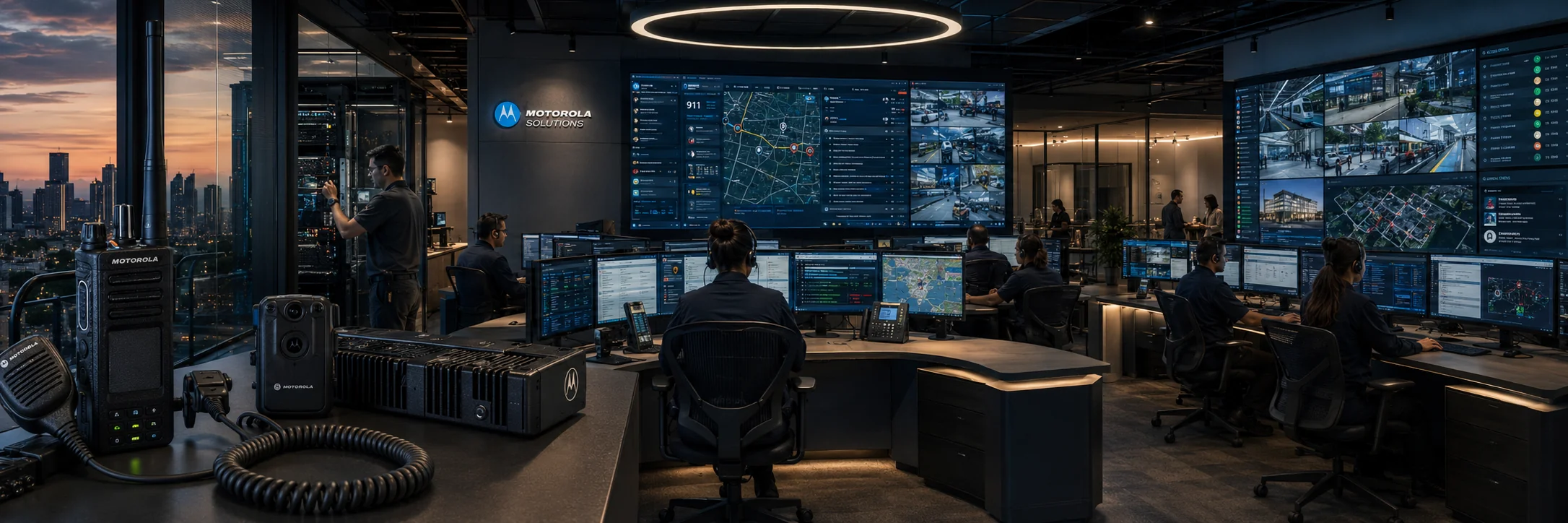
Mission-critical land mobile radio infrastructure embedded in public safety workflows creates switching costs measured in institutional risk rather than dollars, because replacing communications systems that police and fire departments depend on carries consequences no procurement savings can justify.
A structural look at how the mission-critical half of the Motorola split built an ecosystem where non-negotiable reliability creates switching costs unlike anything in commercial technology.
The Life-Safety Standard
Motorola Solutions (MSI) operates in a domain where the consequences of system failure are measured not in lost revenue or customer churn but in human lives. Police officers, firefighters, paramedics, and emergency dispatchers depend on Motorola’s land mobile radio networks, command center software, and video surveillance systems to coordinate responses when seconds determine outcomes.
The structural dynamics of this market — where reliability is existential rather than aspirational — produce competitive positions unlike anything found in commercial technology.
The company that exists today as Motorola Solutions is the product of one of the most consequential corporate splits in American technology history. In 2011, the original Motorola — a company that had invented the car radio, built the first handheld cellular phone, and powered the Apollo moon communications — divided itself into two entities. Motorola Mobility took the consumer handset business and was eventually acquired by Google, then sold to Lenovo. Motorola Solutions kept the enterprise and government communications business — the radios, the infrastructure, the dispatch systems. The split was not merely financial restructuring. It was a philosophical separation: consumer electronics, where margins compress and product cycles accelerate, from mission-critical infrastructure, where reliability requirements create structural durability that consumer markets cannot replicate. The divergent trajectories of these two entities after separation would prove to be one of the clearest demonstrations of how structural market position determines long-term value creation more decisively than brand recognition or technological capability.
Understanding Motorola Solutions requires understanding the structural properties of its market rather than the features of its products. The company's position is defined by the P25 radio standard it helped create and dominates, by government procurement cycles that favor incumbents with decades of deployment history, by the irreplaceable nature of communications infrastructure that emergency responders have trained on for their entire careers, and by a deliberate expansion into adjacent domains — video surveillance, body cameras, command center software — that deepens the ecosystem dependency with each new layer. The result is a business whose competitive position resembles critical infrastructure more than it resembles a technology company. To understand Motorola Solutions is to understand how a company can embed itself so deeply into the operational fabric of public safety that displacement becomes not merely expensive but functionally inconceivable within any normal planning horizon.
The Long-Term Arc
Motorola Solutions' trajectory spans nearly a century if traced to its corporate parent, but the structurally relevant arc begins with the land mobile radio systems that became the backbone of American public safety communications and extends through the company's systematic transformation from a hardware vendor into a software-and-services platform provider. Each phase built structural dependencies that the next phase deepened, creating a compounding effect where the switching costs of the entire ecosystem far exceed the switching costs of any individual component.
How did car radios and wartime forge Motorola's reliability culture?
The original Motorola, founded by Paul Galvin in 1928, began as a manufacturer of car radios — the company's name itself derives from "motor" and "Victrola." The early business was consumer-oriented, but it was World War II that established the structural pattern that would define the company's most durable franchise. Motorola produced the SCR-300, the first backpack FM radio used by Allied forces, and the handie-talkie SCR-536. These military communications systems demonstrated a principle that would prove foundational: in high-stakes, time-critical operations, the reliability and interoperability of the communications system matters more than any other technological consideration. Soldiers did not evaluate radio options through procurement committees. They needed communications that worked under fire, in rain, across rough terrain, without failure. This wartime crucible forged the engineering culture and reliability obsession that would eventually define Motorola's public safety business.
After the war, Motorola adapted its military radio expertise for civilian public safety. Police departments, fire departments, and emergency medical services adopted two-way radio systems that Motorola designed, manufactured, and maintained. Through the 1950s, 1960s, and 1970s, Motorola's land mobile radio (LMR) systems became the default communications infrastructure for American first responders. This was not the result of winning competitive bids against equally positioned rivals. It was the result of being the company that built the systems first, trained the dispatchers on them, maintained them through decades of service, and earned the institutional trust that comes from reliable performance during actual emergencies. The relationship between Motorola and public safety agencies was not transactional — it was institutional. Motorola engineers were the people who came when systems needed maintenance. Motorola training programs were where dispatchers learned their craft. Motorola's name was on the radios that officers carried on their belts every shift.
The structural significance of this early dominance cannot be overstated. Public safety radio infrastructure is not replaced on consumer technology timelines. A police department that installed a Motorola radio system in 1985 might upgrade components over the following decades, but the basic architecture — the towers, the frequencies, the dispatch integration, the training protocols — persisted. Each year of operation deepened the switching costs. Each emergency successfully coordinated reinforced the institutional preference. The officers who had used Motorola radios as patrol officers became the sergeants, lieutenants, and chiefs who made procurement decisions. The dispatchers who had trained on Motorola consoles became the dispatch center supervisors who evaluated replacement systems. By the time digital radio standards emerged in the 1990s, Motorola's position in public safety communications was not merely dominant — it was structurally embedded in the operational DNA of American emergency response. The entire institutional memory of how public safety communications work in America was, to a remarkable degree, a memory of Motorola systems.
What was the P25 radio standard designed to do?
The transition from analog to digital radio in public safety created an inflection point that Motorola navigated with structural precision. The Project 25 (P25) standard, developed through a collaboration between the Association of Public-Safety Communications Officials (APCO), the National Association of State Telecommunications Directors, and federal agencies, was designed to ensure interoperability between different agencies' radio systems. A police department in one county should be able to communicate with firefighters in the next county during a mutual aid response. The standard was intended to be open — any manufacturer could build P25-compliant equipment. In theory, this openness would create a competitive market where agencies could choose among interoperable vendors based on price and features.
In practice, Motorola's influence on the P25 standard's development and its head start in implementation created an advantage that the standard's openness could not neutralize. Motorola's engineers were deeply involved in defining P25 specifications — not through corruption of the process but through the practical reality that the company with the most deployed public safety radio systems had the deepest understanding of what the standard needed to accomplish. Motorola's existing installed base of analog systems provided the upgrade path that most agencies followed into the digital era. And Motorola's system integration expertise — the ability to deploy and maintain complex, multi-site radio networks across sprawling geographies — proved as important as the radios themselves. A P25 system serving a metropolitan area might include hundreds of tower sites, thousands of subscriber radios, complex simulcast configurations, redundant dispatch consoles, and encryption management for dozens of talk groups. Building and maintaining such a system requires engineering expertise that accumulates over decades of deployment experience. Competitors like Harris Corporation (now L3Harris Technologies) and Kenwood competed for P25 business, but Motorola consistently captured the majority of large public safety system deployments.
The P25 standard's structural dynamics favored the incumbent in ways that open standards in commercial technology typically do not. In consumer markets, open standards reduce switching costs by ensuring interoperability — a USB device works with any USB port. In public safety, the complexity of system deployment — frequency coordination, coverage engineering, dispatch integration, encryption management, multi-agency interoperability testing, system redundancy design, failover configuration — meant that interoperability at the protocol level did not translate into interchangeability at the system level. An agency could theoretically replace Motorola radios with another P25-compliant vendor's equipment. In practice, doing so required re-engineering the entire system integration, retraining dispatchers and field personnel, managing a multi-year transition during which both old and new systems must coexist, and accepting a period of uncertainty in a domain where uncertainty carries life-or-death consequences. The open standard paradoxically reinforced the incumbent's position by providing the appearance of choice without the practical reality of painless switching. This dynamic — where an open standard conceals rather than eliminates switching costs — is one of the more structurally revealing patterns in Motorola Solutions' competitive position.
The P25 dominance also created a self-reinforcing cycle in the competitive landscape. Because Motorola won the majority of large system deployments, it accumulated the most deployment experience, which improved its ability to win the next deployment. Engineers who had built P25 systems gravitated toward the company with the most complex and interesting projects. Reference customers — the large metropolitan systems that smaller agencies look to when making procurement decisions — were overwhelmingly Motorola deployments. Each deployment reinforced the next, not through contractual lock-in but through the accumulation of expertise, references, and institutional relationships that competitors could observe but not quickly replicate.
Why did Motorola's two businesses become incompatible?
By the mid-2000s, the original Motorola was struggling under the weight of its own diversity. The mobile phone division — which had created the iconic Razr but then failed to follow it with competitive smartphones as the iPhone redefined the category — was hemorrhaging money. The enterprise and government communications division was profitable but starved of investment attention by the consumer business's volatility. The consumer electronics market demanded rapid product iteration, massive marketing spending, and willingness to accept compressed margins. The mission-critical infrastructure market demanded patient investment, deep engineering, and the institutional credibility that comes from decades of reliable service. These two businesses had fundamentally incompatible capital allocation needs, risk profiles, and strategic time horizons.
Activist investor Carl Icahn pushed for a separation, arguing that the combined structure was destroying value for both businesses. The split, completed on January 4, 2011, created Motorola Mobility (consumer devices) and Motorola Solutions (enterprise and government). The structural logic was sound and has been vindicated comprehensively. Motorola Mobility was acquired by Google in 2012 for $12.5 billion, primarily for its patent portfolio, and then sold to Lenovo in 2014 for $2.91 billion — a trajectory that illustrated the value destruction inherent in competing in commoditized consumer hardware without a sustainable structural advantage. Motorola Solutions, freed from the consumer business's drag, embarked on a focused strategy of deepening its position in mission-critical communications and expanding into adjacent domains.
The split was the foundational structural event that enabled everything that followed. It allowed Motorola Solutions to allocate capital to LMR system modernization, software development, and strategic acquisitions without competing for resources with a consumer hardware business operating on fundamentally different economics. It clarified the company's identity — not a technology conglomerate, but a mission-critical infrastructure provider. And it established the strategic framework that CEO Greg Brown has executed consistently for over a decade: deepen the core LMR position, expand into adjacent technology layers, and shift the revenue mix toward recurring software and services. The consistency of this execution over more than a decade — through economic cycles, technological shifts, and competitive challenges — is itself a structural feature of the business. Motorola Solutions has not pivoted, has not chased adjacent markets opportunistically, and has not been distracted by the technological fashions that periodically sweep through the broader technology industry. The strategic direction set at the split has been maintained with a discipline that reflects both the clarity of the opportunity and the stability of the leadership.
What problem did FirstNet's broadband network address?
The September 11, 2001 attacks exposed a catastrophic failure in public safety communications: first responders from different agencies could not communicate with each other during the crisis. The interoperability problem — which P25 was designed to address for voice communications — extended to the lack of broadband data capabilities for public safety. Police officers in the field could talk on their radios but could not access databases, view building floor plans, or receive real-time video from surveillance cameras. The response, developed over more than a decade of legislative and regulatory effort, was FirstNet — the First Responder Network Authority — a nationwide broadband network dedicated to public safety, built on LTE technology and operated through a partnership with AT&T that was awarded in 2017.
FirstNet represented both a threat and an opportunity for Motorola Solutions. The threat was existential in theory: if broadband LTE could replace narrowband LMR for mission-critical voice communications, Motorola's core franchise was at risk. Industry analysts and technology commentators periodically suggested that LMR was a legacy technology destined for obsolescence — that public safety would follow the same migration path from narrowband to broadband that commercial telecommunications had traveled. The opportunity was practical: public safety agencies needed devices, applications, and integration services to use the FirstNet network alongside their existing LMR systems.
Motorola Solutions navigated this transition with a strategy that acknowledged LTE's capabilities while emphasizing LMR's irreplaceable characteristics for mission-critical voice — specifically, the reliability of dedicated spectrum that is not shared with commercial users, the resilience of purpose-built infrastructure designed to operate during disasters that destroy commercial cell towers, and the push-to-talk functionality that LTE could approximate but not structurally guarantee with the same latency and reliability characteristics. When a firefighter enters a burning building, the radio must work. Not probably work. Not usually work. Must work. This reliability requirement — absolute rather than statistical — is the structural foundation that protects LMR from broadband displacement.
The structural outcome has been that LTE and LMR coexist rather than compete. FirstNet provides broadband data — video, images, database access, situational awareness applications — to first responders in the field. LMR continues to provide the mission-critical voice communications that agencies depend on when buildings are collapsing and cell towers are overloaded. Motorola Solutions positioned itself as the integration layer between these two systems, providing devices that operate on both LMR and LTE networks and command center software that coordinates across both. The company developed the APX NEXT radio — a device that combines P25 LMR capabilities with LTE broadband in a single device — embodying the coexistence strategy in hardware. Rather than being displaced by broadband, Motorola Solutions absorbed broadband into its ecosystem — a structural adaptation that converted a potential threat into an expansion of its addressable market. The company now serves both the narrowband voice and broadband data needs of public safety, with the integration between these layers becoming itself a source of competitive advantage.
How did Motorola Solutions transform from hardware into a software platform?
The most consequential strategic shift in Motorola Solutions' post-split history has been the deliberate transformation from a hardware-centric company into a software-and-services platform. This transformation has been executed primarily through acquisitions, each chosen to add a technology layer that public safety agencies need and that integrates with the existing communications infrastructure. The acquisition of Avigilon in 2018 brought AI-powered video surveillance and analytics. The acquisition of Vigilant Solutions added license plate recognition technology. The acquisition of WatchGuard brought body-worn cameras and in-car video systems. The acquisition of Rave Mobile Safety added mass notification capabilities — the systems that send alerts to citizens' phones during emergencies. The acquisition of Command Central software assets created an integrated records management, dispatch, and analytics platform for public safety agencies.
Each acquisition followed a consistent structural logic: add a technology layer that public safety agencies need, integrate it with the existing LMR and command center infrastructure, and convert the relationship from periodic hardware purchases into recurring software subscriptions and service contracts. A police department that once bought Motorola radios every 10-15 years now runs Motorola's video surveillance, wears Motorola's body cameras, dispatches through Motorola's command center software, manages digital evidence through Motorola's platforms, and receives Motorola's mass notification alerts — each layer generating recurring revenue and deepening the ecosystem dependency. The genius of this strategy lies not in any individual acquisition but in the cumulative effect: each layer makes every other layer more valuable because the data flows between them, the workflows connect across them, and the training investment spans all of them.
The 911 dispatch center — the command center — deserves particular attention as a structural node in this ecosystem. The dispatch center is where emergency calls are received, where resources are allocated, where field communications are managed, and where incident data is recorded. Motorola Solutions' command center software — including computer-aided dispatch (CAD) systems, records management systems (RMS), and real-time intelligence platforms — sits at the operational center of the public safety workflow. An agency running Motorola dispatch software receives 911 calls, dispatches Motorola-equipped officers, communicates over Motorola radio networks, records body camera footage through Motorola systems, manages evidence through Motorola platforms, and generates reports through Motorola analytics. The command center software is the connective tissue that binds the entire ecosystem together, and its position at the center of the workflow makes it perhaps the most strategically significant layer in the stack — more significant, in some ways, than the radio infrastructure that remains Motorola's historical foundation.
The revenue mix shift tells the structural story quantitatively. In the years immediately following the split, hardware sales dominated revenue. By the mid-2020s, software and services represented a growing majority, with recurring revenue streams from cloud-based software, maintenance contracts, and managed services comprising an increasing share of total revenue. This shift is not merely a financial recomposition — it represents a structural transformation from a company that sells equipment into a company that operates the technology ecosystem on which public safety depends. The financial characteristics change accordingly: revenue becomes more predictable, margins expand as software scales without proportional cost increases, and the customer relationship transforms from episodic procurement events into continuous service delivery.
Why did Motorola Solutions acquire Avigilon?
The 2018 acquisition of Avigilon, a Canadian video surveillance and analytics company, marked Motorola Solutions' most significant expansion beyond communications. Avigilon brought AI-powered video analytics — appearance search, unusual motion detection, facial recognition capabilities — that extended Motorola's value proposition from "how agencies communicate" to "what agencies can see and understand." The subsequent integration of Avigilon's technology with body-worn cameras, in-car video systems, and command center software created a video ecosystem that operates as a unified layer within Motorola's broader platform. The analytics capabilities transform raw video from passive recording into active intelligence — the ability to search across thousands of cameras for a specific individual, to detect unusual patterns of movement, to alert operators to events that would otherwise go unnoticed in the flood of visual data.
The strategic logic was sound: video is increasingly central to public safety operations, from evidentiary body camera footage to real-time situational awareness through fixed surveillance cameras. Municipal surveillance camera deployments have expanded dramatically, and body camera mandates have been adopted by police departments across the country. By controlling both the camera hardware and the analytics software — and integrating both with dispatch and records management systems — Motorola Solutions created a workflow integration that point-solution video vendors cannot match. A body camera that automatically tags footage with incident data from the dispatch system, uploads to cloud storage, triggers analytics workflows, and becomes searchable within the broader evidence management platform is structurally different from a standalone camera that merely records video. The integration creates value that resides in the connections between systems, not in any individual component — a pattern consistent with Motorola Solutions' broader ecosystem strategy.
This expansion into video brought Motorola Solutions into direct competition with Axon Enterprise (AXON), the dominant provider of body-worn cameras and digital evidence management for law enforcement. Axon's position in body cameras — built on the foundation of its TASER conducted energy device franchise and extended through the Evidence.com cloud platform — represents the most significant competitive friction Motorola Solutions faces in its platform expansion strategy. Axon's Evidence.com has become the de facto standard for digital evidence management in many law enforcement agencies, and its integration with Axon's body cameras, TASER devices, and real-time operations platform creates a focused, vertically integrated ecosystem that competes directly with Motorola Solutions' broader but less specialized video and evidence capabilities. The competition between Motorola Solutions and Axon Enterprise illustrates a broader structural dynamic: the convergence of communications, video, and data management in public safety is creating platform competition where formerly distinct product categories overlapped minimally. The outcome of this convergence — whether the market favors Motorola's breadth across radio, video, and software or Axon's depth in the law enforcement technology vertical — is one of the defining competitive questions in public safety technology.
Which commercial customers does Motorola Solutions serve beyond public safety?
While public safety accounts for the structurally most defensible portion of Motorola Solutions' business, the company also serves commercial and enterprise customers — airports, utilities, transportation systems, oil and gas operations, manufacturing facilities, hospitality venues, and retail environments that need reliable communications infrastructure. These enterprise deployments share some structural characteristics with public safety — reliability requirements, multi-site complexity, mission-critical operational needs — but lack the existential switching costs that make public safety the deepest moat. A hotel chain that switches radio vendors faces operational disruption but not life-safety risk. A utility company that migrates to a competing system faces transition costs but not the institutional trauma of a communications failure during an emergency.
The enterprise segment provides diversification and a broader base for software and services revenue, but its structural character is fundamentally different from public safety. Enterprise customers have more vendor options, more willingness to evaluate alternatives, and shorter decision cycles. The enterprise business benefits from Motorola Solutions' brand credibility and engineering capabilities but does not enjoy the same depth of structural entrenchment. Understanding this distinction — between the public safety business, where switching costs are existential, and the enterprise business, where switching costs are merely substantial — is important for assessing the company's overall competitive position. The two segments are reported together in Motorola Solutions' financial statements, but their structural properties differ in ways that aggregate metrics can obscure.