 CompanyGraph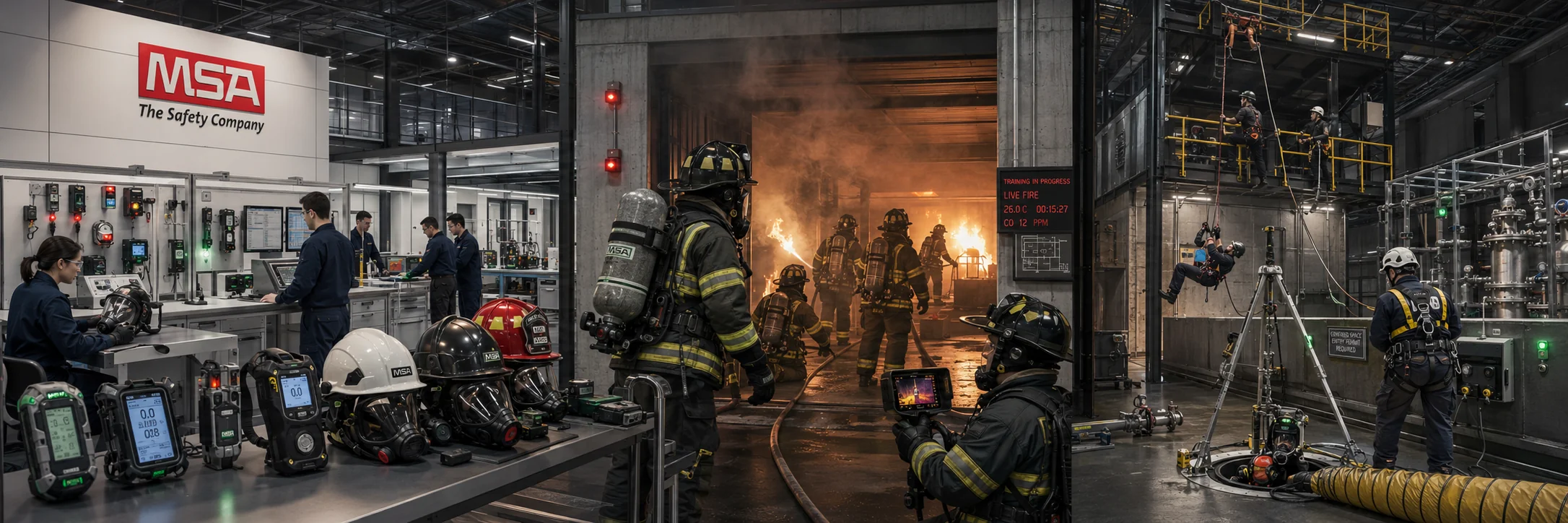
Safety equipment supplies protection only when its design, certification, condition, fit, training, and use match the hazard in front of a worker.
The product meets a hazard, not a slogan
A gas detector must sense a defined atmosphere and warn in time. A self-contained breathing apparatus must supply breathable air under the specified conditions. A harness must arrest a fall through a compatible anchor, fit, inspection, and rescue plan. A helmet must protect against the impacts and objects its design covers. These are different physical functions, even when a catalogue groups them under “safety.”
MSA Safety's 2025 Form 10-K describes Detection, Fire Service, and Industrial PPE and Other categories, including portable and fixed gas detection, breathing apparatus, firefighter helmets, and fall protection. The equipment is valuable because it changes what a worker can safely do; a unit count does not establish that the right equipment was worn, calibrated, or maintained.
Standards create a boundary around evidence
Regulations and standards can require performance, labeling, inspection, training, or replacement. They create a reason to buy and a common language for testing. They do not remove the employer's work of identifying the hazard, choosing the correct class of equipment, fitting it, and ensuring that it is available at the moment of exposure.
A test report observes a product under defined conditions. A certificate records conformity to a standard or approval route. An inspection records a defined check. An incident report records what someone observed after an event. None alone establishes the complete condition of a detector in a contaminated plant or a harness after an unreported fall.
Money changes whether protection is ready
Safety equipment is often purchased before an incident, when the benefit is an accident that does not happen. Employers must pay for detectors, spare sensors, breathing-air maintenance, fit testing, training, inspection, cleaning, and replacement while production schedules and budgets exert pressure elsewhere. The cost of postponing a replacement is visible; the avoided injury is not recorded as revenue.
MSA's 2025 annual report reports about $1.9 billion in sales and 4.3% of sales invested in R&D. That capacity supports new sensors, wearable detection, and protective equipment, but a manufacturer cannot finance an employer's inspection program or decide whether a particular contaminated garment must be discarded. Money is causal at each boundary: it determines whether the equipment, service, and trained time are physically available.
Condition changes after purchase
A gas monitor can drift, a filter can saturate, a battery can weaken, a harness can suffer a load, and a helmet can be damaged without losing its shape. The relevant condition may require calibration, inspection, service history, or a reason to retire the item. Reusable equipment preserves function only when its identity and condition remain knowable.
Use also depends on the worker and environment. A detector may be worn outside its sensing range; a respirator may not seal on a particular face; a harness may be attached to an unsuitable anchor; a crew may not recognize an alarm. These are not reasons to blame the user for every failure. They show that protection is produced by equipment, training, management, and the physical setting together.
Feedback must reach the right boundary
MSA can change a sensor, label, software, or service interval. A standards body or regulator can change a requirement. An employer can change training, inspection, staffing, or procurement. A worker can report a near miss or damaged equipment. Correction works only when the event preserves enough identity and context to reach the person with authority and money.
A sales metric can show demand. It cannot show that a worker was protected. A low incident rate can mean good prevention, low exposure, or missing reports. A recall can identify a product issue without proving that every item in the field failed. Each observation is useful, but none is the whole safety result.
What MSA Safety actually maintains
MSA's durable position comes from connecting hazard knowledge, product design, certification, manufacturing, training, inspection, and employer trust. Regulation helps sustain the market because organizations need defensible protection, but regulation does not make every product suitable or every workplace safe. Trust is earned when equipment performs in the conditions for which it was selected and when failures produce learnable corrections.
The long-term story is therefore not that life-critical demand is automatic. It is that the cost of protection must be paid before the danger is visible, and that the physical route continues after the sale. A detector, harness, helmet, or breathing apparatus is useful only while the worker, hazard, employer, and equipment remain connected.