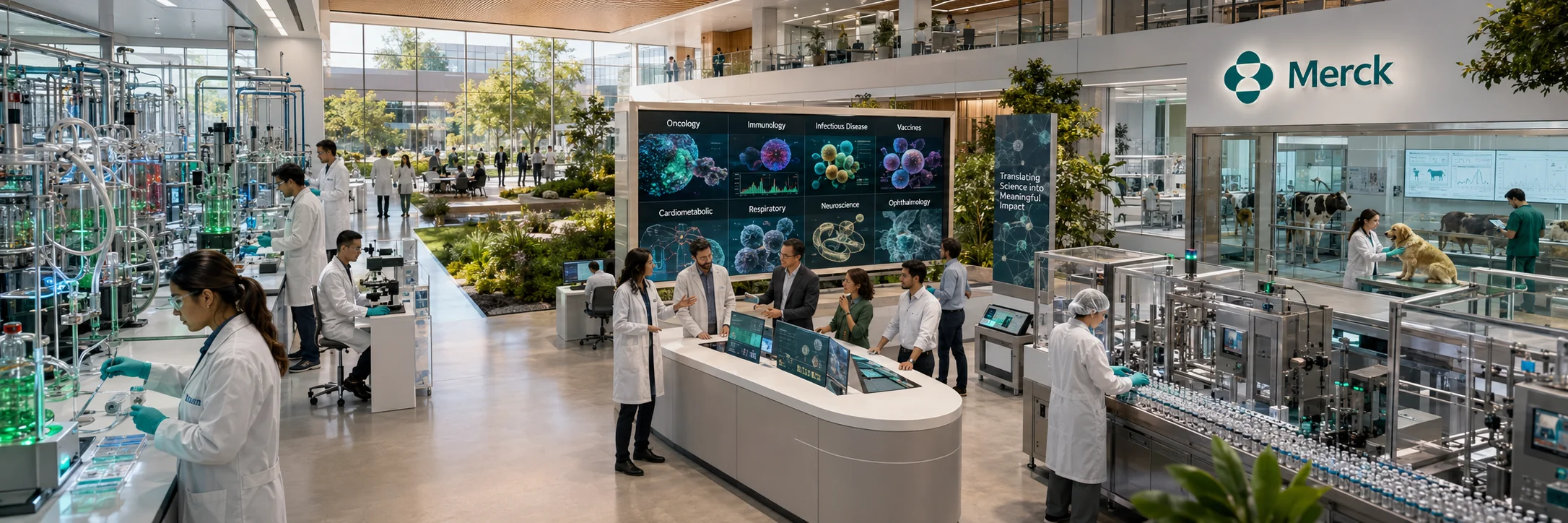
Keytruda's oncology dominance defines both the company's greatest cash-generating strength and its most acute structural vulnerability, concentrating franchise risk in a single molecule whose patent expiration timeline determines the company's trajectory.
A structural look at how a research-first pharmaceutical company built one of the most valuable drug franchises while confronting patent-dependent revenue concentration.
The Keytruda Concentration
The current structural reality of Merck (MRK) is dominated by a single drug: Keytruda (pembrolizumab), an anti-PD-1 immunotherapy that has become the best-selling pharmaceutical product in the world. In 2024, Keytruda generated over $25 billion in annual revenue, representing roughly 45% of Merck’s total sales. The magnitude of this contribution and the proximity of its patent expiration in 2028 create a structural tension that defines Merck’s present and near-term future.
Merck & Co has occupied a distinctive position in the pharmaceutical industry for over a century. While most large pharma companies define themselves through a combination of acquisitions, marketing prowess, and portfolio breadth, Merck's institutional identity has been built around internal research and development. The company's founding ethos — articulated by George W. Merck in 1950 when he said medicine is for the people, not for the profits — established a self-image as a science-first organization. Whether that self-image accurately describes the company's behavior in every era is debatable. What is not debatable is that the orientation toward internal R&D as the primary engine of value creation has shaped Merck's strategic choices, capital allocation, and competitive position in ways that distinguish it from peers who rely more heavily on acquisition-driven growth.
Understanding Merck requires examining three interlocking structural features: the research-driven identity that shapes how the company allocates capital and evaluates opportunities; the franchise drug dynamics that create both extraordinary profitability and existential concentration risk; and the portfolio diversification strategies — including animal health, targeted acquisitions, and pipeline development — that the company employs to buffer against the inevitable patent cliff. These features interact in ways that simple financial analysis cannot capture. Merck is best understood not as a collection of revenue streams but as a coordination system under constraint — a system whose behavior is governed by feedback loops between scientific output, regulatory approval, patent protection, and commercial execution.
The Long-Term Arc
Merck's history is best understood as a series of research-driven drug cycles, punctuated by institutional crises and strategic pivots. Unlike conglomerates that grow through diversification, Merck has repeatedly bet its future on the productivity of its laboratories — sometimes brilliantly, sometimes with consequences that took decades to fully manifest.
How did Merck's American operations begin and become independent (1891 - 1970s)?
Merck's American operations originated as a subsidiary of the German chemical company E. Merck, established in 1891. During World War I, the U.S. government seized the company's assets under the Trading with the Enemy Act, and it operated independently thereafter — a structural severing from its European parent that created an entirely American pharmaceutical enterprise. The two companies remain separate entities today, operating under the Merck name in different geographies (Merck & Co in the United States and Canada, and Merck KGaA — the German parent — elsewhere). This naming duality is itself a structural artifact of the wartime seizure.
The critical structural decision came in the mid-twentieth century when Merck invested heavily in building internal research capabilities at a scale unusual for the era. The Merck Research Laboratories, established with deep academic connections and a culture that valued publication and scientific rigor alongside commercial development, became the institutional foundation that would produce decades of drug breakthroughs. George W. Merck's leadership established a principle that research should operate with a degree of autonomy from commercial pressure — that scientists should pursue promising biology even when the commercial pathway was not immediately obvious. This philosophy attracted elite researchers who might otherwise have remained in academia.
Through the 1950s and 1960s, Merck's laboratories produced a remarkable series of innovations: cortisone, streptomycin (in collaboration with Rutgers University), and early vaccines including those for measles, mumps, and rubella. The MMR vaccine, developed by Maurice Hilleman at Merck, became one of the most consequential public health interventions in history. Hilleman alone is credited with developing over 40 vaccines during his career at Merck — a research productivity record that has never been approached in the pharmaceutical industry. These successes were not accidental — they reflected a deliberate institutional commitment to maintaining research infrastructure that could operate on long time horizons without immediate commercial pressure.
This era also established Merck's vaccine business as a structurally important franchise. Unlike small-molecule drugs that face generic competition upon patent expiration, vaccines have higher manufacturing barriers to entry and more durable market positions. The vaccine portfolio — later expanded to include Gardasil for HPV and Pneumovax for pneumonia — would provide Merck with a revenue base whose dynamics differed fundamentally from the blockbuster drug cycle that dominated its pharmaceutical operations.
This foundational era established the structural identity that Merck would carry forward: the belief that superior science produces superior drugs, and that superior drugs produce superior commercial outcomes. The model worked spectacularly when it worked, but it also created an institutional culture that was slower to embrace acquisition-driven growth when internal R&D productivity declined — a structural rigidity that would become visible in later decades.
What drove Merck's research-driven blockbuster era (1980s - 2000s)?
The 1980s and 1990s represented the peak of Merck's research-driven model. Vasotec (enalapril), an ACE inhibitor for hypertension, launched in 1985 and became a major commercial success. Mevacor (lovastatin), the first commercially available statin for cholesterol management, launched in 1987 and opened the cardiovascular drug category that would generate hundreds of billions in industry-wide revenue over subsequent decades. Zocor (simvastatin), a more potent statin, followed and became one of the best-selling drugs in the world, with peak annual revenues exceeding $7 billion.
During this period, Merck was widely regarded as the finest pharmaceutical company in existence. Fortune magazine named it America's most admired company for seven consecutive years from 1987 to 1993 — a record of sustained recognition that no other pharmaceutical company has matched. The research pipeline was producing blockbusters with regularity. The company's scientists were winning recognition and publishing in top journals. Revenue growth was strong and consistent. The structural model — invest heavily in internal R&D, produce innovative drugs, capture blockbuster revenue — appeared to be the definitive strategy for pharmaceutical success.
The contrast with Pfizer (PFE) during this era is structurally instructive. While Merck built its franchise through internal research, Pfizer was developing a more acquisition-heavy model — culminating in the transformative acquisitions of Warner-Lambert in 2000 (which brought Lipitor) and Pharmacia in 2003. Merck viewed this approach with institutional skepticism. Merck's culture held that buying innovation was inferior to creating it — that the research laboratory, not the deal table, was where durable competitive advantage was built. This philosophical divergence would shape both companies' trajectories for decades, with Pfizer building a larger but more heterogeneous portfolio through serial acquisition while Merck maintained a more focused but less buffered business.
But the blockbuster model contained a structural fragility that the success obscured. Each blockbuster drug followed the same lifecycle: years of development, a period of patent-protected revenue growth, and then a cliff when generics entered. Merck's ability to sustain growth depended on the timing of new blockbusters relative to patent expirations on existing ones. When the pipeline delivered — as it did through the 1990s — the model appeared invincible. When it did not, the exposure became acute. The loss of patent protection on Zocor in 2006 demonstrated the velocity of decline: within two years of generic entry, branded revenue fell by over 80%. The same pattern would repeat with Fosamax (alendronate) for osteoporosis, further compressing Merck's top line in the mid-2000s.
What was Vioxx before its withdrawal (2004 - 2007)?
Vioxx (rofecoxib), a COX-2 selective nonsteroidal anti-inflammatory drug, was approved in 1999 for pain and inflammation. It became a massive commercial success, generating approximately $2.5 billion in annual revenue at its peak. Vioxx represented exactly the kind of blockbuster that Merck's research model was designed to produce — a novel mechanism addressing a large patient population with a differentiated clinical profile. The drug was marketed aggressively, including direct-to-consumer advertising that positioned Vioxx as a safer alternative to traditional NSAIDs for patients at risk of gastrointestinal complications.
On September 30, 2004, Merck voluntarily withdrew Vioxx from the market after a clinical trial — the APPROVe study, which was investigating Vioxx's potential to prevent colon polyps — revealed an increased risk of cardiovascular events, including heart attacks and strokes, in patients taking the drug long-term. The withdrawal was one of the largest drug safety actions in pharmaceutical history. Within days, Merck's market capitalization declined by approximately $27 billion. The company faced over 50,000 lawsuits and eventually settled for $4.85 billion in 2007.
The Vioxx withdrawal was not merely a financial setback. It was a structural crisis that challenged the core of Merck's institutional identity. The company that defined itself through scientific excellence had produced and aggressively marketed a drug that harmed patients. Internal documents revealed in subsequent litigation suggested that Merck had been aware of cardiovascular signals from the VIGOR trial as early as 2000 — four years before the withdrawal — but had not communicated these risks with the transparency that physicians and patients deserved. The gap between the company's stated commitment to patient welfare and its behavior during the Vioxx period damaged the trust architecture that the research-first identity was supposed to sustain.
The institutional response to Vioxx was significant and lasting. Merck restructured its drug safety monitoring processes, enhanced its clinical trial design protocols, and adopted a more cautious approach to marketing claims about safety profiles. The company also faced a period of pipeline weakness that compounded the financial impact of the withdrawal. Merck was losing a $2.5 billion revenue product while simultaneously facing patent expirations on Zocor, Fosamax, and other key drugs, and paying billions in legal settlements. The combination forced restructuring, layoffs, and a strategic reassessment that would take years to resolve. Merck's stock price did not recover to its pre-Vioxx levels for nearly a decade.
The Vioxx episode also changed the broader pharmaceutical industry's approach to drug safety monitoring and the FDA's regulatory stance. The creation of the FDA's Sentinel System for post-market drug surveillance was influenced in part by the Vioxx experience. For Merck specifically, the crisis functioned as a structural reset — a forced confrontation with the limits of the research-first identity when commercial incentives and safety signals came into conflict.
Why did Merck acquire Schering-Plough (2007 - 2014)?
In 2009, Merck acquired Schering-Plough in a $41 billion deal — the largest acquisition in the company's history. The merger was a structural acknowledgment that internal R&D alone could not fill the revenue gaps created by patent expirations and the Vioxx withdrawal. Schering-Plough brought several valuable assets: Remicade and its successor Simponi in immunology, Nasonex in respiratory, and an established animal health business that would become strategically important.
The Schering-Plough merger represented a departure from Merck's historical model. The company had always positioned itself as distinct from acquisition-driven competitors like Pfizer. The merger acknowledged that this distinction, while philosophically appealing, was insufficient when internal pipeline productivity could not sustain the revenue base. The integration was complex — combining two large pharmaceutical organizations with different cultures, different commercial operations, and overlapping therapeutic areas required years of restructuring. Thousands of positions were eliminated in the consolidation. The combined company retained the Merck name, but the organizational identity absorbed elements of Schering-Plough's more commercially aggressive culture.
One subtle but consequential outcome of the Schering-Plough acquisition was the integration of the animal health businesses. Schering-Plough's Intervet unit, when combined with Merck's existing animal health operations, created a business of significant scale. This combined entity — Merck Animal Health — would grow to generate over $5 billion in annual revenue, making it one of the largest animal health companies in the world alongside Zoetis (which had been spun off from Pfizer in 2013). The structural importance of this business would become increasingly apparent as the Keytruda patent cliff approached — animal health revenue operates on different cycles and faces different competitive dynamics than human pharmaceuticals, providing a diversification buffer that pure-play pharma companies lack.
During this rebuilding period, Merck's pipeline was quietly advancing a drug that would transform the company's trajectory. Pembrolizumab, an antibody targeting the PD-1 receptor on T cells, was in clinical development. The drug's origins traced through a complex chain: the antibody was initially developed by Organon, a Dutch pharmaceutical company that Schering-Plough had acquired in 2007. When Merck acquired Schering-Plough in 2009, pembrolizumab came along as part of the portfolio. The program had been accelerated under Merck's stewardship, and initial clinical results in melanoma were striking. The competitive race against Bristol-Myers Squibb's nivolumab (Opdivo) was intensifying, and Merck's clinical development team made strategic choices about trial design and biomarker strategy that would prove decisive.
How did the Keytruda era begin (2014 - Present)?
Keytruda received FDA approval for advanced melanoma in September 2014, making it the first anti-PD-1 therapy approved in the United States. The approval came through the FDA's accelerated approval pathway, reflecting the breakthrough therapy designation the drug had received. Bristol-Myers Squibb's Opdivo had received approval in Japan earlier that year, and the two drugs were locked in a commercial race that both companies treated as strategically existential. The early framing in the oncology community was that Opdivo had the commercial advantage — it was approved first in several indications, had broader initial labeling, and a simpler dosing regimen that oncologists found more convenient.
What changed the competitive landscape was the KEYNOTE-024 trial, published in the New England Journal of Medicine in 2016, which demonstrated that Keytruda was superior to platinum-based chemotherapy as a first-line treatment for non-small cell lung cancer in patients whose tumors expressed PD-L1 on at least 50% of tumor cells. This result repositioned Keytruda from a second-line melanoma treatment to a first-line lung cancer therapy — lung cancer being the most common cause of cancer death worldwide and the single largest oncology market by revenue. The strategic significance was enormous: first-line treatment means every eligible newly diagnosed patient encounters Keytruda before any other therapy, creating a structural advantage that compounds as physicians accumulate experience with the drug.
Bristol-Myers Squibb's CheckMate-026 trial, by contrast, failed to demonstrate a similar first-line benefit for Opdivo. This clinical divergence — driven by differences in trial design, patient selection criteria, and biomarker strategy — created a durable competitive advantage for Keytruda that persists to this day. Merck had made the strategic decision to enrich its trial population for patients most likely to respond (those with high PD-L1 expression), while Bristol-Myers Squibb used a broader population. The enrichment strategy produced a cleaner signal and a successful trial, while the broader approach diluted the effect. This was a pivotal moment that illustrates how clinical development strategy — not just the underlying science — determines commercial outcomes in oncology.
From 2016 onward, Keytruda's revenue trajectory was extraordinary. The drug expanded into dozens of cancer types: lung, head and neck, bladder, gastric, esophageal, cervical, liver, kidney, endometrial, triple-negative breast cancer, and others. Each new indication expanded the addressable patient population and deepened Keytruda's integration into oncology treatment protocols. Merck pursued what was arguably the most aggressive clinical development program in pharmaceutical history — running hundreds of trials simultaneously across tumor types, lines of therapy, and combination regimens. By 2020, Keytruda had surpassed $14 billion in annual revenue. By 2023, it exceeded $25 billion, making it the best-selling drug in the world by annual revenue — surpassing AbbVie's Humira, which had held that distinction for years.
The Keytruda franchise is structurally unusual even by pharmaceutical standards. Most blockbuster drugs address a single disease or a narrow set of related conditions. Keytruda functions as a platform — its mechanism of action (restoring the immune system's ability to recognize and attack cancer cells by blocking the PD-1 checkpoint) is applicable across many tumor types where the immune system's anti-cancer response has been suppressed. This platform dynamic means that each new indication does not merely add incremental revenue; it deepens the drug's integration into oncology treatment protocols, strengthens the clinical evidence base that supports its use, and creates a network of physician familiarity and comfort that makes Keytruda the default choice in settings where multiple options exist.
The combination strategy further extends the platform. Keytruda is being tested and approved in combination with chemotherapy, targeted therapies, and other immunotherapy agents across dozens of settings. These combinations create clinical data packages that are difficult for competitors to replicate — each combination trial adds to a body of evidence that would take years and hundreds of millions of dollars for a biosimilar or competitor to match in post-patent clinical practice.
What did Merck separate in the Organon spinoff (2021)?
In June 2021, Merck completed the spinoff of Organon & Co, a new public company comprising Merck's women's health, biosimilars, and established brands portfolios. The separated products included older drugs like NuvaRing, Nexplanon, and a collection of off-patent medicines that generated stable but low-growth revenue. The spinoff separated approximately $6 billion in annual revenue from Merck's consolidated financial statements.
The Organon spinoff served multiple structural purposes. It removed slower-growing, lower-margin products from Merck's financial reporting, improving the growth profile of the remaining business. It allowed Organon to operate independently with a capital structure and management focus appropriate for a mature pharmaceutical portfolio. And it signaled to investors that Merck intended to concentrate its resources on high-growth areas — primarily oncology, vaccines, and animal health — rather than maintaining a broad portfolio of legacy products.
The structural logic paralleled Johnson & Johnson's Kenvue spinoff: when a diversified portfolio's coordination costs exceed its diversification benefits, separation creates value for both entities. For Merck, the spinoff simplified the narrative around the company's growth trajectory and freed management attention for the Keytruda franchise extension and pipeline development challenges that represent the company's existential strategic priorities. But the spinoff also had an underappreciated consequence: it removed a layer of revenue diversification that, while low-growth, had provided some buffer against pharmaceutical revenue volatility. Post-spinoff, Merck is a more concentrated business — more dependent on Keytruda and more exposed to the consequences of the patent cliff.
What does Keytruda's 2028 patent expiration mean for Merck (2024 - Forward)?
Keytruda's core composition of matter patent in the United States expires in 2028. After that date, biosimilar competitors will be able to enter the market, and Keytruda's revenue will decline — potentially rapidly. For a drug generating over $25 billion annually, even a modest rate of biosimilar erosion would represent billions in lost revenue. Merck has pursued patent lifecycle management strategies, including a subcutaneous formulation of Keytruda that may carry additional patent protection extending into the 2030s. The subcutaneous approach — if commercially successful — could provide a differentiated product that retains physician and patient loyalty even after the intravenous formulation faces biosimilar competition. But the fundamental reality of patent expiration cannot be avoided indefinitely.
The pipeline replacement imperative is the defining structural challenge of Merck's current era. The company must develop or acquire enough new revenue sources to offset the majority of Keytruda's contribution within a relatively compressed timeframe. This is not a new challenge for pharmaceutical companies — every major pharma company faces patent cliffs — but the scale of Keytruda's revenue makes this particular cliff unusually steep. Replacing $25 billion in annual revenue would require several simultaneous blockbuster launches, each successful on a scale that is historically rare. For context, only a handful of drugs in pharmaceutical history have ever achieved even $10 billion in annual revenue.
Merck's approach combines internal pipeline development, targeted acquisitions, and lifecycle management. The vaccine portfolio, anchored by Gardasil (HPV), provides a durable revenue base with structural characteristics distinct from the patent-cliff-driven pharmaceutical business. Gardasil generates over $8 billion annually and benefits from expanding global vaccination programs, though it too faces eventual competitive and patent pressures. The acquisition of Acceleron Pharma in 2021 for $11.5 billion brought sotatercept, a treatment for pulmonary arterial hypertension that received FDA approval under the brand name Winrevair and represents meaningful diversification into cardiovascular medicine. Early commercial uptake has been encouraging, suggesting sotatercept could become a multi-billion dollar product — though at a scale well below Keytruda's contribution.
The acquisition of Prometheus Biosciences in 2023 for $10.8 billion added pipeline assets in inflammatory bowel disease, specifically targeting the TL1A pathway. This deal represents a bet on immunology — a therapeutic area where Merck has historically had limited presence compared to competitors like AbbVie and Johnson & Johnson. Additional acquisitions, including the purchase of Harpoon Therapeutics and investments in bispecific antibodies and antibody-drug conjugates, signal Merck's effort to build a next-generation oncology portfolio that can sustain its position in cancer treatment beyond the Keytruda era.
The structural question is whether the sum of these efforts — subcutaneous Keytruda lifecycle extension, Winrevair in cardiovascular, Prometheus assets in immunology, Gardasil in vaccines, animal health stability, and next-generation oncology combinations — can collectively approach the revenue scale of Keytruda at its peak. The honest structural assessment is that this is uncertain. No pharmaceutical company has ever successfully replaced a franchise of Keytruda's magnitude without experiencing a period of revenue contraction. Merck's management has acknowledged this challenge publicly, and the company's stock price already reflects a degree of market skepticism about the transition.
Why is Merck Animal Health a distinct structural pillar?
Merck Animal Health deserves examination as a distinct structural element of the company. With over $5 billion in annual revenue, the animal health division operates in a market governed by different dynamics than human pharmaceuticals. Product development cycles are shorter. Regulatory pathways, while rigorous, move faster than FDA approval for human drugs. Revenue is driven by livestock production economics — cattle, poultry, swine health products — and companion animal spending trends, which correlate with pet ownership rates and willingness to spend on veterinary care rather than with disease prevalence in human populations.
The structural value of animal health to Merck is its independence from the pharmaceutical patent cycle. When Keytruda's patent expires, animal health revenue will be unaffected. When pipeline candidates fail in clinical trials, the animal health business continues to generate cash. This countercyclical quality provides Merck with a stability floor that pure-play pharmaceutical companies — those without a diversified revenue base — cannot access. Zoetis, spun off from Pfizer in 2013, demonstrated the standalone value of animal health businesses by achieving a market capitalization that at times exceeded $80 billion. Merck has not indicated any intention to separate its animal health business, and the structural argument for retention — as a buffer during the Keytruda transition — is strong.
The animal health business also provides optionality. Companion animal spending trends have been consistently positive for decades, driven by the humanization of pet care and increasing willingness to invest in veterinary treatments that parallel human medicine — including oncology treatments for pets. This secular trend provides organic growth opportunities that do not depend on the binary outcomes of clinical trials or patent timelines.