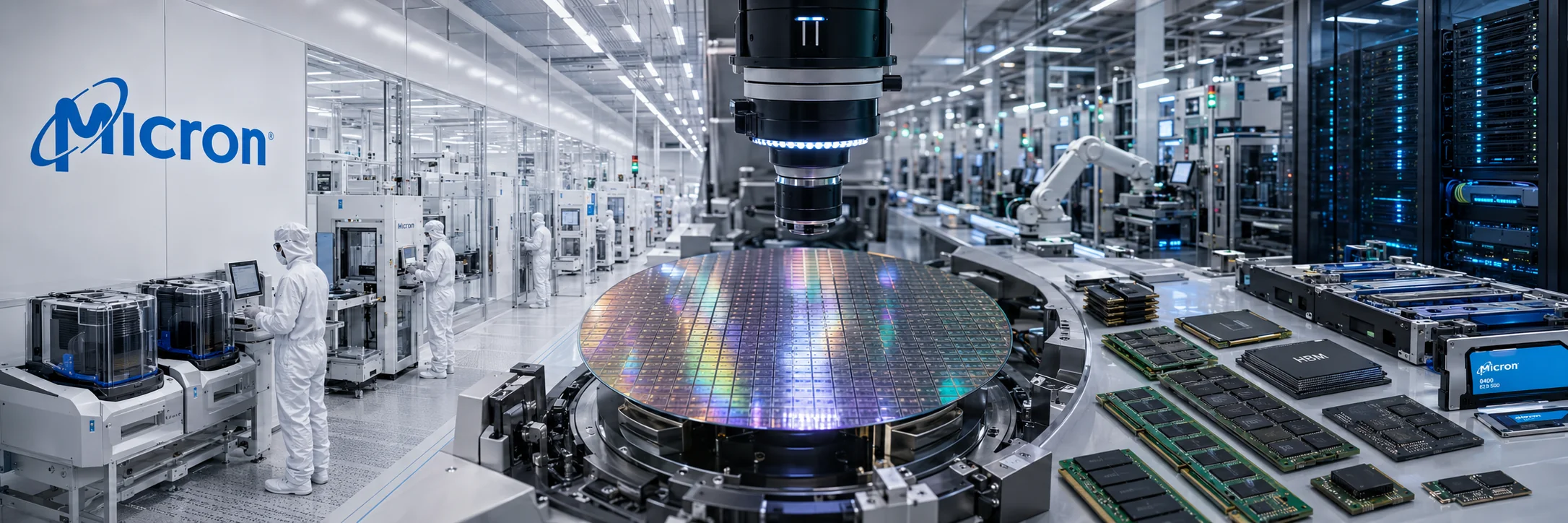
Brutal consolidation leaving only three DRAM producers creates an oligopoly where boom-bust capital intensity cycles are structural, while AI-driven demand for high-bandwidth memory represents a potential shift from commodity cycling to sustained capacity scarcity.
A structural look at how the last American memory chipmaker outlasted dozens of competitors through capital endurance and oligopoly dynamics.
The Commodity-Frontier Tension
What makes Micron Technology (MU)’s story structurally distinctive is the tension between two forces that define its existence. Memory chips are commodity products — functionally interchangeable, sold on price, subject to cycles that produce violent swings in profitability. Yet manufacturing these commodities requires some of the most advanced technology on Earth and billions in capital per fabrication facility.
Micron operates at the intersection of commodity economics and frontier engineering, and this duality shapes everything about the company.
Micron makes memory chips — DRAM and NAND flash — the two forms of semiconductor memory that store and retrieve data in virtually every electronic device on the planet. Smartphones, servers, PCs, automobiles, industrial equipment, and AI accelerators all depend on memory chips to function. Without memory, processors have nothing to work with. A CPU or GPU without memory is an engine without fuel — structurally capable but operationally inert. Micron is one of only three companies in the world that manufactures DRAM at scale, alongside Samsung and SK Hynix. In NAND flash, the field is slightly wider but still concentrated among five or six producers. This oligopoly structure is not accidental — it is the end state of decades of consolidation driven by capital intensity, technology complexity, and the relentless economics of commodity manufacturing.
Understanding Micron requires understanding memory economics: why the industry consolidated, how capital cycles drive profitability, what technology transitions mean for competitive positioning, and how the emergence of AI-driven demand for high-bandwidth memory may be altering the structural dynamics that have defined the memory business for decades. The company's arc is not a story of a single brilliant strategy or a visionary founder's plan. It is a story of survival through attrition in an industry that has destroyed most of its participants — a story where the primary competitive advantage has been the ability to endure conditions that drove dozens of rivals into bankruptcy, merger, or exit.
The Long-Term Arc
How did Micron survive its early years (1978 – 1990s)?
Micron was founded in 1978 in Boise, Idaho — far from the semiconductor clusters of Silicon Valley, Texas, or East Asia. The company was started by a small group of semiconductor engineers in the basement of a dental office, a humble origin that contrasts starkly with the multi-billion-dollar fabrication complexes the company operates today. Micron began manufacturing DRAM chips at a time when dozens of competitors populated the memory industry, including major American firms like Texas Instruments, Motorola, and Intel, as well as Japanese companies that would come to dominate the market through the 1980s. Memory was Intel's original business — the company's name literally derives from "integrated electronics" and its first products were memory chips — but Intel exited DRAM in 1985 to focus on microprocessors. That exit, one of the most consequential strategic decisions in technology history, illustrates how brutally competitive memory manufacturing had already become within a decade of Micron's founding.
The 1980s were shaped by the Japanese memory invasion. Companies like NEC, Toshiba, Hitachi, and Fujitsu invested heavily in DRAM production, supported by industrial policy, patient capital from Japanese banks, and a manufacturing culture that produced exceptional yields and quality. They drove prices down relentlessly and captured the majority of global market share. The U.S. semiconductor industry experienced what felt like an existential crisis — Japanese producers were winning on cost, quality, and reliability simultaneously. Most American memory companies exited the business entirely, concluding that competing with government-backed Japanese manufacturers in a commodity market was economically irrational.
Micron survived — barely — through a combination of cost discipline, manufacturing efficiency, and a successful antidumping trade case against Japanese producers. The company's Idaho location, far from the high-cost Bay Area, contributed to a lower cost structure that provided a thin margin of survival when others were being squeezed out. Micron also developed a reputation for lean operations and aggressive cost management that would become cultural hallmarks. The Simplot family, Boise-based agricultural industrialists, provided patient capital during periods when outside investors might have demanded an exit from the memory business. This local ownership structure gave Micron a form of financial resilience that publicly traded competitors in more demanding capital markets lacked.
This early period established a pattern that would repeat throughout Micron's history: the memory industry periodically overbuilds capacity, prices collapse, weaker players exit or consolidate, and survivors emerge with improved structural positions. The mechanism is straightforward but brutal. When memory prices are high, producers invest in new fabrication capacity to capture profits. The capacity takes two to three years to come online. By the time it does, multiple producers have expanded simultaneously, supply overshoots demand, and prices fall — often below the cost of production. Companies with insufficient financial reserves or technological competitiveness are forced to exit, merge, or declare bankruptcy. The survivors absorb their capacity and market share, and the cycle begins again. Micron's survival through the Japanese onslaught was the first of several cycles where the company outlasted competitors through a combination of cost efficiency, technology execution, and sheer endurance.
How did the DRAM industry consolidate (1990s — 2010s)?
The global DRAM industry entered a long period of consolidation that would reduce dozens of producers to a handful. The economics were relentless: each new technology generation required larger capital investments, the minimum efficient scale of production grew larger, and commodity pricing meant that only the lowest-cost producers could sustain profitability through the inevitable down cycles. Companies that could not keep pace with investment requirements or that made technology bets that failed were absorbed or eliminated. The list of companies that once produced DRAM and no longer exist — or no longer produce memory — is extensive: Qimonda, Elpida, ProMOS, Powerchip, Nanya (reduced to a minor player), Winbond (exited mainstream DRAM), Hitachi, NEC, Toshiba (exited DRAM), Fujitsu, Siemens/Infineon, and many others. The graveyard of failed memory producers is one of the largest in any industry.
The Japanese producers that had dominated in the 1980s gradually lost ground to Korean manufacturers — Samsung and what would become SK Hynix. Samsung, backed by the deep pockets of its conglomerate parent and a willingness to invest counter-cyclically, became the world's largest memory producer. Its strategy of expanding capacity during downturns — when competitors were retrenching and prices were at their lowest — was structurally devastating to rivals. Samsung could absorb losses that smaller players could not, and the new capacity it brought online during downturns ensured that the subsequent recovery was less profitable for everyone. When prices recovered, Samsung had more capacity producing at lower costs than competitors who had cut back. This counter-cyclical investment pattern was not merely aggressive capital allocation — it was a form of competitive attrition that systematically weakened and eliminated rivals over successive cycles.
The Korean approach to memory manufacturing reflected a different philosophy of industrial investment than prevailed in the United States or Japan. Samsung and Hyundai (later renamed Hynix, then SK Hynix after acquisition by the SK Group) treated memory as a strategic national industry worthy of sustained investment regardless of short-term profitability. Government support, conglomerate cross-subsidization, and a cultural willingness to accept years of losses in pursuit of long-term market position enabled a level of investment patience that standalone American or Japanese memory producers could not match. This structural advantage in capital patience was arguably more important than any specific technology lead in determining which companies survived.
Through this period, the roster of DRAM producers shrank steadily. Qimonda, the memory spinoff of Germany's Infineon, went bankrupt in 2009 during the global financial crisis — unable to sustain investment through yet another severe downturn. Elpida Memory, Japan's last major DRAM producer (formed from the merger of NEC and Hitachi's memory operations), filed for bankruptcy in 2012 after years of losses and a strong yen that disadvantaged its cost structure. Micron acquired Elpida's assets in 2013 for approximately $2 billion — a transformative deal that significantly expanded Micron's DRAM production capacity and technology portfolio, particularly in mobile DRAM where Elpida had been strong. The Elpida acquisition was Micron's most consequential strategic move, securing the company's position as a top-three DRAM producer at a time when the industry's structure was solidifying into its modern oligopoly form.
Other acquisitions reinforced Micron's position. The company acquired Numonyx (a flash memory joint venture originally created by Intel and STMicroelectronics) in 2010, gaining NOR flash technology and additional NAND capabilities. In 2016, Micron fully acquired Inotera Memories, a Taiwanese DRAM joint venture partner in which Micron had held a partial stake, consolidating full ownership and control of significant DRAM fabrication capacity. Each acquisition added manufacturing capacity, technology, and scale — the critical inputs for survival in an industry where scale determines cost competitiveness and cost competitiveness determines survival. Micron was not acquiring for growth in the conventional sense. It was acquiring to reach and maintain the minimum viable scale required to compete in a consolidating industry.
By the mid-2010s, the DRAM industry had consolidated to three producers: Samsung, SK Hynix, and Micron. Together they control approximately 95% of global DRAM production. This oligopoly structure fundamentally changed the industry's economics, though not in the way a simple oligopoly model might predict. With only three players, the risk of catastrophic oversupply diminished — though it did not disappear entirely. Capital discipline, while imperfect, improved relative to the era of fragmented competition when a dozen producers would independently decide to expand capacity simultaneously. The boom-bust cycles continued, but their amplitude moderated somewhat as fewer players made more considered investment decisions. Profitability through the cycle improved materially — the memory industry went from one that periodically bankrupted its participants to one that, on average, generated positive returns, albeit with significant volatility.
How did NAND flash diversify Micron's product line?
Micron's involvement in NAND flash memory added a second major product line alongside DRAM, diversifying the company's exposure across two distinct but related memory markets. NAND flash — the technology behind solid-state drives, USB drives, and smartphone storage — has its own distinct economics and competitive dynamics. Unlike DRAM, which is volatile (data is lost when power is removed) and serves as a system's working memory, NAND is non-volatile and stores data persistently. The two products serve complementary functions in every computing system: DRAM provides fast temporary storage for active workloads, while NAND provides slower but persistent storage for data at rest.
The NAND market is somewhat less concentrated than DRAM, with Samsung, SK Hynix, Kioxia (formerly Toshiba Memory), Western Digital, and Micron as the major producers. This five-player structure creates different competitive dynamics than the DRAM triopoly — more fragmented capacity decisions, less pricing discipline, and historically lower average margins. Micron's position in NAND has generally been that of a mid-tier producer, not the market leader. Samsung has consistently led in NAND technology and scale, with Kioxia and Western Digital (who share fabrication facilities in a long-standing joint venture) and SK Hynix also holding significant positions.
Technology transitions in NAND have been particularly dramatic and have repeatedly reshuffled competitive positions. The industry moved from planar (two-dimensional) NAND to 3D NAND, where memory cells are stacked vertically in layers. This transition, which began in earnest around 2015, was one of the most significant manufacturing shifts in semiconductor history. For decades, the memory industry had followed Moore's Law by shrinking features on a flat surface — making transistors smaller to fit more on each chip. By the mid-2010s, planar NAND had reached physical limits where further shrinking degraded reliability. The solution was to go vertical: stack layers of memory cells on top of each other, like floors in a skyscraper. 3D NAND added an entirely new manufacturing dimension, requiring different equipment, different process flows, and different engineering expertise than the shrink-based approach that had prevailed for forty years.
Samsung led the 3D NAND transition and initially gained a significant competitive advantage by being first to mass-produce 3D NAND with acceptable yields and reliability. Micron, along with its former NAND joint venture partner Intel (with whom it co-developed flash memory for years before their partnership dissolved), developed its own 3D NAND technology using a different cell architecture — a charge-trap approach called CMOS Under the Array (CUA) that placed peripheral logic beneath the memory array to improve density. This approach eventually proved competitive, but the transition period was costly, technically demanding, and involved years where Micron's NAND technology trailed Samsung's. The 3D NAND transition demonstrated a recurring pattern in memory: technology shifts create windows where established positions can be reinforced or disrupted, and execution during these transitions carries outsized consequences for a producer's competitive standing for the generation that follows.
The industry has since progressed to stacking over 200 layers in leading-edge 3D NAND, with further increases planned. Each additional block of layers requires incremental process innovation — etching deeper and more precisely through increasingly tall stacks of materials. Micron has been competitive in the layer-count race, at times claiming industry-leading layer counts. The company's dissolution of its long-standing NAND joint venture with Intel (Intel sold its NAND business to SK Hynix in 2020) left Micron as an independent NAND producer, fully responsible for its own technology development and capital investment in flash memory.
In DRAM, technology transitions have followed a more incremental but no less important path. Each generation of DDR (Double Data Rate) memory offers higher bandwidth and lower power consumption than its predecessor. Micron has navigated transitions from DDR3 to DDR4 to DDR5, each requiring significant process engineering, circuit design innovation, and extensive product qualification with customers. DDR5, the current generation, offers substantially higher bandwidth — up to double the data rate of DDR4 — and is particularly relevant for data center and AI applications where memory bandwidth is a critical system bottleneck. DRAM process technology has also continued advancing to smaller nodes, though the pace of shrinking has slowed as the industry approaches physical limits in how small DRAM cell structures can be made while maintaining adequate charge storage and refresh characteristics. Extreme ultraviolet (EUV) lithography, already used in advanced logic chip manufacturing by TSMC (tsmc) and Samsung Foundry, is being adopted for DRAM production to enable continued scaling — adding yet another layer of capital investment required to remain competitive.
How is AI demand reshaping Micron's memory business (2023 — Present)?
The emergence of large-scale AI computing has introduced a structural demand driver that may be qualitatively different from previous memory cycles. AI training and inference workloads — particularly those running on GPUs and custom accelerators — are extraordinarily memory-intensive. Large language models with hundreds of billions of parameters must hold their weights in memory during both training and inference. Image and video generation models process enormous tensors that consume memory bandwidth at rates far exceeding traditional computing workloads. The gap between processor compute capability and memory bandwidth — sometimes called the "memory wall" — has become the binding constraint on AI system performance. This has created surging demand for a specialized product called High-Bandwidth Memory, or HBM.
HBM is a form of DRAM that stacks multiple memory dies vertically using through-silicon vias (TSVs) — tiny copper pillars that pass through the silicon substrate to connect layers electrically — and packages them on a silicon interposer alongside the processor die. This three-dimensional architecture provides dramatically higher bandwidth than conventional DRAM modules. Where a standard DDR5 DIMM might deliver bandwidth in the range of 50-60 gigabytes per second, an HBM stack can deliver over one terabyte per second — roughly a twenty-fold improvement. This bandwidth comes at lower power per bit transferred than would be achievable with an equivalent number of conventional DRAM chips spread across a circuit board. HBM is essential for modern AI accelerators — Nvidia's H100, H200, and Blackwell GPU generations use HBM extensively, as do AMD's Instinct MI300 accelerators, Google's TPUs, and custom AI chips from companies like Amazon and Microsoft.
SK Hynix was the early leader in HBM production, having invested in the technology years before AI demand materialized at scale. SK Hynix secured a dominant position as the primary HBM supplier to Nvidia, the most important customer in the AI accelerator market. Micron entered the HBM market later but has been rapidly scaling production of its HBM3E products, which the company claims offer industry-leading power efficiency. Micron's HBM3E has been qualified for use in Nvidia's systems, a critical milestone for any memory producer given Nvidia's dominant position in AI accelerators. Samsung, despite being the world's largest memory producer overall and a pioneer in 3D stacking technologies, faced quality and yield challenges with its HBM products that temporarily ceded ground to SK Hynix and Micron — a notable competitive stumble for the industry's traditional leader.
HBM is structurally different from commodity DRAM in ways that matter profoundly for Micron's economics and competitive position. It commands significantly higher prices per bit than standard DRAM — estimates suggest HBM pricing is several times higher than equivalent commodity DRAM on a per-gigabyte basis. It requires advanced packaging capabilities — specifically, the ability to stack and connect multiple dies using TSV technology and to integrate these stacks onto silicon interposers — that go beyond standard wafer fabrication competencies. This packaging complexity limits the number of producers who can manufacture HBM at scale and at acceptable yields, creating a tighter supply structure than exists for commodity DRAM. HBM also involves closer technical collaboration with processor customers, as the memory stacks must be physically co-packaged with or adjacent to the processor die. This creates relationships that are more partnership-like than commodity-like — a qualitative shift from the transactional nature of standard DRAM sales.
Most importantly, HBM demand is driven by a secular trend — the buildout of AI computing infrastructure across cloud providers, enterprises, and sovereign AI initiatives — rather than by the traditional PC and smartphone replacement cycles that have historically governed memory demand. This raises a fundamental question for Micron and the broader memory industry: does HBM represent a permanent structural shift away from pure commodity dynamics, or is it a cyclical supercycle that will eventually revert to standard commodity patterns as production scales, competition intensifies, and AI investment normalizes? The answer has significant implications for Micron's long-term margin structure, capital allocation, and competitive positioning. History suggests that technology premiums in memory tend to erode as production scales, but the structural characteristics of HBM — its packaging complexity, its deep integration with processor designs, and the concentration of demand among a small number of large AI infrastructure builders — may prove more durable than previous differentiation attempts.
Why does Micron's status as the sole American memory maker matter?
Micron's position as the sole remaining American memory manufacturer has taken on geopolitical significance in an era of semiconductor supply chain anxiety. The concentration of advanced memory manufacturing in East Asia — South Korea (Samsung, SK Hynix), Japan (Kioxia), and Taiwan (formerly significant, now diminished after Micron's consolidation of Inotera) — has been identified as a strategic vulnerability by the U.S. government. The U.S. CHIPS and Science Act, enacted in 2022, provides substantial subsidies for domestic semiconductor manufacturing, including memory production. Micron has announced plans for major fabrication facility investments in the United States, including a large-scale fab complex in Clay, New York (near Syracuse), with potential investment exceeding $100 billion over the coming decades, as well as expansions at its headquarters facility in Boise, Idaho, and in Manassas, Virginia. These investments, supported by billions in federal subsidies, represent the most significant domestic memory manufacturing buildout in decades and would partially address the geographic concentration risk in global memory supply chains.
Simultaneously, Micron has faced restrictions in China that highlight the double-edged nature of geopolitical entanglement. In 2023, China's Cyberspace Administration conducted a security review of Micron products and subsequently banned the use of Micron memory in critical Chinese infrastructure, citing security concerns. The move was widely interpreted as retaliatory — part of the escalating technology competition between the United States and China that has involved U.S. export controls on advanced semiconductor equipment and chips to Chinese entities. China represents a significant portion of global memory demand, and restrictions on Micron's ability to sell into this market create both direct revenue risk and competitive asymmetry, as Samsung and SK Hynix have not faced equivalent restrictions and continue to operate significant manufacturing and sales operations in China.
The geopolitical dimension introduces a category of risk and opportunity that did not meaningfully exist for memory producers a decade ago. Government subsidies reduce the cost of domestic capacity expansion but come with strings — employment commitments, technology-sharing restrictions, and political expectations. Market access restrictions reduce the addressable market but may be offset by preferential treatment in other regions. The net effect on Micron's competitive position is ambiguous and depends on how geopolitical dynamics evolve — an inherently unpredictable variable that nonetheless now shapes capital allocation decisions, customer relationships, and long-term strategic planning in ways that pure market competition never did.
How does Micron's pure-play model compare to its rivals?
Understanding Micron's position requires comparing its structural model with those of its primary competitors and adjacent semiconductor companies. Samsung Electronics is not merely a memory company — it is a diversified technology conglomerate that produces memory chips, logic chips (through Samsung Foundry, a competitor to TSMC), displays, smartphones, appliances, and more. Samsung's memory division benefits from the conglomerate's deep financial reserves, its ability to cross-subsidize memory investment during downturns, and its vertical integration that allows Samsung to consume its own memory products in its smartphone and consumer electronics divisions. This integration provides Samsung with a structural resilience that Micron, as a pure-play memory company, does not possess. When memory prices collapse, Samsung's other divisions continue generating cash flow. Micron has no such buffer.
SK Hynix operates as part of the SK Group, one of South Korea's largest conglomerates, with interests spanning telecommunications, energy, and chemicals. While less diversified than Samsung at the product level, SK Hynix benefits from conglomerate backing and has been strategically aggressive — its acquisition of Intel's NAND business in 2020 significantly expanded its flash memory capabilities and customer relationships. SK Hynix's early and decisive investment in HBM technology has given it a structural lead in the highest-growth segment of the memory market, demonstrating that in technology-intensive commodity industries, being early with the right product architecture can create meaningful — if potentially temporary — competitive separation.
TSMC (tsmc), while not a memory producer, provides an instructive structural comparison. TSMC operates a pure-play foundry model — manufacturing logic chips designed by other companies (Apple, AMD, Nvidia, Qualcomm) without designing competing products of its own. This model eliminates the conflict of interest that Samsung faces as both a foundry and a chip designer competing with its foundry customers. Micron's model is different from both: it designs and manufactures its own memory products but does not offer foundry services. In the logic chip world, the industry has disaggregated design from manufacturing (the fabless-foundry model). In memory, vertical integration remains the norm — all three major DRAM producers design and manufacture their own chips. This structural difference reflects the unique economics of memory manufacturing, where process technology and product design are so deeply intertwined that separating them would sacrifice critical optimization opportunities.