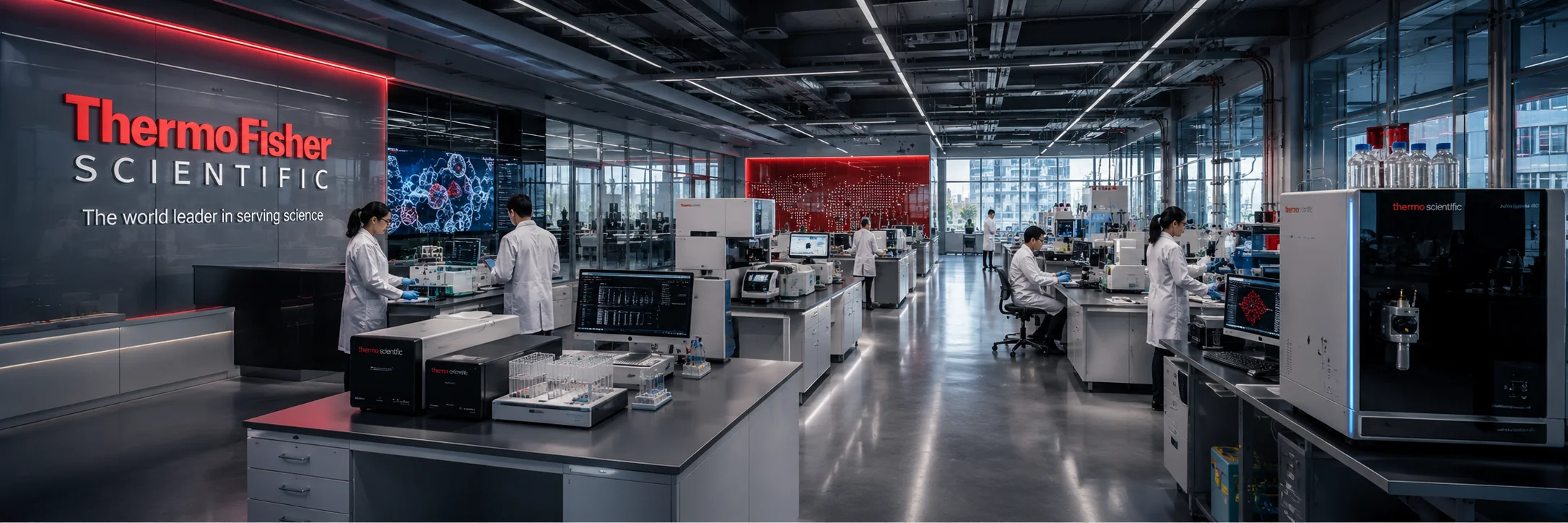
The broadest product portfolio in life sciences tools creates cross-selling opportunities where instruments, consumables, and services reinforce each other's switching costs, because each additional product adopted deepens the operational dependency on the integrated platform.
A structural look at how assembling the broadest portfolio of laboratory instruments, consumables, and services created compounding advantages in life sciences tools.
Introduction
Thermo Fisher (TMO) Scientific is the largest company in life sciences tools that most people outside the industry have never heard of. The company does not discover drugs. It does not treat patients. What it does is supply the instruments, consumables, chemicals, software, and services that make drug discovery, diagnostics, and scientific research physically possible. Every pharmaceutical company, every university research lab, every hospital diagnostic department depends on products and services that flow through Thermo Fisher's distribution network.
The company exists in its current form because of a single structural insight pursued over decades: in a fragmented industry where researchers need thousands of different products, the company that assembles the broadest portfolio and the deepest distribution network captures advantages that compound with each addition. Every new product category added to the catalog makes the existing catalog more valuable to customers who prefer fewer vendor relationships. Every customer acquired through one product category becomes a cross-selling opportunity for every other category.
Understanding Thermo Fisher requires examining how portfolio breadth—rather than excellence in any single product—creates structural advantages in a market defined by high switching costs, consumable replenishment cycles, and the essential nature of the underlying demand. Research does not stop during recessions. Drug development timelines do not compress because budgets tighten. The demand for laboratory tools is structurally persistent in ways that few other industries can match.
The Long-Term Arc
The Two Predecessor Companies
Thermo Electron Corporation, founded in 1956, grew into a diversified manufacturer of analytical instruments, environmental monitoring equipment, and laboratory products. The company pursued a distinctive structure through the 1980s and 1990s—spinning off subsidiary companies as publicly traded entities while retaining majority ownership. This structure was intended to create entrepreneurial incentives within divisions, but it also created complexity, redundancy, and structural inefficiency. By the early 2000s, Thermo Electron had re-absorbed most of its subsidiaries and refocused on its core analytical instruments business.
Fisher Scientific, founded in 1902, evolved from a laboratory supply company into a broad distributor of scientific equipment, chemicals, and consumables. Fisher's structural strength was distribution—the ability to deliver hundreds of thousands of products to laboratories across the world through a single ordering relationship. The company understood that researchers optimize for convenience and reliability in procurement. A lab that can order reagents, glassware, safety equipment, and instruments from one supplier with one account and one delivery system will resist switching to a fragmented set of vendors.
These two companies represented complementary structural assets. Thermo Electron brought proprietary high-value instruments—mass spectrometers, chromatography systems, electron microscopes. Fisher Scientific brought distribution reach and consumable product breadth. The combination was structurally logical in a way that few mergers are.
What did the 2006 merger create?
The merger of Thermo Electron and Fisher Scientific in 2006 created Thermo Fisher Scientific—immediately the largest company in the life sciences tools space. But the structural significance went beyond size. The combination created a system where proprietary instruments generated demand for proprietary consumables and reagents, which flowed through the industry's broadest distribution network, which provided customer access for selling more instruments. Each element of the system reinforced the others.
Integration was governed by PPI—the Practical Process Improvement business system that Thermo Fisher adopted and scaled across the combined entity. PPI is a continuous improvement methodology modeled on lean manufacturing principles, applied not just to production but to every business process: order fulfillment, R&D prioritization, customer service, and acquisition integration. The system provides a repeatable playbook for absorbing acquired companies, extracting cost synergies, and standardizing operations. PPI is what makes Thermo Fisher's acquisition-driven strategy structurally viable—without a reliable integration methodology, rapid acquisition would create organizational chaos rather than compounding value.
How did Thermo Fisher's acquisition engine work?
Following the merger, Thermo Fisher pursued an aggressive acquisition strategy that systematically filled gaps in its product portfolio. The company acquired Life Technologies in 2014 for approximately $13.6 billion—at the time one of the largest deals in the life sciences tools industry—gaining leading positions in genetic analysis, cell biology, and bioproduction. This was followed by acquisitions in clinical diagnostics, pharmaceutical services, specialty chemicals, and laboratory software.
The acquisition logic is consistent: identify product categories where laboratories spend significant money, where Thermo Fisher's existing customer relationships provide distribution advantage, and where the PPI system can improve operational performance post-acquisition. Each acquisition makes the portfolio broader, the distribution network more valuable, and the cross-selling opportunity larger.
The strategy compounds because each addition increases the attractiveness of the platform to the next potential acquisition target—sellers recognize that their products will reach more customers through Thermo Fisher's network than through independent distribution.
The company also expanded into pharmaceutical services—contract development and manufacturing for drug companies. The acquisition of Patheon in 2017 added capabilities in drug formulation and manufacturing, extending Thermo Fisher's relationship with pharmaceutical customers from supplying their research labs to supporting their commercial production. This vertical integration deepened customer dependency and created new revenue streams connected to the same underlying client relationships.
What did pandemic demand mean for Thermo Fisher?
The COVID-19 pandemic generated extraordinary demand for Thermo Fisher's diagnostic capabilities. The company became a major supplier of PCR testing instruments, reagents, and consumables. Pandemic-related revenue reached billions of dollars annually—a windfall that significantly exceeded normal growth rates. This revenue was structurally temporary. Once testing demand normalized, the pandemic contribution declined sharply.
The structural aftermath is more interesting than the windfall itself. Thermo Fisher used pandemic-era cash flows to fund additional acquisitions and invest in capacity expansion. The company also gained new customer relationships—particularly with government health agencies and clinical testing laboratories—that may generate ongoing demand for non-pandemic products. The pandemic demonstrated the company's ability to scale production rapidly, reinforcing its position as a reliable supplier during crises. Whether these structural benefits persist at a level that compensates for the lost pandemic revenue is a question the system is still resolving.