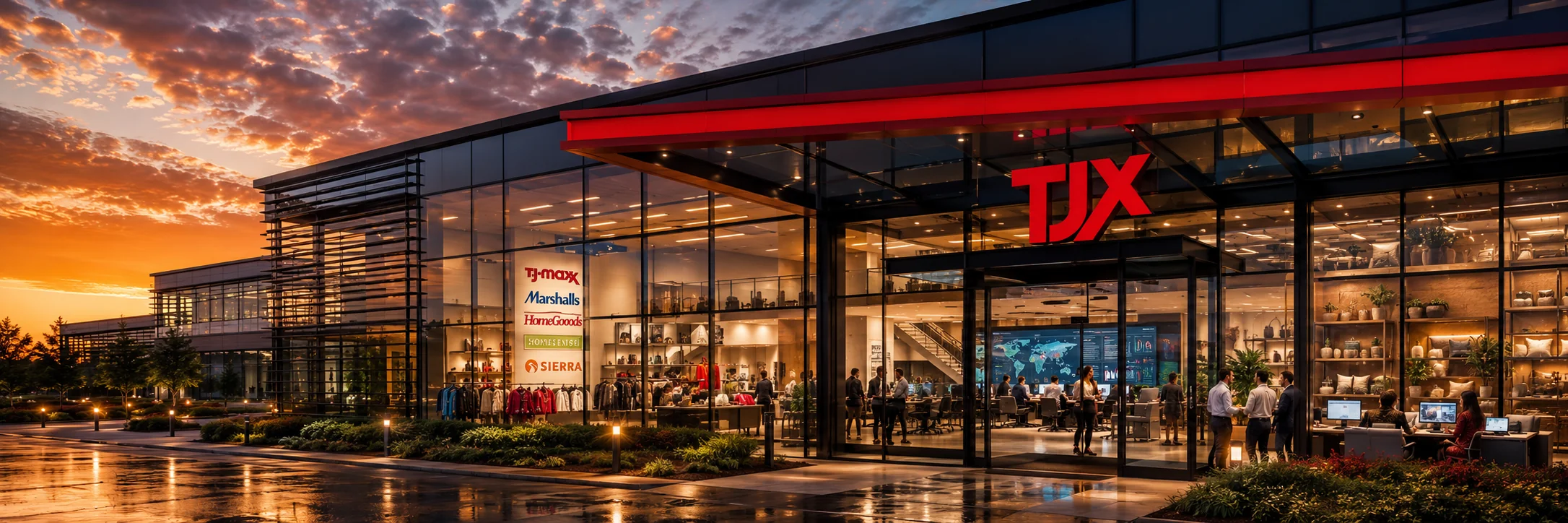
Transforming the structural inefficiencies of apparel and home goods overproduction into a buying advantage creates a self-reinforcing system where 1,200 merchant buyers and rapid inventory turnover produce treasure-hunt economics that full-price retailers and e-commerce cannot replicate.
A structural look at how an off-price retailer converted the fashion industry's chronic overproduction problem into a self-reinforcing system of opportunistic buying, rapid turnover, and counter-cyclical resilience that traditional retail and e-commerce cannot replicate.
Introduction
TJX Companies (TJX) operates what appears to be a collection of discount stores. TJ Maxx, Marshalls, HomeGoods, Winners, HomeSense — the banners are familiar, the stores ubiquitous. Racks of clothing, aisles of home goods, bins of accessories, all at prices marked 20% to 60% below department store levels. The surface description sounds like a simple discount operation. But the structural reality is something entirely different. TJX is not a retailer that happens to buy cheap inventory. It is a buying organization that happens to operate stores. The stores are the distribution mechanism. The buying system is the business.
This distinction matters because it determines everything downstream. Traditional retailers begin with merchandise plans — they decide what to sell months in advance, place orders with vendors, and then attempt to sell that inventory at full price before marking it down. TJX inverts this sequence entirely. Its buyers do not plan assortments seasons ahead. They respond to what is available now, purchasing excess inventory from brands and manufacturers at deep discounts, then routing it through stores within weeks. The system does not predict demand; it harvests supply. This inversion eliminates the most expensive risk in retail — the risk of guessing wrong about what consumers will want — and replaces it with a fundamentally different kind of expertise: the ability to recognize value in the moment, across thousands of vendors, in dozens of countries, every single day.
What emerges is a system with unusual structural properties. It gets stronger when its suppliers struggle. It thrives on the very overproduction and forecasting errors that damage conventional retailers. It creates a shopping experience — the treasure hunt — that is resistant to e-commerce replication because it depends on physical browsing of unpredictable, constantly rotating inventory. And it compounds these advantages through scale: the larger TJX becomes, the more vendors need it as a clearance channel, and the more access it gains to the best opportunistic inventory before anyone else can bid. Understanding TJX requires seeing it not as a chain of stores but as a coordination system that sits at the intersection of the fashion industry's structural inability to match supply with demand.
The Long-Term Arc
TJX's evolution traces a path from a single off-price concept to the world's largest off-price retailer, operating over 4,900 stores across nine countries. The business model has remained structurally consistent for decades — what changed was the scale of the buying organization, the geographic reach, and the depth of vendor relationships. The core logic — buy opportunistically, sell quickly, repeat — has been the same since the beginning. This consistency is itself a structural feature: the model did not require reinvention because the industry inefficiency it exploits has proven permanent.
What founding insight shaped TJX's off-price concept (1976 – 1995)?
TJ Maxx opened its first store in Auburn, Massachusetts, in 1977, operating under the Zayre Corporation. The founding insight was architectural: the apparel industry chronically overproduces. Brands manufacture more than they can sell at full price. Department stores order more than their customers will buy. Seasons change, styles shift, forecasts miss — and the result is a permanent, structural surplus of quality merchandise that needs to find a home. TJ Maxx positioned itself as that home, offering brands a discreet channel to clear excess without the public embarrassment of deep markdowns in their own stores or department store partners.
The early model was straightforward but contained the seeds of everything that followed. Buyers purchased end-of-season goods, canceled orders, and overruns from brand-name manufacturers at 20% to 60% below wholesale prices. The stores were no-frills environments — minimal fixtures, limited signage, racks organized by size rather than brand or lifestyle category. The shopping experience required effort. Customers had to dig through racks, compare items, judge quality on the spot. This friction was not a deficiency; it was a selection mechanism. The customers who shopped TJ Maxx were those who valued the hunt — who derived satisfaction from finding a premium brand at a fraction of its normal price, and who were willing to invest time in browsing as the price of that satisfaction. This self-selecting customer base would prove critical to the model's durability, because it meant TJX's core shoppers were intrinsically motivated by the format rather than reluctantly accepting it as a compromise.
In 1987, TJX Companies was formally incorporated as the parent entity, separating from Zayre's struggling conventional retail operations. The separation was structurally significant in ways that extended beyond corporate housekeeping. It freed TJX from the organizational overhead and strategic confusion of operating both full-price and off-price formats under one umbrella. Zayre's conventional stores were failing — the same markdown spiral and inventory risk problems that fed TJX's supply were destroying the parent company. The separation clarified TJX's identity as a pure off-price operator, unburdened by the conflicts inherent in managing both the problem and the solution under one roof.
The acquisition of Marshalls in 1995 — then the second-largest off-price chain in the United States — was the defining move of this era and arguably the single most important structural decision in TJX's history. Marshalls gave TJX a second major banner with distinct store identities but shared buying infrastructure. Two banners could operate in the same trade area without cannibalizing each other, because the inventory was different in each store on any given day. A customer walking into TJ Maxx on Tuesday and Marshalls on Wednesday would encounter entirely different merchandise — different brands, different styles, different discoveries. This structural property — two different treasure hunts in the same market — would become a template for future multi-banner expansion and would give TJX a store-density advantage that single-banner competitors like Ross Stores could not match without self-cannibalization.
How did TJX build its buying organization into a core asset (1995 – 2008)?
With TJ Maxx and Marshalls operating under one roof, TJX entered a phase of systematic investment in its buying organization — the asset that would prove most decisive in the long run. The company recruited, trained, and deployed buyers across an expanding network of buying offices worldwide. By the mid-2000s, TJX had over 1,000 buyers sourcing merchandise from more than 18,000 vendors in over 100 countries. This was not a procurement department executing purchase orders against a seasonal plan. It was the company's core competitive asset — a distributed network of skilled evaluators whose collective judgment determined the quality and value of every store's inventory.
The buying system operated on principles that differed fundamentally from conventional retail purchasing. TJX buyers were trained to evaluate merchandise on its own terms — fabric quality, construction, brand equity, current market price — rather than against a pre-set assortment plan. They had authority to make purchases on the spot, often completing transactions within hours rather than the weeks or months that traditional retail procurement cycles required. This speed was critical. The best opportunistic inventory — canceled orders from a major department store, a European brand entering liquidation, a manufacturer sitting on excess fabric from an overrun — appeared unpredictably and disappeared quickly. The buying organization that could evaluate and commit fastest got access to the best merchandise. This created an information and relationship advantage that compounded over time: vendors who needed fast, reliable clearance learned to call TJX first because TJX could say yes and move money faster than anyone else.
The training pipeline for buyers became a structural investment in itself. TJX developed internal programs to teach new buyers how to assess value across categories, how to negotiate with vendors under time pressure, and how to maintain vendor relationships that ensured continued access. The buyers rotated across categories and geographies, building versatile expertise rather than narrow specialization. This created organizational resilience — the departure of any single buyer did not remove a critical vendor relationship because the institutional knowledge and the relationships were distributed across a team, not concentrated in individuals. The buying culture became self-perpetuating: experienced buyers trained the next generation, who inherited both skills and vendor networks.
During this period, TJX also scaled HomeGoods (launched in 1992), extending the off-price model into home furnishings. The home goods category proved structurally similar to apparel: chronic overproduction, seasonal obsolescence, and high fragmentation among vendors created a steady stream of surplus inventory. HomeGoods applied the same treasure-hunt shopping experience — constantly rotating inventory, brand-name goods at below-retail prices, physical browsing as the discovery mechanism — to a new product category. The banner grew steadily, benefiting from the same buying infrastructure that served TJ Maxx and Marshalls. A buyer sourcing home textiles for HomeGoods could leverage the same vendor relationships used for apparel accessories at TJ Maxx, creating cross-category efficiency that reinforced the buying organization's scale advantage.
This period also revealed an important structural dynamic in TJX's relationship with its vendors. The relationship was not purely transactional — it was symbiotic in a specific way. Brands needed TJX as a discreet clearance channel. The alternative to selling excess inventory through off-price was markdowns in their own stores or department store partners, which visibly eroded brand perception. TJX offered something different: the goods appeared in a treasure-hunt environment where brand-specific merchandising did not exist, where products were not displayed with promotional signage, and where the shopping experience was about discovery rather than brand loyalty.
This discretion was valuable to vendors. It meant their excess could be cleared without public acknowledgment of overproduction. TJX, in turn, gained preferential access to quality merchandise because it offered a solution that other clearance channels — outlet malls, online liquidators, job-lot dealers — could not match at the same scale or with the same discretion.
How did the 2008 crisis validate TJX's model (2008 – 2019)?
The 2008-2009 financial crisis was a structural proof point for TJX's model, one that would have been difficult to demonstrate under normal conditions. While conventional retailers experienced devastating sales declines — department stores hemorrhaged revenue, specialty chains closed locations, several mid-tier retailers entered bankruptcy proceedings — TJX posted positive comparable store sales growth throughout the downturn. The mechanism was direct and multi-layered: economic distress created more off-price inventory (as struggling retailers canceled orders and brands liquidated excess), more value-conscious consumers (as household budgets tightened and discretionary spending contracted), and more vendor willingness to sell to TJX at deep discounts (as alternative clearance channels shrank). Every force that damaged traditional retail simultaneously strengthened TJX's supply of cheap inventory and its pool of willing customers.
This counter-cyclical dynamic was not a one-time anomaly attributable to the specific character of the Great Recession. It reflected a structural feature of TJX's position in the retail ecosystem — a feature that recurs in every downturn because it is embedded in the system's architecture, not in the specifics of any particular crisis. TJX functions as a pressure valve for the broader fashion and home goods industry. When the system produces more than it can sell at full price — which it does chronically, and more acutely during downturns — TJX absorbs the excess. This role makes TJX more valuable to vendors during periods of distress, which is precisely when TJX has the most leverage to negotiate favorable terms. The system's economics improve when the broader environment deteriorates. This is not a strategy that management implements during recessions; it is an emergent property of TJX's structural position that activates automatically when conditions change.
The post-recession period also saw aggressive international expansion. TJX had operated Winners and HomeSense in Canada since acquiring Winners in 1990, but the European push accelerated significantly. TK Maxx — renamed from TJ Maxx to avoid confusion with the existing British chain T.K. Maxx (unrelated) — expanded across the United Kingdom, Germany, Poland, Austria, the Netherlands, and eventually Australia. The off-price model proved culturally portable for the same structural reason it worked in the United States: the global apparel industry overproduces everywhere. European and Asian brands had the same surplus inventory problems as American ones. The fashion industry in Italy, France, and Germany faced the same seasonal cycles, the same forecasting challenges, and the same need for discreet clearance channels. International expansion both diversified TJX's geographic footprint and, critically, expanded the buying organization's access to global vendor networks. European buying offices sourced merchandise that could flow to American stores, and vice versa, creating a global arbitrage where inventory moved to whichever market offered the best margin opportunity.
The comparative dynamics between TJX and traditional retailers during this period are structurally illuminating. Consider Target (TGT), which operates a full-price general merchandise model. Target must forecast demand months in advance, commit to inventory purchases based on those forecasts, price merchandise at full retail, and then manage the markdown cycle when items do not sell as planned. Every forecasting error costs money — in markdowns, in storage, in wasted shelf space. TJX faces none of these costs because its buying is reactive, not predictive. Target builds assortments; TJX harvests leftovers. Target absorbs fashion risk; TJX buys after the risk has resolved. Target competes with Amazon on convenience and selection; TJX competes with no one on the specific experience it offers. The structural differences between these two models — one predictive and exposed to forecasting risk, the other reactive and insulated from it — explain why TJX's operating margins have been remarkably stable while traditional retailers' margins have compressed under e-commerce pressure.
Why has e-commerce not disrupted TJX (2019 — Present)?
The most structurally revealing feature of TJX's recent history is what did not happen: e-commerce disruption. Over the past decade, the narrative of retail has been dominated by the migration of consumer spending to online channels. Department stores, specialty retailers, and mall-based chains have all experienced significant traffic declines as consumers shifted to Amazon, Shopify-powered direct-to-consumer brands, and social media-driven shopping. TJX has been largely immune to this pressure — not because it invested heavily in digital capabilities, but because the off-price treasure-hunt experience is structurally incompatible with e-commerce in a way that reveals something important about the nature of the model itself.
The reason is fundamental and worth examining carefully. Online shopping is optimized for search: a customer knows what they want and finds it efficiently. Product pages display specifications, reviews, and price comparisons. Algorithms recommend related items based on browsing history. The entire experience is designed to reduce friction between intention and purchase. Off-price shopping is optimized for the opposite: discovery. A customer browses unpredictable, constantly rotating inventory and finds value they did not anticipate when they walked in. The treasure hunt depends on physical presence — handling fabrics, checking labels, comparing prices against remembered retail benchmarks — and the serendipity of encountering an unexpected brand at an unexpected price. These are different cognitive and behavioral modes. One is directed; the other is exploratory. One benefits from algorithmic efficiency; the other benefits from human browsing in a chaotic physical environment.
Algorithms cannot replicate the off-price experience because the inventory itself is unpredictable. TJX's buyers do not know what they will find next week, so there is no stable catalog for an algorithm to organize, no product pages to build, no searchable database to query. The absence of a predictable product assortment, which would be a fatal flaw in e-commerce, is the defining feature that makes off-price shopping engaging in person. When a customer finds a cashmere sweater from a premium Italian brand at 60% below department store price, the satisfaction is amplified by the uncertainty that preceded it — the fact that they might not have found it at all, that it might not be there tomorrow, that nobody told them it would be on that rack. This variable reinforcement schedule — the same psychological mechanism that makes slot machines compelling — operates continuously in TJX's stores and cannot be replicated in a digital format that requires predictability and searchability to function.
TJX today operates more than 4,900 stores globally, generates over $54 billion in annual revenue, and maintains a buying organization of more than 1,200 merchants sourcing from over 21,000 vendors across 100-plus countries. The company's store portfolio spans TJ Maxx and Marshalls (Marmaxx division), HomeGoods and HomeSense (Home division), Winners and Marshalls in Canada, TK Maxx and HomeSense in Europe, and TK Maxx in Australia. Comparable store sales have grown consistently for decades, interrupted only by the COVID-19 pandemic-related closures — a forced physical shutdown, not a demand failure. The post-pandemic recovery confirmed the model's resilience: when stores reopened, customers returned with pent-up demand, and the buying organization capitalized on the industry-wide inventory glut that followed supply chain normalization.
The system's current position reflects decades of compounding within a structural framework that has remained fundamentally unchanged since the 1990s: buy opportunistically from a vast and growing vendor network, turn inventory rapidly through stores that customers visit for the experience of discovery, and reinvest the resulting cash flows into expanding the store base and returning capital to shareholders. TJX has increased its dividend for nearly three decades and operates an active share repurchase program, funded by consistent free cash flow generation that exceeds capital expenditure requirements. The capital allocation pattern is conventional; the business model that funds it is not.