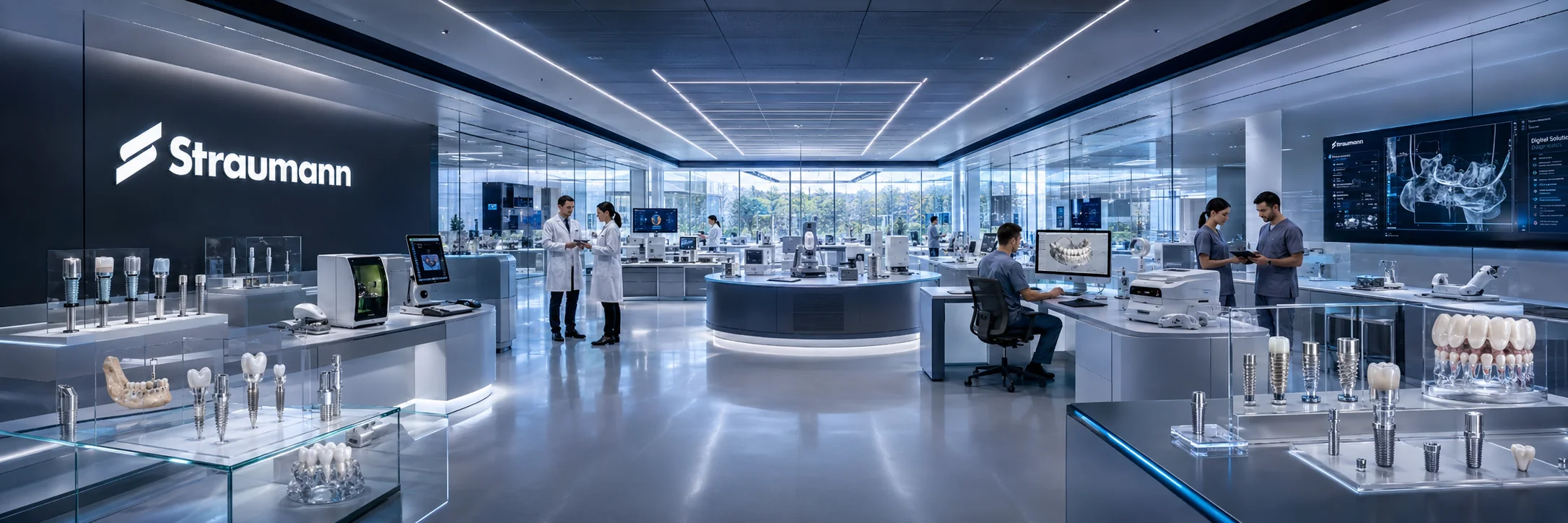
Dentist training on a specific implant system creates switching costs rooted in clinical muscle memory, while razor-and-blade economics convert each placed implant into recurring revenue from prosthetic components and digital workflow tools.
A structural look at how a Swiss dental implant company built one of the most durable competitive positions in medical devices through training ecosystems, switching costs measured in years, and the quiet expansion into digital dentistry.
Introduction
Straumann (SAUHF) is the global leader in dental implant systems and oral rehabilitation. The company designs and manufactures the titanium fixtures that are surgically placed into jawbones, the abutments that connect fixtures to prosthetic teeth, and the digital tools that plan and guide the entire procedure. It is not a household name, yet Straumann's products are present in millions of mouths worldwide, and the company's structural position in its industry is remarkably difficult to replicate.
What makes Straumann structurally interesting is not the product itself—titanium implants are, at a material level, not extraordinarily complex. What makes Straumann interesting is the system that surrounds the product. Dentists do not simply buy implants; they invest years learning a specific implant system's surgical protocols, prosthetic workflows, and digital planning tools. Once a dentist has internalized the Straumann system, switching to a competitor means relearning procedures that are performed on living patients. The switching cost is not financial—it is cognitive, procedural, and measured in years of muscle memory and clinical confidence.
Understanding Straumann's arc reveals how companies in specialized medical devices build moats that are invisible to anyone who looks only at product specifications or market share numbers. The moat lives in the training ecosystem, in the prosthetic component library, in the digital workflow integration, and in the trust relationship between a surgeon and the system they rely on during irreversible procedures.
The Long-Term Arc
Straumann's history spans over seven decades, beginning with research into dental metallurgy and evolving into a global platform for oral rehabilitation. The arc traces a progression from material science to systems thinking—from making better implants to controlling the ecosystem that surrounds them.
How did materials research lead Straumann into dentistry (1954–1990)?
Straumann's origins lie in the Straumann Research Institute, founded by Reinhard Straumann in Waldenburg, Switzerland, in 1954. The institute initially focused on metallurgy and materials science—specifically, developing alloys for watchmaking and industrial applications. The pivot toward dental applications came through the institute's work on biocompatible metals, particularly titanium alloys that could integrate with bone tissue. This research aligned with the broader emergence of osseointegration—the discovery that titanium can fuse permanently with living bone—which was transforming dental surgery from an experimental field into a predictable clinical discipline.
The foundational period established two structural characteristics that would define Straumann for decades. First, the company's identity was rooted in research and clinical evidence rather than in manufacturing or sales. This orientation attracted academic clinicians and opinion leaders who valued scientific rigor—relationships that would later become central to Straumann's competitive moat. Second, the focus on materials science gave Straumann deep expertise in the interface between engineered surfaces and biological tissue, a domain where small differences in surface treatment can meaningfully affect clinical outcomes.
How did Straumann build its dentist training ecosystem (1990–2015)?
The commercialization of Straumann's implant system through the 1990s and 2000s was not simply a story of manufacturing and distribution. It was a story of ecosystem construction. Straumann invested heavily in education—running training courses for dentists, sponsoring clinical research, building relationships with universities and teaching hospitals. Each dentist who completed a Straumann training program represented not just a potential customer but a node in a network of practitioners committed to a specific surgical and prosthetic workflow.
The prosthetic component system reinforced this lock-in. Dental implants operate on a two-stage economic model that resembles razor-and-blade dynamics. The implant fixture is placed once during surgery, but the prosthetic components—abutments, healing caps, impression copings, temporary and final prosthetics—generate revenue over the life of the implant. These components are system-specific: a Straumann prosthetic component works only with a Straumann fixture. Once a fixture is placed in a patient's jaw, that patient's prosthetic needs are locked into the Straumann ecosystem for the life of the implant, which can be decades. Each placed fixture creates a stream of future component revenue that is structurally captive.
What did Straumann's expansion into digital dentistry add (2015–Present)?
The most structurally significant recent development is Straumann's expansion into digital dentistry. The company has assembled—through acquisition and internal development—a platform that spans the full digital treatment workflow: intraoral scanning, implant planning software, guided surgery, and digitally manufactured prosthetics. This expansion extends Straumann's influence beyond the implant itself and into the entire decision chain that precedes and follows implant placement. A dentist using Straumann's digital planning software to design a surgical guide is more likely to place a Straumann implant, creating a feedback loop between digital tools and physical products.
Simultaneously, Straumann addressed its most significant structural vulnerability—concentration in the premium segment—through the acquisition of Neodent, a Brazilian implant company focused on value-oriented markets. This gave Straumann access to price-sensitive segments and emerging markets without diluting the premium positioning of the Straumann brand. The multi-brand strategy—Straumann for premium, Neodent for value, Anthogyr and Medentika for additional segments—allows the company to capture volume across the full price spectrum while maintaining brand-specific positioning. The structural effect is a wider funnel: more dentists enter the Straumann Group ecosystem at various price points, and the training and digital tools create pathways for upgrading to premium products over time.