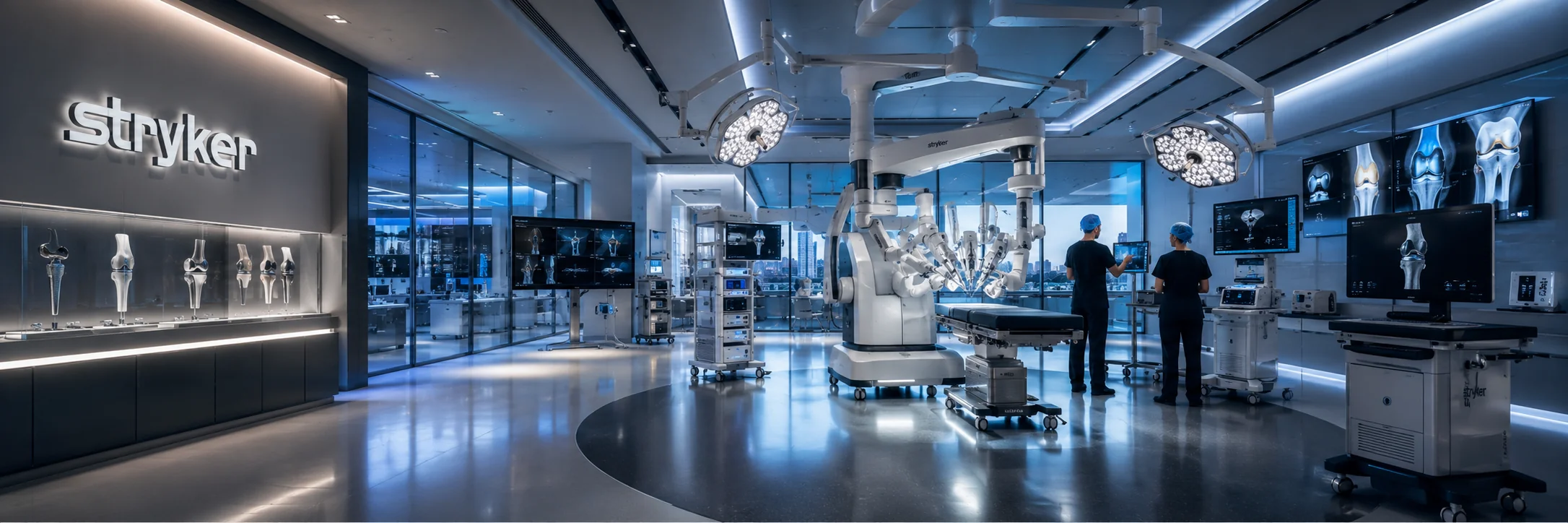
Surgeon preference item dynamics, robotic surgery training lock-in, and regulatory barriers create multiple reinforcing layers of switching costs that purchasing departments find extraordinarily difficult to overcome even when lower-cost alternatives exist.
A structural look at how a medical technology company built compounding switching costs through surgeon training, hospital workflow integration, and a robotic platform that deepens the moat with each procedure performed.
Introduction
Stryker (SYK) is one of the world's largest medical technology companies, with a portfolio spanning orthopedic implants, surgical equipment, neurotechnology, and spine products. The company generates over $20 billion in annual revenue and holds leading market positions across multiple device categories. These are facts that appear in every financial summary. What they do not explain is why Stryker's competitive position is so difficult to challenge.
The answer lies in a structural dynamic that operates largely invisible to financial statements: the surgeon preference item. In orthopedic surgery, the individual surgeon — not the hospital purchasing department, not the group purchasing organization, not the insurer — selects the implant system used in each procedure. This selection is driven by training, familiarity, and tactile confidence developed over hundreds of surgeries with a specific manufacturer's instruments and implant designs. A hospital administrator cannot simply substitute a cheaper knee implant the way a procurement team might switch paper towel suppliers. The surgeon's hands, muscle memory, and procedural workflow are calibrated to a specific system.
Understanding Stryker's arc requires seeing how this practitioner-level lock-in interacts with regulatory complexity, robotic surgery platforms, and an acquisition strategy that has expanded the company's footprint while reinforcing the structural core. The result is a competitive position that compounds rather than erodes — each additional surgeon trained, each Mako robot installed, each adjacent technology acquired adds another layer to an already formidable moat.
The Long-Term Arc
Stryker's development traces a path from focused orthopedic innovator to diversified medical technology platform, with each phase adding structural depth to the company's competitive position. The pattern is one of deliberate layering — building new switching costs on top of existing ones rather than replacing them.
How did Stryker grow from a surgeon's inventions (1941 to 2000s)?
Homer Stryker, an orthopedic surgeon in Kalamazoo, Michigan, founded the company in 1941 after inventing a turning frame for hospital beds and an oscillating saw for removing casts. This origin matters structurally: Stryker began as a surgeon solving problems for surgeons. The company's culture of clinical intimacy — understanding what surgeons actually need in the operating room — was established at its founding and has persisted for decades.
Through the second half of the twentieth century, Stryker built its orthopedic franchise around hip and knee replacement systems. The company invested heavily in surgeon education and training programs, creating a cadre of orthopedic surgeons who learned their craft on Stryker instruments and implants. Each training relationship created a long-term revenue stream: a surgeon who trained on Stryker's Triathlon knee system during residency and fellowship would use that system for potentially thirty years of practice. The upfront investment in training yielded decades of implant purchases — a payback period that rewarded patience and discouraged competitors from attempting to poach established surgeon relationships.
Why did Stryker acquire the Mako robotic platform (2000s to 2020)?
The 2013 acquisition of Mako Surgical for $1.65 billion marked a structural inflection point. At the time, Mako's robotic-arm assisted surgery platform was underperforming commercially and the acquisition was viewed skeptically by many analysts. Stryker saw something different: a technology layer that could be placed on top of the existing surgeon preference dynamic to create a second, reinforcing switching cost. A surgeon who preferred Stryker implants was already locked in at the product level. A surgeon who performed procedures using the Mako system was now locked in at both the product level and the technology level.
Simultaneously, Stryker pursued acquisitions that expanded beyond the orthopedic core. The $1.4 billion purchase of Trauson in 2013 added trauma products and China market access. The acquisition of Sage Products in 2016 added patient care disposables. The $5.4 billion purchase of Wright Medical in 2020 strengthened the extremities and biologics portfolio. Each acquisition followed a pattern: add adjacent capabilities that touch the same hospital relationships and surgical workflows rather than diversifying into unrelated medical fields. The company was building a broader platform while keeping the surgeon at the center of the structural equation.
How did the Mako platform deepen Stryker's moat (2020 to Present)?
The Mako platform has evolved from a skeptically received acquisition into the centerpiece of Stryker's competitive strategy. Over 2,500 Mako systems are now installed globally, and the platform has been extended from partial knee replacement to total knee and total hip procedures. Each Mako installation represents a multi-year commitment by the hospital — the system costs approximately $1 million to $1.5 million, requires dedicated operating room space and support staff, and generates recurring revenue through per-procedure fees and Stryker implant utilization.
The structural significance of Mako's expansion goes beyond the installed base economics. When a hospital installs a Mako system, it is making a platform commitment that affects surgeon recruitment and retention. Orthopedic surgeons increasingly expect robotic-assisted capabilities at their hospitals. A hospital with Mako can attract and retain surgeons who have trained on the platform; a hospital without it risks losing them to competitors who offer the technology.
This dynamic creates a circular reinforcement: surgeons want Mako, hospitals install Mako to attract surgeons, and the growing installed base makes Mako the default training platform for the next generation of orthopedic surgeons.