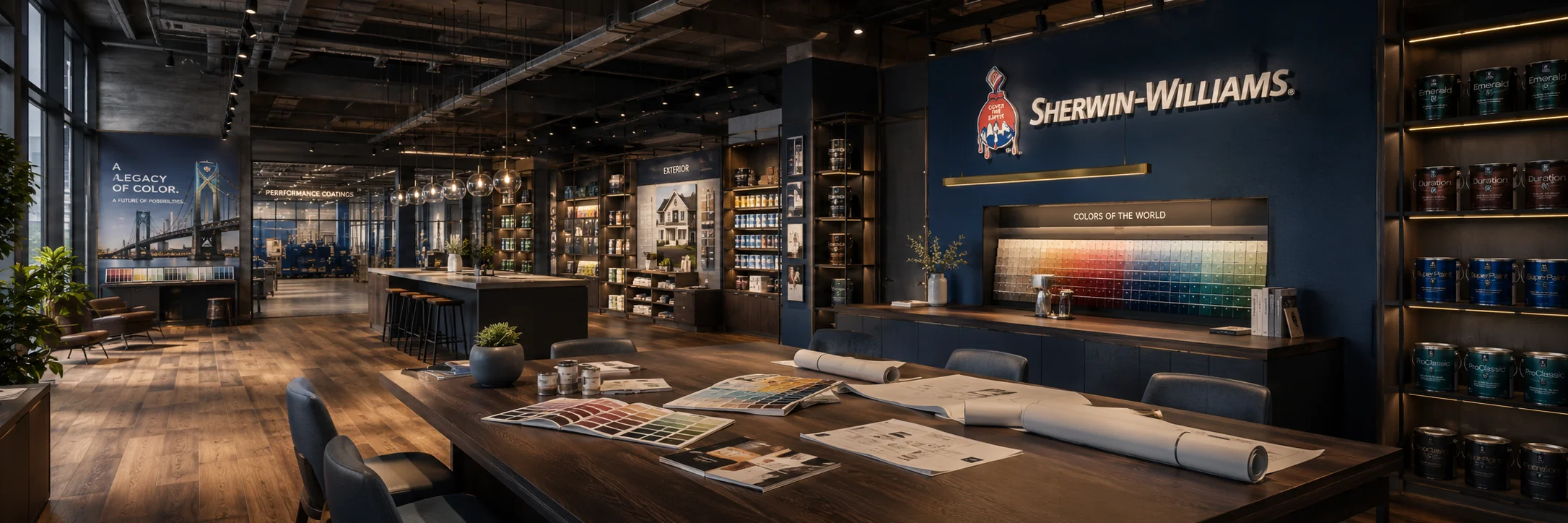
A company-owned retail network of nearly 4,800 stores creates a distribution and relationship infrastructure that locks in professional painters through convenience and consistency, generating switching costs rooted in workflow dependency rather than product differentiation.
A vertically integrated paint system where company-owned stores create a distribution moat that competitors cannot replicate through product alone.
Introduction
Sherwin-Williams (SHW) is the largest paint and coatings company in the world. This fact alone is instructive, because paint is not a glamorous industry. There are no network effects in the traditional sense, no winner-take-all platform dynamics, no exponential scaling curves. Yet Sherwin-Williams has built a structural position so durable that it has compounded value for over 150 years. The mechanism is not technological disruption or brand mystique. It is a vertically integrated distribution system — manufacturing linked directly to company-owned retail — that creates a feedback loop between the professional painter and the company that is extraordinarily difficult to replicate.
The company operates roughly 4,800 company-owned stores across North America, forming the largest specialty paint distribution network in existence. These stores do not primarily serve weekend homeowners browsing color swatches. They serve professional painters — contractors who buy paint repeatedly, in volume, under time pressure, and with exacting requirements for color consistency and product availability. The store network is the structural asset. It is the interface where Sherwin-Williams captures the professional relationship, and that relationship is where the moat actually resides.
Understanding Sherwin-Williams requires seeing the store network not as a retail operation but as a control system. Each store is a node in a distribution infrastructure that connects manufacturing capacity to the professional end user with minimal friction. The system optimizes for reliability, speed, and relationship continuity — not for the lowest shelf price. This distinction separates Sherwin-Williams structurally from competitors who distribute through third-party retailers and compete primarily on cost.
The Long-Term Arc
Sherwin-Williams' evolution traces a pattern of patient infrastructure building. The company did not stumble into its current position through a single acquisition or strategic pivot. It built its store network incrementally over decades, added manufacturing depth through vertical integration, and then consolidated the global coatings industry through the transformative Valspar acquisition. The arc is one of compounding structural advantage rather than dramatic reinvention.
What structural decision defined Sherwin-Williams from its founding (1866 – 1980)?
Sherwin-Williams was founded in Cleveland in 1866 by Henry Sherwin and Edward Williams. The company's earliest structural decision — one that would define its competitive position for the next century and a half — was to sell paint through its own retail outlets rather than relying exclusively on independent dealers or hardware stores. This was an unusual choice. Most paint manufacturers treated distribution as someone else's problem. Sherwin-Williams treated it as the core of the business.
The company-owned store model created several structural advantages that were invisible at small scale but compounded dramatically over time. Direct ownership meant Sherwin-Williams controlled the customer relationship, the product assortment, the pricing, the service level, and the local inventory. Store managers could build personal relationships with professional painters in their territory — learning their preferences, anticipating their needs, extending credit, and ensuring that specific products were in stock when jobs required them. This relationship density, replicated across thousands of locations, created an information and service advantage that no manufacturer distributing through third parties could match.
How did Sherwin-Williams turn store density into a switching cost (1980 – 2015)?
Through the 1980s and 1990s, Sherwin-Williams accelerated its store expansion across North America. The strategy was deliberate: saturate metropolitan markets with enough store density that no professional painter was more than a short drive from a Sherwin-Williams location. Convenience is a structural variable in the professional painting business. Contractors operate under tight schedules, moving between job sites, and the ability to pick up exactly the right product quickly — with confidence that the color match will be precise — is worth a premium. Sherwin-Williams' store density converted that convenience into a switching cost.
During this period, the professional painter channel became the gravitational center of the business. While competitors like PPG and Benjamin Moore pursued various distribution strategies — including selling through big-box retailers like Home Depot and Lowe's — Sherwin-Williams maintained its focus on the professional. Professional painters are structurally attractive customers: they buy in high volume, they buy frequently, they are less price-sensitive than consumers because paint cost is a small fraction of total job cost, and they develop product preferences that create habitual purchasing patterns.
Once a professional painter settles into a Sherwin-Williams store as their primary supplier, the switching costs are significant — not because of contracts, but because of learned convenience, color-match confidence, established credit terms, and personal relationships with store staff.
What did the Valspar acquisition do to Sherwin-Williams (2015 – Present)?
The 2017 acquisition of Valspar for approximately $11.3 billion was the most consequential structural event in Sherwin-Williams' modern history. Valspar was a major coatings company with particular strength in industrial, packaging, and international markets — segments where Sherwin-Williams had historically been less present. The acquisition transformed Sherwin-Williams from a North American paint powerhouse into a global coatings company with operations spanning architectural paint, industrial coatings, automotive finishes, packaging coatings, and protective and marine applications.
The integration of Valspar expanded Sherwin-Williams' addressable market significantly while adding manufacturing capabilities and geographic reach that the company's organic store-by-store expansion could not have achieved within any reasonable timeframe. Critically, the acquisition diversified revenue streams beyond the architectural paint market — adding industrial and specialty coatings businesses with different demand drivers and customer bases. The combined entity operates across three segments: The Americas Group (the store network), the Consumer Brands Group (products sold through third-party retailers), and the Performance Coatings Group (industrial, automotive, and specialty coatings). This three-segment structure distributes risk while maintaining the company-owned store network as the highest-margin, most structurally advantaged business within the portfolio.