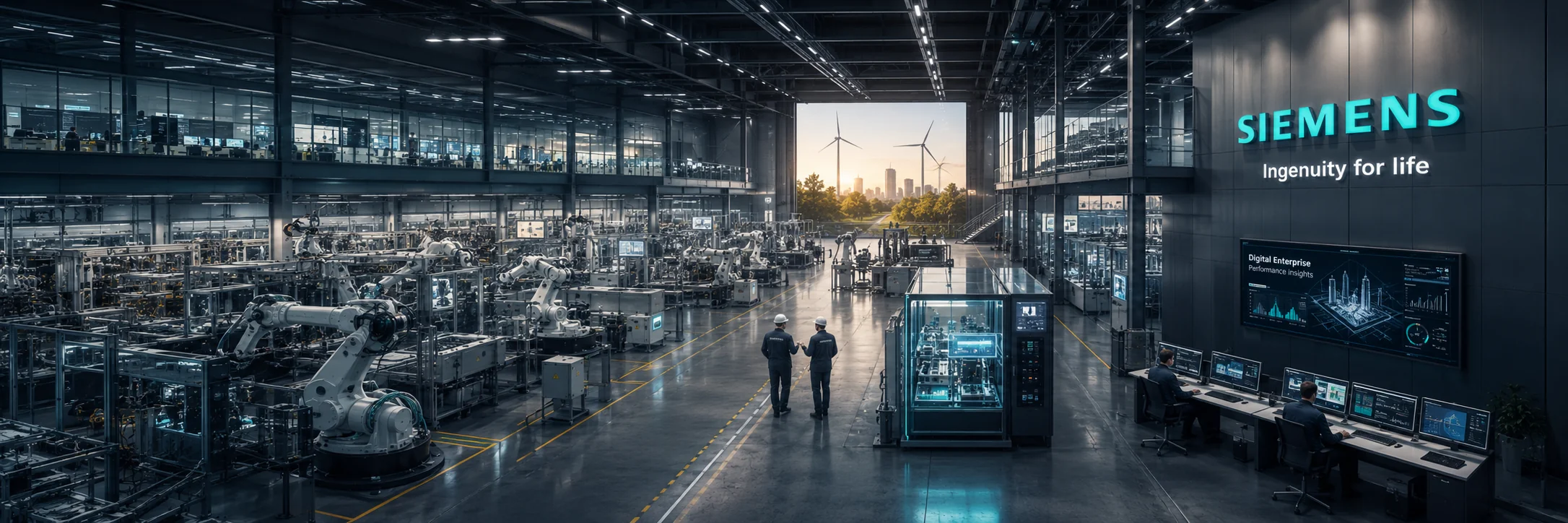
Deliberate portfolio reshaping through spin-offs and divestitures reveals that the structural costs of managing diverse industrial businesses eventually exceed the benefits of centralized ownership, concentrating the remaining entity on businesses where industrial and digital capabilities compound.
A structural look at how a European industrial conglomerate reshaped its portfolio to resolve the tension between breadth and focus.
Introduction
Siemens (SIEGY) makes infrastructure work. Power grids, factory automation systems, building management technology, rail signaling, medical imaging equipment — the company's products operate at the foundational layer of industrial economies. Most people encounter Siemens technology daily without recognizing it. The trains run, the factories produce, the hospitals diagnose — and Siemens equipment is embedded in each of these systems.
The company's arc spans nearly two centuries, beginning with telegraph technology in the 1840s and extending through electrification, industrialization, digitalization, and now the reshaping of energy systems. Across this history, one structural theme recurs: the tension between conglomerate breadth — which provides resilience, cross-business knowledge transfer, and scale — and focused competition, which demands undivided capital and management attention. Siemens has navigated this tension more deliberately than most industrial conglomerates, choosing portfolio surgery over fragmentation.
Understanding Siemens reveals patterns about how diversified industrial businesses accumulate complexity, how that complexity interacts with the competitive demands of individual markets, and how portfolio reshaping — through spin-offs rather than fire sales — can release structural value that the conglomerate form suppresses.
The Long-Term Arc
How did Siemens begin with the telegraph?
Siemens was founded in 1847 by Werner von Siemens, an inventor whose pointer telegraph improved on existing designs. The company laid telegraph lines across Europe and into Asia, building infrastructure that connected economies and governments. This foundational business established a pattern that would persist: Siemens supplied the systems that other institutions depended upon to function.
As electrical technology advanced, Siemens expanded into power generation, electric lighting, and electric railways. The company built the first electric streetcar, supplied dynamos to power plants, and wired buildings for electricity. Each expansion followed a structural logic — electrical engineering was a platform capability, and adjacent applications of that capability created new business lines without requiring fundamentally new expertise.
How did Siemens grow into a sprawling conglomerate?
Through the twentieth century, Siemens expanded into medical equipment, telecommunications, automotive components, semiconductors, and industrial automation. Two world wars disrupted operations, destroyed facilities, and forced rebuilding. Each reconstruction broadened the company's scope as post-war demand pulled Siemens into new domains. The conglomerate grew through a combination of deliberate strategy and historical circumstance.
By the late twentieth century, Siemens operated across energy generation, power transmission, healthcare imaging, factory automation, building technology, rail systems, telecommunications, and financial services. The breadth was extraordinary. Each business served different customers, faced different competitors, and operated on different investment cycles. The unifying thread was electrical and electronic engineering — but the competitive dynamics of medical imaging equipment bear little resemblance to those of gas turbines or rail signaling systems.
Why did Siemens's conglomerate breadth become a strain?
The structural challenge of managing this breadth intensified as individual markets became more competitive. Factory automation required competing against focused Japanese and American specialists. Healthcare imaging required competing against GE Healthcare and Philips. Power generation required competing against GE Power and Mitsubishi. Each market demanded increasing capital investment, specialized talent, and management attention. The conglomerate structure spread these resources across too many fronts.
Compliance failures — including a bribery scandal that resulted in substantial penalties in the late 2000s — revealed how organizational complexity could exceed oversight capacity. The issue was structural rather than moral: a company operating in dozens of countries across dozens of business lines faced monitoring challenges that more focused enterprises did not. Complexity itself was a risk factor.
How did Siemens reshape its portfolio?
Siemens responded not with a sudden breakup but with deliberate portfolio surgery conducted over more than a decade. Telecommunications was divested. The semiconductor business became Infineon. The lighting business became Osram. Healthcare became Siemens Healthineers — listed as a separate public company with Siemens retaining a majority stake. The energy business — gas turbines, wind power, power transmission — became Siemens Energy, also publicly listed.
Each separation followed a structural logic: the divested business faced competitive dynamics that differed from Siemens's core industrial automation and infrastructure focus. Healthcare required pharmaceutical-adjacent R&D investment cycles. Energy required navigating a generational transition from fossil fuels to renewables. Both demanded capital and strategic attention that competed with the remaining industrial businesses for priority within the conglomerate.
What does the narrower Siemens focus on?
The Siemens that remains after these separations is substantially narrower: industrial automation, smart infrastructure, rail systems, and the digital platforms that connect them. The company has invested heavily in software for industrial operations — product lifecycle management, manufacturing execution systems, building management, and the digital twin concept that creates virtual models of physical systems.
This focus represents a structural bet that the digitalization of industrial operations — sometimes labeled Industry 4.0 — creates value at the intersection of physical infrastructure and software intelligence. Siemens occupies a position where decades of domain expertise in how factories, buildings, and grids actually work converges with software platforms that optimize those operations. The question is whether this intersection proves more valuable as a focused enterprise than it was embedded within a broader conglomerate.