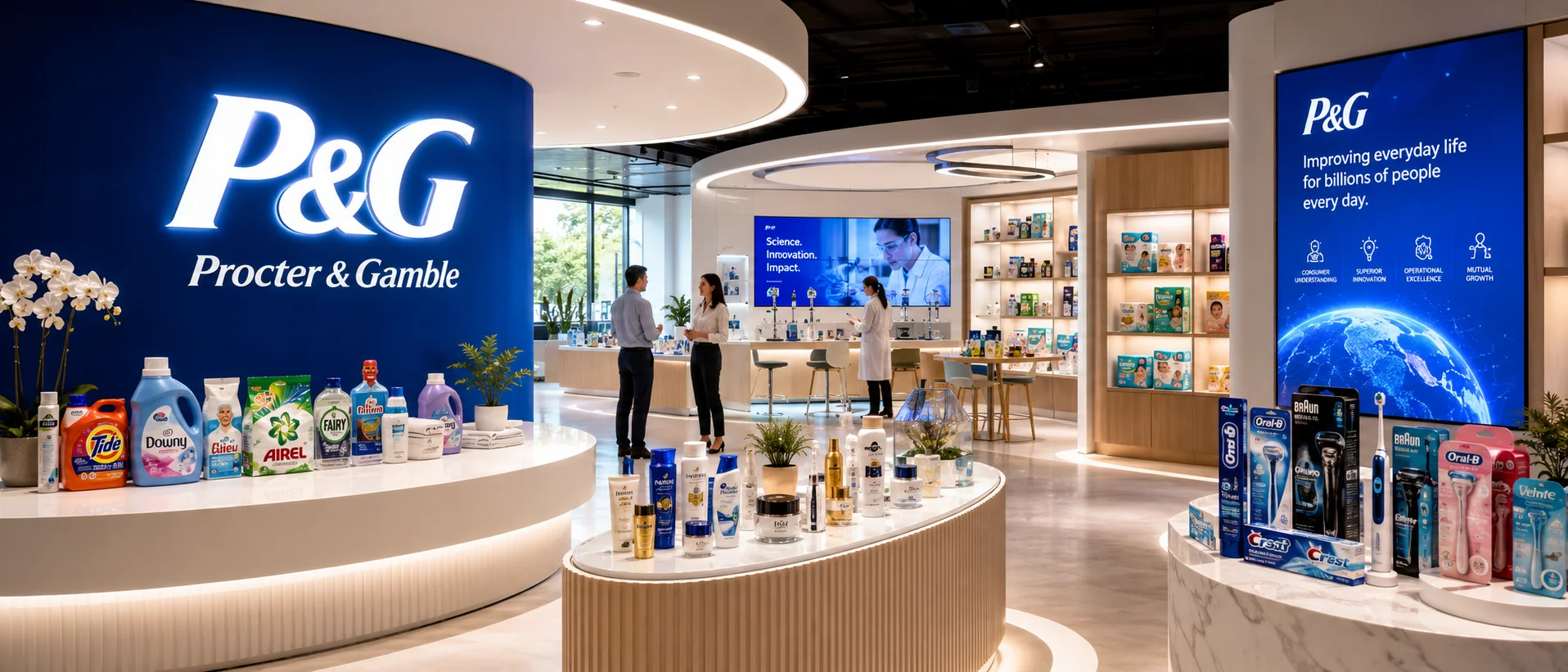
The brand management system organizes competition at the category level rather than the corporate level, creating a portfolio where each brand defends its own market position while shared supply chain and R&D infrastructure provide scale advantages invisible to consumers.
A structural look at how a consumer products company turned brand management into a replicable system that makes category leadership self-reinforcing.
The Brand Management System
Procter & Gamble (PG) is commonly described as a consumer goods company. Structurally, it is a brand management system — an organizational machine that creates, positions, and sustains brands across categories where the underlying goods are functionally similar. The company has held category-leading positions in laundry detergent, toothpaste, diapers, and razors for decades. The explanation is not product superiority but the structural system that connects brand identity, distribution, and consumer habit into a self-reinforcing position.
P&G's arc is instructive because it reveals how competitive advantage functions in categories where product differentiation is modest. When the physical product can be approximated by competitors, the durable advantage shifts to the system around the product: brand recognition that drives trial, distribution relationships that ensure availability, advertising scale that maintains awareness, and consumer habits that resist switching. These system-level properties are more defensible than any formulation or feature.
Understanding P&G's trajectory requires examining how brand management works as an organizational structure, how multi-brand strategies function within single categories, how global expansion replicates brand positions across geographies, and what happens when the structural logic of brand proliferation encounters the structural logic of portfolio focus.
The Long-Term Arc
Why did a candle maker and a soap maker combine forces?
Procter & Gamble was founded in 1837 in Cincinnati by William Procter, a candle maker, and James Gamble, a soap maker. The partnership was pragmatic — both businesses competed for the same raw material, animal fat, and combining operations reduced that competition. The company's earliest structural advantage was geographic: Cincinnati sat at the intersection of river trade routes and meatpacking operations that provided abundant raw material supply.
The Civil War provided P&G's first demonstration of how institutional scale creates market position. Government contracts for soap and candle supply to Union soldiers exposed millions of men to P&G products. When those soldiers returned home, they carried brand familiarity with them — an early instance of the recognition-distribution-habit feedback loop that would define P&G's competitive model for the next century and a half. The company was building distribution through institutional exposure before the concept of brand marketing existed.
Ivory soap, introduced in 1879, was P&G's first nationally marketed branded product. The "99 and 44/100% pure" claim and the soap's ability to float were product characteristics elevated into brand identity through sustained advertising. Ivory demonstrated a structural principle that P&G would exploit across every subsequent category: in markets where products are functionally similar, the brand that establishes a distinctive identity first captures a position that competitors find difficult to displace.
Where did the brand management system come from?
In 1931, Neil McElroy — then a junior marketing manager, later P&G's CEO and eventually U.S. Secretary of Defense — wrote a memo proposing that each brand be managed by a dedicated team responsible for its positioning, advertising, and market performance. This memo is widely credited as the origin of the brand management system that became the standard organizational model for consumer products companies worldwide.
The structural implications were profound. Brand management transformed marketing from a centralized corporate function into a distributed, competitive system. Each brand team operated as a quasi-independent business unit, responsible for its brand's success and measured against both external competitors and other P&G brands in the same category. Tide competed with external detergent brands but also, structurally, with P&G's own Cheer and Gain. This internal competition created a selection mechanism: brands that could not sustain a distinct position within P&G's own portfolio were unlikely to sustain one in the broader market.
The brand management system also created a talent development machine. Brand managers made real decisions with real consequences early in their careers. The system produced general managers with experience in strategy, marketing, operations, and competitive analysis. P&G became a net exporter of management talent to other consumer products companies — a structural indicator that the organizational system was producing capability beyond what the company itself could absorb.
How does P&G operate multiple brands in one category?
P&G's most distinctive structural choice was operating multiple brands within the same product category. In laundry detergent alone, P&G maintained Tide, Gain, Cheer, Era, and other brands simultaneously. Each brand targeted a different consumer segment — premium performance, value, fragrance emphasis, gentle formulation — but all were manufactured and distributed by the same company. The strategy appears counterintuitive: why compete against yourself?
The structural logic is precise. Shelf space in retail stores is finite. Every linear foot occupied by a P&G brand is a foot unavailable to competitors. Multiple brands across a category increase P&G's aggregate shelf presence, distribution leverage with retailers, and consumer capture rate. A consumer who rejects Tide might choose Gain rather than a competitor's product. The multi-brand strategy converts category-level market share into something approaching structural control of the category's retail presence.
This approach also provided a hedging function. Consumer preferences shift — between premium and value, between performance claims and emotional positioning. A multi-brand portfolio can accommodate these shifts without repositioning any individual brand. Tide remains the performance leader. Gain owns the fragrance position. Each brand maintains a stable identity while the portfolio collectively adapts to shifting demand. The system is more flexible than any individual brand could be.
How did P&G replicate its brands across global markets?
P&G's international expansion followed a structural template: establish a category-leading brand in the U.S. market, then replicate that brand's positioning in new geographies. Tide, Pampers, Gillette, Crest, and other brands were introduced to international markets using the same brand management system that had proven effective domestically. The approach leveraged global advertising scale — campaigns developed for one market could be adapted for others — and global R&D investment that no local competitor could match.
The template was not universally successful. Markets with established local brands, different consumer habits, or distinct regulatory environments sometimes resisted the replication model. P&G's experience in Japan — where the company struggled for years against established local competitors before eventually building strong positions — illustrated the limits of assuming that brand positions are directly transferable across cultures. The system worked best when consumer need states were similar across geographies and when P&G could leverage its advertising and distribution scale against smaller local competitors.
By the early twenty-first century, P&G operated in over 180 countries with a portfolio of brands that generated billions in revenue across fabric care, home care, baby care, grooming, health care, and beauty. The geographic diversification provided revenue stability — currency effects aside — and exposure to growth in developing economies where rising household incomes expanded the addressable market for branded consumer products.
What did the Gillette acquisition add to P&G?
P&G's acquisition of Gillette in 2005 for approximately $57 billion was the largest transaction in consumer products history at the time. The structural logic extended beyond adding razors to P&G's product lineup. Gillette's brand portfolio — including Gillette razors, Oral-B dental care, Duracell batteries, and Braun appliances — occupied category-leading positions in markets where P&G had limited presence. The acquisition added categories with high consumer loyalty, recurring purchase patterns, and premium pricing power.
The razor business in particular exhibited structural properties that aligned with P&G's model. Razor handles function as platforms that lock consumers into proprietary blade systems. Blades are high-margin consumables purchased repeatedly. Brand loyalty in grooming is reinforced by habit and switching costs — learning a new shaving system carries enough inconvenience to sustain existing brand relationships. These dynamics produced stable, high-margin revenue streams that P&G's distribution and brand management capabilities could amplify globally.
The Gillette acquisition also revealed the limits of portfolio expansion. Duracell was divested in 2014 — a recognition that batteries occupied a different competitive structure than P&G's core categories. The divestiture illustrated a structural principle: not every category-leading brand benefits from inclusion in a consumer products portfolio. The synergies between razors and laundry detergent are distribution-level, not product-level. When distribution synergies are insufficient to justify portfolio complexity, separation creates more value than combination.
Why did P&G cut roughly 100 brands from its portfolio?
Between 2014 and 2017, P&G executed a substantial portfolio reduction, divesting or discontinuing approximately 100 brands to focus on roughly 65 core brands across 10 product categories. The brands retained were category leaders or strong second-position brands with structural advantages in their categories. The brands divested were those occupying weaker competitive positions where P&G's scale advantages were insufficient to generate adequate returns.
This pruning acknowledged a structural tension inherent in the multi-brand strategy. Each brand requires management attention, marketing investment, and distribution capacity — resources that are finite. As the portfolio grew through decades of brand creation and acquisition, the marginal return on each additional brand declined. Some brands occupied positions so narrow or so weakly defended that the organizational cost of maintaining them exceeded their contribution. The portfolio reduction concentrated resources on brands where P&G's structural advantages — scale, distribution, consumer insight — could generate the highest returns.
The focused portfolio strategy produced measurable results. Organic growth improved. Market share in core categories stabilized or increased. The structural logic was confirmed: in brand management, concentration of resources on strong positions generates better outcomes than diffusion across marginal ones. The system that had built value through brand proliferation eventually reached the point where it built more value through brand concentration.