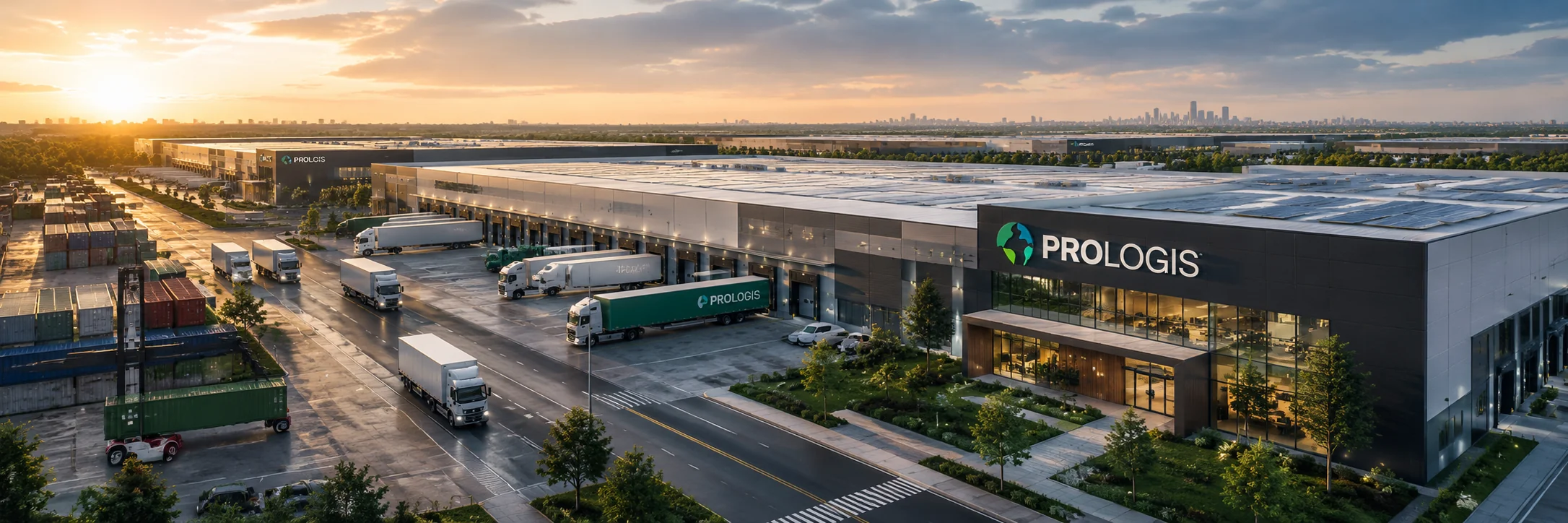
Positioning logistics real estate at the intersection of global supply chains and e-commerce infrastructure creates a development-to-hold flywheel where rising replacement costs, declining vacancy, and embedded rent escalators compound the value of properties that cannot be quickly replicated.
A structural look at how an industrial warehouse operator became the indispensable physical layer of global e-commerce and supply chain infrastructure.
The Logistics Infrastructure
Prologis (PLD) is commonly classified as an industrial REIT. That label obscures the structural reality. Prologis does not merely own warehouses — it operates the dominant physical network through which a substantial share of global commerce flows. With approximately 1.2 billion square feet of logistics facilities across 19 countries, the company estimates that 2.8% of global GDP passes through its buildings every year. This is not a landlord in the traditional sense but infrastructure, as essential to the modern economy as fiber optic cables or electrical grids.
The distinction between landlord and infrastructure matters because it determines how the business compounds. A landlord collects rent on a fixed set of assets. An infrastructure platform captures value from the structural reorganization of how goods move through the economy. The shift from brick-and-mortar retail to e-commerce does not merely increase demand for warehouse space — it fundamentally changes the type of space required, the optimal locations, and the services embedded within it. E-commerce fulfillment requires approximately three times the warehouse square footage per dollar of revenue compared to traditional retail distribution. It demands modern, high-clear-height facilities optimized for automation, proximity to population centers for last-mile delivery, and increasingly, embedded energy infrastructure and technology systems.
Prologis has positioned itself at every node of this transformation: last-mile delivery hubs near population centers, mega-distribution facilities along logistics corridors, and the energy and technology infrastructure that modern fulfillment operations demand through its Essentials platform.
Understanding Prologis requires looking beyond occupancy rates and rental spreads — though both tell important structural stories — to the deeper forces that make logistics real estate a compounding asset class in ways that office buildings, shopping malls, and apartment complexes are not. The secular growth of e-commerce, the increasing complexity and regionalization of global supply chains, the steadily rising replacement cost of modern warehouse facilities, and the irreversible scarcity of well-located land near major population centers all converge to create a demand environment that Prologis is uniquely positioned to serve. The company's four-decade arc — from a small San Francisco investment firm to the largest industrial REIT in the world — reveals how patient capital deployment in an unglamorous asset class, combined with disciplined development, strategic consolidation, and global scale, can produce one of the most durable competitive positions in modern real estate.
The Long-Term Arc
Why does Prologis have two parallel origins (1983 – 1998)?
The Prologis that exists today is the product of two distinct corporate lineages that evolved independently for nearly three decades before merging. Understanding both is necessary because the combined company inherited specific structural strengths from each — and the tension between their different philosophies shaped the merged entity's identity.
The first lineage began in 1983 when Hamid Moghadam and Doug Abbey founded Abbey, Moghadam and Company, a real estate investment management firm based in San Francisco. The firm initially managed diversified real estate portfolios for institutional investors — office buildings, shopping centers, and industrial properties. T. Robert Burke joined the following year, and the business became AMB Property Corporation. Through the late 1980s and early 1990s, AMB progressively narrowed its focus. The firm shed its office and retail holdings and concentrated exclusively on industrial logistics facilities, particularly those located near major airports, seaports, and highway interchanges. The insight was that logistics-oriented industrial real estate, while lacking the prestige of office towers or the foot traffic of malls, offered a combination of stable demand, low tenant turnover, and structural growth characteristics that other property types could not match.
AMB went public in 1997 and established a clear identity: a disciplined, financially conservative operator focused on high-barrier coastal markets. The company's portfolio concentrated on infill locations in markets like San Francisco, Los Angeles, New York/New Jersey, and Miami — places where land scarcity and transportation infrastructure created natural constraints on new supply. AMB's approach emphasized quality over quantity: fewer markets, better locations, higher rents per square foot, and a balance sheet that prioritized financial flexibility over aggressive growth. Moghadam's operating philosophy — patient, data-driven, and allergic to excessive leverage — would prove decisive in the company's eventual trajectory.
The second lineage traces to William Sanders, a real estate entrepreneur who formed Security Capital Industrial Trust (SCI) in 1991. SCI went public in 1994 with 16.1 million square feet of industrial property across 16 cities. Where AMB was focused and conservative, SCI — which rebranded as ProLogis Trust in 1998 — was expansionist and global. ProLogis pursued scale relentlessly. By the late 1990s, the company was active in 84 markets across 12 countries, with a market capitalization approaching $5 billion. ProLogis entered Japan in 2001 and China in 2003, building an international portfolio that no competitor in industrial real estate could approach. The company acquired Meridian Industrial Trust for $862.5 million in 1998 and was added to the S&P 500 in 2003.
ProLogis also developed a complex fund management structure, co-investing with institutional partners through property funds that allowed the company to earn management fees while deploying capital beyond its own balance sheet. This structure amplified returns in good times but added layers of complexity that would prove problematic when conditions deteriorated. By the mid-2000s, ProLogis was the largest owner of industrial real estate globally — a genuine global logistics platform — but its aggressive expansion had been funded with significant leverage and its fund structures created obligations that reduced flexibility.
What did the financial crisis expose at ProLogis (2007 – 2010)?
The 2008 financial crisis exposed the structural fragility of ProLogis's leveraged expansion model with brutal clarity. The company had accumulated substantial debt to fund its global development pipeline and property fund commitments. When credit markets seized, property values plummeted, and transaction volumes evaporated, ProLogis faced a liquidity crisis that threatened the enterprise. The company was forced to cut its dividend by 50% — a devastating signal for a REIT whose investors depended on income — sell assets at depressed valuations, raise equity at dilutive prices, and restructure its balance sheet. The stock price fell from above $70 per share in 2007 to below $5 in early 2009. Billions of dollars of shareholder value evaporated.
AMB, with its more conservative financial structure and concentrated portfolio, weathered the crisis with significantly less damage. The company maintained its dividend and emerged from the downturn with its balance sheet largely intact. The contrast between the two companies was instructive and would shape the philosophy of the merged entity. Both companies owned high-quality logistics assets with strong long-term demand characteristics. The difference was not in the quality of the real estate but in the capital structure overlaying it. Leverage amplified both the upside of expansion and the downside of contraction. ProLogis's global reach was genuinely valuable — the portfolio contained irreplaceable assets in critical logistics markets worldwide — but the financial architecture built to assemble it had proven dangerously fragile.
The crisis created the conditions for the merger that would follow. ProLogis needed AMB's financial discipline, conservative balance sheet philosophy, and operational focus. AMB, for its part, could benefit from ProLogis's unmatched global footprint and the scale advantages that came with being the largest industrial owner worldwide. The distress of 2008-2009 made what had previously been an unlikely combination — two proud, independent companies merging as equals — both feasible and strategically compelling.
What did the AMB-ProLogis merger of equals create (2011)?
In January 2011, AMB Property Corporation and ProLogis announced a definitive agreement to merge. The transaction closed in June, creating the largest industrial real estate company in the world. The combined entity, which retained the Prologis name and traded under the PLD ticker, had a pro forma equity market capitalization of approximately $14 billion, a total market capitalization exceeding $24 billion, and gross assets owned and managed of approximately $46 billion. The portfolio encompassed roughly 600 million square feet of distribution facilities across 22 countries — a scale of logistics real estate ownership that was unprecedented and, as it would turn out, essentially unreplicable.
Hamid Moghadam, AMB's co-founder, became chairman and CEO of the combined company. This was more than a personnel decision — it was a structural signal. Moghadam's operating philosophy — financial discipline, quality-focused portfolio management, and a preference for measured growth over aggressive expansion — would guide the merged entity. The integration process reflected this philosophy. The combined company rationalized overlapping market positions, sold non-core assets, simplified the complex fund management structures that ProLogis had accumulated, and systematically reduced leverage. Within three years, the merged Prologis had a cleaner balance sheet, a more focused portfolio, and a clearer strategic identity than either predecessor had possessed independently.
The merger also achieved something that no amount of organic growth could have replicated: the elimination of the most capable direct competitor in global logistics real estate. Before the combination, AMB and ProLogis competed for the same tenants, the same development sites, and the same institutional capital. After the merger, no other REIT possessed comparable scale, geographic diversity, development capability, and market penetration. This structural consolidation did not create a monopoly — logistics real estate remains a fragmented market with thousands of local and regional owners — but it created a platform so far ahead of the next largest competitor that the gap has continued widening rather than narrowing in the years since.
How did e-commerce transform demand for Prologis (2012 – 2019)?
The post-merger years coincided with — and were profoundly shaped by — the explosive growth of e-commerce fulfillment infrastructure. This timing was fortunate, but the positioning was deliberate. Prologis's management had recognized earlier than most that the migration of retail spending from physical stores to online channels would permanently alter the demand curve for logistics real estate. The structural logic was straightforward and powerful: every dollar that shifted from in-store purchase to home delivery required a fundamentally different physical infrastructure, and that infrastructure centered on the modern warehouse.
Traditional retail distribution was relatively simple. Goods moved from manufacturer to regional distribution center to retail store, and the customer's final leg of transportation was their own car. E-commerce inverted this model entirely. Every individual order required picking from inventory, packing for shipment, and last-mile delivery to a specific address. The logistics footprint required to support online retail was not incrementally larger — it was structurally different. Industry estimates suggested that fulfilling one billion dollars of e-commerce sales required approximately three times the warehouse space of one billion dollars of brick-and-mortar retail sales. Moreover, e-commerce demanded a different kind of warehouse: modern, high-clear-height facilities (36 feet or more) that could accommodate automation equipment, mezzanine levels, and the complex sorting systems that efficient order fulfillment required.
Amazon (AMZN) became the most visible embodiment of this demand shift and Prologis's single largest tenant. As Amazon constructed its massive fulfillment network — from large regional fulfillment centers to medium-sized sortation facilities to last-mile delivery stations — it leased millions of square feet from Prologis across multiple markets. Amazon's scale of logistics expansion was without precedent: the company added more warehouse space in 2020 and 2021 than most industrial REITs owned in total. But Amazon's impact on Prologis extended beyond direct leasing. Amazon's delivery speed standards — same-day, next-day, two-day — established consumer expectations that forced every other retailer to invest in comparable logistics infrastructure. Walmart, Target, Home Depot, and hundreds of smaller retailers all expanded their warehouse footprints to compete. Third-party logistics providers, parcel carriers, food delivery services, and direct-to-consumer brands added further demand. The entire retail economy was reorganizing its physical infrastructure, and Prologis — with its portfolio concentrated in the highest-demand markets and its development pipeline capable of building the purpose-designed facilities that modern fulfillment required — captured a disproportionate share of this generational shift.
The e-commerce transformation also created an increasingly sharp distinction between modern and obsolete warehouse space. Older facilities built in the 1970s, 1980s, and 1990s — with low ceiling heights, inadequate power infrastructure, and locations chosen for manufacturing proximity rather than last-mile delivery efficiency — became functionally obsolete for e-commerce operations. Tenants were willing to pay significant premiums for modern, high-clear-height buildings in infill locations that could support same-day and next-day delivery. This quality bifurcation in the warehouse market worked powerfully in Prologis's favor. The company's portfolio, weighted toward modern facilities in the most supply-constrained markets, commanded — and continues to command — rent premiums that widen as the gap between modern and obsolete logistics space grows.
What did the pandemic surge do to Prologis (2020 – 2022)?
The COVID-19 pandemic compressed years of e-commerce adoption into months. Stay-at-home orders, store closures, and health concerns drove consumers online at rates that exceeded even the most optimistic industry projections. E-commerce penetration in the United States jumped from roughly 16% of total retail sales in early 2020 to over 20% within months — a leap that would have taken three to four years under normal adoption curves. Retailers scrambled to secure warehouse capacity to fulfill surging online demand. Logistics real estate vacancy rates plummeted to historic lows — below 4% nationally and below 2% in the tightest markets like Southern California and New Jersey.
For Prologis, the pandemic created an extraordinary mark-to-market opportunity. The gap between what existing tenants were paying under legacy leases signed years earlier and what the current market would bear on renewal or new leasing expanded to levels that no one in industrial real estate had previously considered possible. Net effective rent changes on new and renewed leases routinely exceeded 30%, 40%, and in some markets 50%. These were not marginal rent increases — they were step-function resets that reflected the yawning chasm between pre-pandemic lease rates and the post-pandemic reality of constrained supply and insatiable demand. Every lease that rolled to market represented a substantial increase in cash flow without any incremental capital investment. The embedded rent upside across the portfolio became one of the most significant value drivers in the entire REIT sector — a reservoir of future earnings growth already built into the existing asset base.
Prologis used the period's strength to consolidate its market position further. In June 2022, the company announced the acquisition of Duke Realty in an all-stock transaction valued at approximately $26 billion, including the assumption of debt. Duke Realty's portfolio comprised 142 million square feet of logistics buildings across approximately 480 facilities in 19 major U.S. markets — Southern California, New Jersey, South Florida, Chicago, Dallas, Atlanta, and others. The acquisition also included 7 million square feet of buildings under development and approximately 17 million square feet of developable land. Prologis planned to retain approximately 94% of Duke Realty's assets, consistent with its development-to-hold philosophy. The transaction deepened Prologis's already dominant domestic footprint, expanded its land bank for decades of future development, and reinforced the competitive moat that scale provides in a market where the largest tenants prefer working with the largest landlord.
How did the logistics market normalize after the pandemic (2023 — Present)?
The post-pandemic period brought a normalization that tested investor patience but did not alter the underlying structural position. The frenzied demand of 2020-2022 had pulled forward years of absorption. Tenants who had scrambled for space during the pandemic had built safety stock inventories and signed leases to secure capacity they would grow into over time. Simultaneously, the elevated rents and near-zero vacancy of the boom years had stimulated a significant construction response — developers broke ground on new warehouse projects in markets across the country, responding rationally to extraordinary market signals. As this new supply delivered into a market where demand had moderated from its pandemic peak, vacancy rates rose from historic lows toward more typical levels. National industrial vacancy climbed from below 4% toward 6-7%, with some markets experiencing sharper increases. Rent growth decelerated from the extraordinary pace of 2021-2022 to more moderate levels.
Rising interest rates added a second headwind. As central banks raised rates to combat inflation, the capitalization rates that the market applied to real estate assets expanded, compressing valuations. For a company like Prologis — whose development pipeline required significant capital, whose properties were valued as long-duration cash flow streams sensitive to discount rate changes, and whose REIT structure required distributing at least 90% of taxable income as dividends — higher rates represented both a direct cost increase and a meaningful valuation headwind. The cost of debt financing rose, the present value of future rental streams declined in the eyes of the market, and the retained capital available for development investment was constrained by distribution requirements.
Yet the underlying structural advantages remained intact beneath the cyclical noise. Prologis's in-place rents still sat substantially below market rates — the company estimated its full-year mark-to-market opportunity at approximately 18% across the portfolio, representing close to $800 million of incremental net operating income not yet reflected in current earnings. This embedded upside would be unlocked lease by lease, year by year, as existing contracts expired and reset to prevailing market rates. The development pipeline continued generating value as completed projects leased at rates significantly above the company's development cost basis. And the long-term demand drivers — continued e-commerce penetration growth, supply chain nearshoring and regionalization, the ongoing obsolescence of aging warehouse stock, and the fundamental scarcity of infill land near population centers — continued operating regardless of short-term vacancy fluctuations.
The normalization period also saw Prologis accelerate its evolution from pure real estate owner to logistics platform operator through its Essentials business. Prologis Essentials provides a range of services to tenants beyond the physical space itself: rooftop solar installations that can supply up to 80% of a tenant's electricity needs, LED lighting retrofits, fleet electrification solutions including EV charging infrastructure for delivery trucks and yard equipment, workforce solutions, and operational technology. The Essentials model operates on an infrastructure-as-a-service basis — no upfront capital expenditure for tenants, with costs recovered through ongoing service fees. This platform extension deepens the landlord-tenant relationship, creates switching costs beyond the lease itself, and generates incremental revenue per square foot that leverages the existing physical footprint without requiring additional real estate investment. The strategy parallels the approach taken by Digital Realty in data centers, where interconnection and service overlays transform a real estate asset into an integrated infrastructure platform.