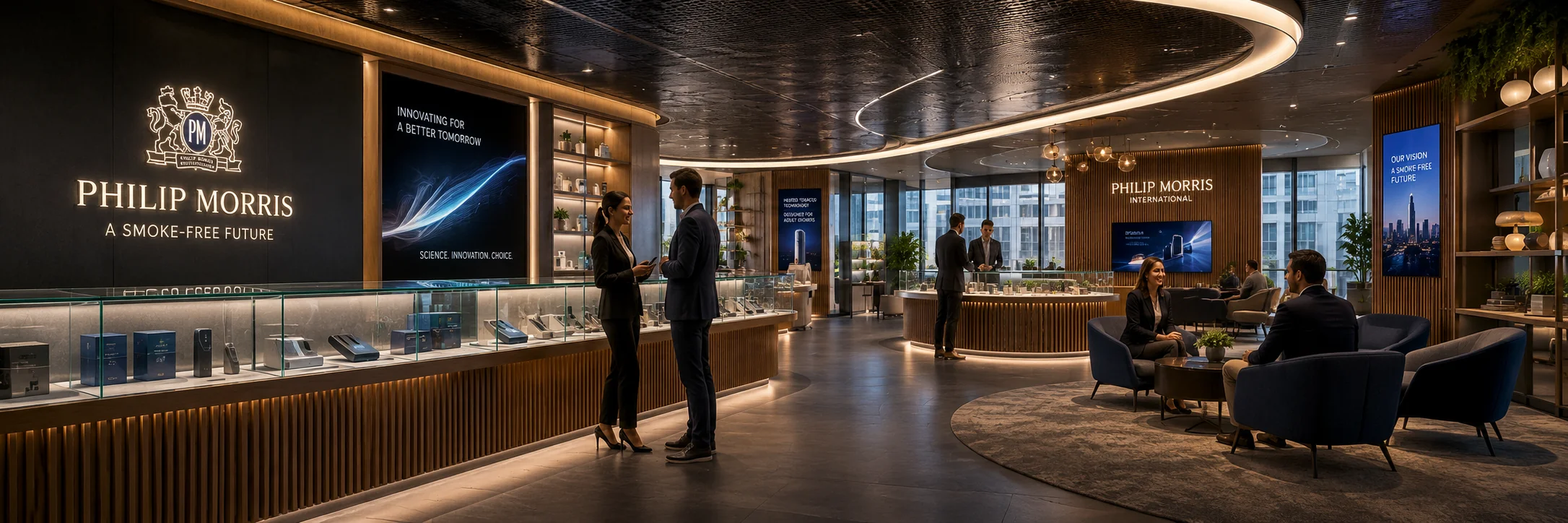
Attempting to replace cigarette revenue with heated tobacco and nicotine alternatives represents one of the most structurally ambitious self-disruptions in consumer goods history, where the transition timeline determines whether declining combustible volumes are replaced before they erode the financial base that funds the transition.
A structural look at how a tobacco company funds the displacement of its own core product — using cigarette cash flows to build the smoke-free alternatives intended to replace them.
The Self-Disruption Tension
Philip Morris International (PM) is commonly understood as a tobacco company. Structurally, it is something more unusual: a company that derives the vast majority of its cash flow from an addictive combustible product sold across more than 180 markets, while simultaneously investing billions to replace that product with alternatives that may not replicate the same economic characteristics. This dual identity — incumbent and disruptor of itself — defines the company’s financial behavior, strategic positioning, and long-term trajectory.
The company came into existence on March 28, 2008, when Altria Group (MO) spun off its international tobacco operations. The logic was structural separation: Altria would retain the U.S. cigarette business — Marlboro domestic, the regulatory burden, and the litigation exposure that defined American tobacco. Philip Morris International would operate free from U.S. legal entanglements, serving international markets where regulation ranged from stringent to nearly absent and where pricing power could be exercised under different constraints. The spinoff was not financial engineering but a recognition that the two businesses operated under fundamentally different structural conditions, and combining them obscured the economics of both.
Understanding Philip Morris International requires examining several structural dynamics simultaneously: the economics of addictive products and the pricing power they confer; the secular decline of cigarette smoking and the compensating mechanism of price increases that — so far — have more than offset volume losses; the IQOS heated tobacco system as a bet on product transformation; the Swedish Match acquisition and the ZYN nicotine pouch business as a second vector of smoke-free growth; the Marlboro brand architecture that anchors the entire enterprise; and the regulatory mosaic across 180-plus markets that creates both risk and opportunity in configurations that a single-market company never encounters. Each of these dynamics interacts with the others, and the interactions matter as much as the individual components. Currency exposure from generating revenue exclusively outside the United States adds yet another layer — a structural feature that no domestic tobacco peer shares and that shapes reported financial results in ways that have nothing to do with operational performance.
The Long-Term Arc
How did Marlboro become the brand PMI inherited?
Philip Morris International's history cannot be understood without reference to the brand architecture it inherited. Marlboro — the world's best-selling cigarette brand — was not always the dominant product it became. In the 1950s, Marlboro was a filtered cigarette marketed primarily to women. The repositioning to a masculine, Western-imagery brand through the Marlboro Man campaign is one of the most consequential brand transformations in consumer goods history. By the time of the 2008 spinoff, Marlboro commanded premium pricing in virtually every market where it was sold, and its brand equity was among the most valuable of any consumer product globally — a paradox, given that tobacco advertising was banned or severely restricted in most developed markets by that point.
The brand's structural properties are distinctive in ways that matter for long-term analysis. Cigarettes are consumed repeatedly throughout the day, creating multiple brand impressions daily — far more than any food, beverage, or household product achieves. Nicotine's addictive properties create switching costs that are neurochemical rather than contractual — a form of consumer lock-in that no loyalty program or ecosystem strategy can replicate. The combination of high-frequency consumption, chemical dependency, and brand identity embedded in a daily ritual produces consumer retention rates that other consumer goods categories cannot structurally achieve. These properties would travel with Philip Morris International when it separated from Altria, forming the economic foundation upon which every subsequent strategic decision would rest.
The pre-spinoff entity had already built distribution infrastructure spanning the globe. Philip Morris operated manufacturing facilities on every inhabited continent, maintained relationships with distributors and retailers in markets ranging from Germany to Indonesia, and had developed the organizational capability to navigate regulatory environments that varied enormously in their treatment of tobacco products. This infrastructure — physical, relational, and institutional — was the operational foundation that the spinoff would inherit. It is worth noting that building equivalent infrastructure from scratch would be effectively impossible today: no new tobacco company could obtain the licensing, distribution agreements, and regulatory relationships that Philip Morris assembled over decades in a regulatory environment that has since closed to new entrants in most jurisdictions.
Why did Altria spin off the international business (2008-2013)?
The 2008 spinoff was not a divestiture of a struggling division. It was a structural separation designed to unlock value by removing the cross-contamination between U.S. litigation risk and international growth opportunity. American tobacco companies operated under a legal cloud — the 1998 Master Settlement Agreement, ongoing individual and class-action lawsuits, and regulatory oversight by the FDA (which gained authority over tobacco in 2009). These U.S.-specific liabilities depressed the valuation of the combined Altria entity, even though the international operations faced fundamentally different legal and regulatory environments. The market was applying a U.S. litigation discount to international cash flows that had no U.S. litigation exposure — a structural mispricing that separation could resolve.
By separating, Philip Morris International could be valued on its own merits: a portfolio of leading cigarette brands — anchored by Marlboro — sold in markets where volume trends, regulatory pressures, and litigation risks differed dramatically from the United States. The company could allocate capital without competing for resources with a U.S. business constrained by settlement obligations and FDA oversight. It could pursue regulatory strategies tailored to individual markets without the reputational burden of the American tobacco litigation history following every interaction with foreign regulators. The separation also created distinct shareholder bases: investors seeking U.S. tobacco income could hold Altria (MO), while those preferring international exposure with different risk characteristics could hold Philip Morris International.
The early post-spinoff years confirmed the structural thesis. Philip Morris International operated with margins that reflected the economics of branded addictive products sold at scale: operating margins consistently above 35%, return on equity amplified by a deliberately leveraged balance sheet, and free cash flow generation that supported both substantial dividends and share repurchases. The company had no U.S. revenue, no U.S. litigation exposure, and a geographic footprint where emerging-market volume growth partially compensated for developed-market smoking declines. The financial profile was that of a cash-generating machine with predictable — if structurally declining — demand. What the early years did not yet reveal was how the company would deploy that cash flow — whether it would manage the decline defensively, returning cash to shareholders while the business gradually contracted, or whether it would attempt something more structurally ambitious.
How does PMI grow revenue as cigarette volumes decline (2008-2017)?
The central economic dynamic of Philip Morris International's cigarette business is the tension between declining volumes and increasing prices. Global cigarette consumption has been declining for decades, driven by public health campaigns, smoking bans, advertising restrictions, and generational shifts in social acceptability. In most developed markets — Western Europe, Japan, Australia — the decline is steady and appears irreversible. In some emerging markets, volume growth persisted longer but has increasingly turned negative as well, as governments in countries like the Philippines, Turkey, and parts of Latin America have adopted stricter tobacco control measures.
The compensating mechanism is pricing power — the ability to raise prices faster than volumes decline, producing revenue growth even as fewer cigarettes are sold. This pricing power derives from several structural sources. Nicotine addiction creates inelastic demand: smokers reduce consumption gradually in response to price increases rather than switching to alternatives or quitting abruptly. Brand loyalty in tobacco is exceptionally strong, limiting the ability of cheaper competitors to capture share through price competition. Government excise taxes — which constitute the majority of the retail price in many markets — create a high base price that makes the manufacturer's price increase a smaller percentage of the total, psychologically buffering the impact on consumers. When a pack of cigarettes costs eight euros and the government takes five euros in tax, the manufacturer raising its share by fifty cents feels less significant to the consumer than it would in an untaxed product category.
The math of this tension is revealing. If cigarette volumes decline by 2-3% annually but the company raises net revenue per unit by 5-7%, the net effect is positive revenue growth from a shrinking business. This has been the pattern for Philip Morris International for most of its existence as an independent company. The pricing power has consistently exceeded the volume decline, producing organic revenue growth from a product category in secular contraction. The question — always present but rarely foregrounded — is whether this dynamic has limits. At some point, the price elasticity of demand could shift, regulatory intervention could cap pricing, or the volume decline could accelerate beyond what pricing can compensate. That inflection point has not yet arrived in most markets, but its existence as a structural constraint is undeniable.
Marlboro's role in this dynamic is central. As the premium brand in most markets, Marlboro captures the highest net revenue per stick, contributes disproportionately to margins, and anchors the pricing architecture of the entire portfolio. When Philip Morris International raises Marlboro prices, it creates pricing room for its mid-tier and value brands. When competitors follow Marlboro's pricing, the entire market moves upward. The brand functions not merely as a product but as a pricing reference point for the global cigarette market — a structural role that no other cigarette brand occupies to the same degree.
During this period, the company also managed its geographic portfolio actively. Markets like Japan, the European Union, Russia, and Indonesia each presented distinct volume and pricing dynamics. Japan offered a declining but highly profitable market with a disciplined regulatory environment and a consumer culture receptive to product innovation. The European Union imposed increasingly restrictive packaging and advertising rules — plain packaging mandates, graphic health warnings — while providing stable pricing environments. Russia and Eastern Europe contributed meaningful volumes with growing pricing sophistication, though geopolitical risk was ever-present. Indonesia — one of the world's largest cigarette markets with relatively permissive regulation and a kretek (clove cigarette) tradition — provided volume stability that offset declines elsewhere. The geographic mosaic meant that Philip Morris International's aggregate performance reflected the interaction of dozens of distinct market dynamics, not a single trend.
What is the IQOS heated-tobacco bet (2014-2021)?
In 2014, Philip Morris International launched IQOS — a heated tobacco system that heats specially designed tobacco sticks (called HEETS or TEREA depending on the generation) to approximately 350 degrees Celsius rather than burning them at the 600-plus degrees that combustion produces. The lower temperature releases nicotine-containing vapor without the combustion byproducts — tar, carbon monoxide, and many of the carcinogenic compounds — that make cigarette smoke harmful. The company positioned IQOS not as a recreational novelty but as a foundational product transformation: the mechanism through which Philip Morris International would transition from a cigarette company to a smoke-free products company.
The structural ambition was extraordinary and essentially unprecedented in consumer goods. Philip Morris International was investing billions of dollars — cumulatively over ten billion — to develop, manufacture, and market a product designed to cannibalize its own cigarette business. The logic rested on several premises: that cigarette volumes would continue declining regardless of the company's actions; that regulators would increasingly constrain combustible tobacco; that a company offering a less harmful alternative could gain regulatory favor and consumer adoption simultaneously; and that the economics of heated tobacco — devices plus consumable sticks — could eventually match or exceed the economics of cigarettes through higher per-user revenue and potentially better volume retention. The alternative — defending a shrinking cigarette business while external competitors or regulators destroyed it — was judged to be structurally worse than controlled self-cannibalization.
Japan became the critical proving ground. IQOS launched in Japan in 2014 and achieved extraordinary market penetration, capturing over 20% of the total tobacco market within several years — a rate of adoption that few consumer product launches in any category have achieved. Japan's regulatory environment was uniquely favorable: heated tobacco products were regulated differently from cigarettes in certain respects, and could be marketed with claims and through channels that were restricted for combustible cigarettes. Japan also lacked a significant e-cigarette or vaping market (nicotine-containing e-liquids were effectively regulated as pharmaceuticals), meaning IQOS faced less competition from alternative smoke-free formats than it would encounter elsewhere. The cultural environment proved receptive as well — Japanese consumers showed willingness to adopt a new consumption format in ways that consumers in other markets initially did not.
The Japan success validated the product concept but also revealed a structural question: was IQOS adoption a function of the product's intrinsic properties or of Japan's specific regulatory, competitive, and cultural conditions? Expansion into European markets — Italy, Germany, the United Kingdom, Eastern Europe, Greece — proceeded more slowly. Consumer adoption required education, trial, and habit change that cigarette-to-cigarette switching did not. The device component introduced complexity: consumers needed to purchase, charge, clean, and maintain a device, creating friction that the simplicity of a cigarette and lighter did not impose. The heated tobacco sticks, while delivering nicotine, did not perfectly replicate the sensory experience of combustion, leading some trial users to revert to cigarettes. Conversion rates — the percentage of trial users who permanently switched — became the critical metric, and these rates varied significantly by market.
Despite these adoption challenges, IQOS grew steadily through the late 2010s and early 2020s. The product expanded to over 70 markets, with particularly strong performance in Japan, Italy, Greece, and several Eastern European countries. The second-generation IQOS ILUMA platform — which used induction heating rather than a blade, eliminating the need to clean the device after each use — addressed some of the friction points that had slowed adoption. By the early 2020s, smoke-free products contributed a growing and meaningful share of Philip Morris International's net revenue, and the company had publicly committed to a future in which cigarettes would be phased out entirely — replaced by a portfolio of reduced-risk products. The commitment was corporate policy, not merely aspiration: executive compensation was tied to smoke-free product targets, and the organizational structure was realigned around the transition.
Why did PMI acquire Swedish Match and ZYN (2022-2024)?
In May 2022, Philip Morris International announced the acquisition of Swedish Match — a Swedish company primarily known for its snus (moist smokeless tobacco) and ZYN nicotine pouch products — for approximately $16 billion. The acquisition was transformative not because of snus, a traditional Scandinavian product with limited global appeal, but because of ZYN: a tobacco-free nicotine pouch that had been growing explosively in the United States and showed potential for global expansion. ZYN's growth rates in the U.S. — where shipment volumes were increasing by double-digit percentages quarter after quarter — suggested a product achieving the kind of consumer-pull adoption that most consumer goods companies can only aspire to.
The structural significance was multilayered. First, ZYN gave Philip Morris International a product with U.S. market exposure — a market the company had exited entirely in the 2008 spinoff. The re-entry came not through cigarettes, where Altria (MO) retained exclusivity under the spinoff terms, but through a product category that did not exist when the separation occurred. This was structurally elegant: the company re-entered the world's most valuable consumer market through a product that sidestepped the legal and competitive constraints that had made the original separation necessary. Second, ZYN represented a different model of smoke-free product than IQOS. Where IQOS was a heated tobacco system requiring a device and specialized tobacco sticks, ZYN was a simple, disposable nicotine pouch — no device, no heating, no tobacco leaf, no smoke, no vapor. The product could be used discreetly in settings where smoking or vaping was prohibited, appealing to a different consumer occasion and a different user profile than IQOS.
Third, and perhaps most structurally important, ZYN's growth trajectory suggested that nicotine demand could be separated from tobacco consumption entirely. If consumers could satisfy nicotine needs through a pouch containing pharmaceutical-grade nicotine rather than tobacco leaf, the regulatory and social constraints specific to tobacco might not apply — or might apply differently. This opened the possibility of nicotine products operating in a regulatory environment closer to that of caffeine products than tobacco products, though this outcome was far from certain and would depend on regulatory decisions not yet made. The FDA's approach to ZYN — whether it would be treated favorably as a harm-reduction product or restrictively as a nicotine delivery device requiring tobacco-equivalent constraints — remained one of the most consequential open questions for the company's long-term trajectory.
The acquisition also carried financial complexity. Philip Morris International funded the deal with debt, increasing its leverage at a time when interest rates were rising globally. The integration required managing a business with different distribution channels (convenience stores and gas stations in the U.S. versus tobacco retailers internationally), different regulatory frameworks (FDA oversight for ZYN in the U.S., European regulations for snus and pouches), and a different consumer relationship (nicotine pouches as an oral product versus IQOS as a heated inhalation product). The strategic logic was coherent — building a multi-product smoke-free portfolio — but the operational execution demanded capabilities across product types, markets, and regulatory regimes that no single company had previously assembled at this scale.
What are PMI's three product platforms today (2024-Present)?
Philip Morris International's current structural position reflects the cumulative result of these decisions: a company operating three distinct product platforms — combustible cigarettes (primarily Marlboro), heated tobacco (IQOS), and nicotine pouches (ZYN) — each with different economic characteristics, regulatory treatments, and growth trajectories. The combustible business generates the majority of cash flow but faces secular volume decline. IQOS grows in markets where regulatory and cultural conditions favor adoption but requires ongoing investment in device technology and consumer education. ZYN grows rapidly — particularly in the United States — driven by consumer demand for a discreet, tobacco-free nicotine delivery format, but faces supply constraints as manufacturing capacity struggles to keep pace with demand, and regulatory uncertainty as the FDA evaluates the category.
The competitive landscape has also evolved. British American Tobacco (BTI) — Philip Morris International's closest structural peer — pursues its own smoke-free transition with the Glo heated tobacco device and Velo nicotine pouches, creating direct head-to-head competition across both smoke-free categories. Japan Tobacco International competes in heated tobacco with its Ploom platform. Numerous smaller companies and startups compete in the nicotine pouch space, where barriers to entry are lower than in heated tobacco (no complex device manufacturing required). The competitive dynamics differ by product category and by geography — IQOS dominates heated tobacco in Japan and Southern Europe but faces stronger competition in other regions, while ZYN leads the U.S. nicotine pouch market but competes with growing alternatives from multiple entrants.
The company has articulated a vision in which smoke-free products eventually replace cigarettes entirely — not through regulatory mandate but through consumer preference, supported by the company's investment in alternatives that deliver nicotine without combustion. The timeline for this transition is measured in decades rather than years, and the company continues to derive the majority of its profits from the product it intends to replace. This creates a structural tension that is genuinely novel in business strategy: the cigarette business funds the transformation, but the transformation's success would eliminate the cigarette business. The economic challenge is ensuring that smoke-free products achieve margins, volumes, and cash flow characteristics sufficient to replace what cigarettes currently provide before the cigarette business declines below the scale necessary to fund the transition. It is a race between two curves — one declining, one ascending — and the outcome depends on their relative slopes.