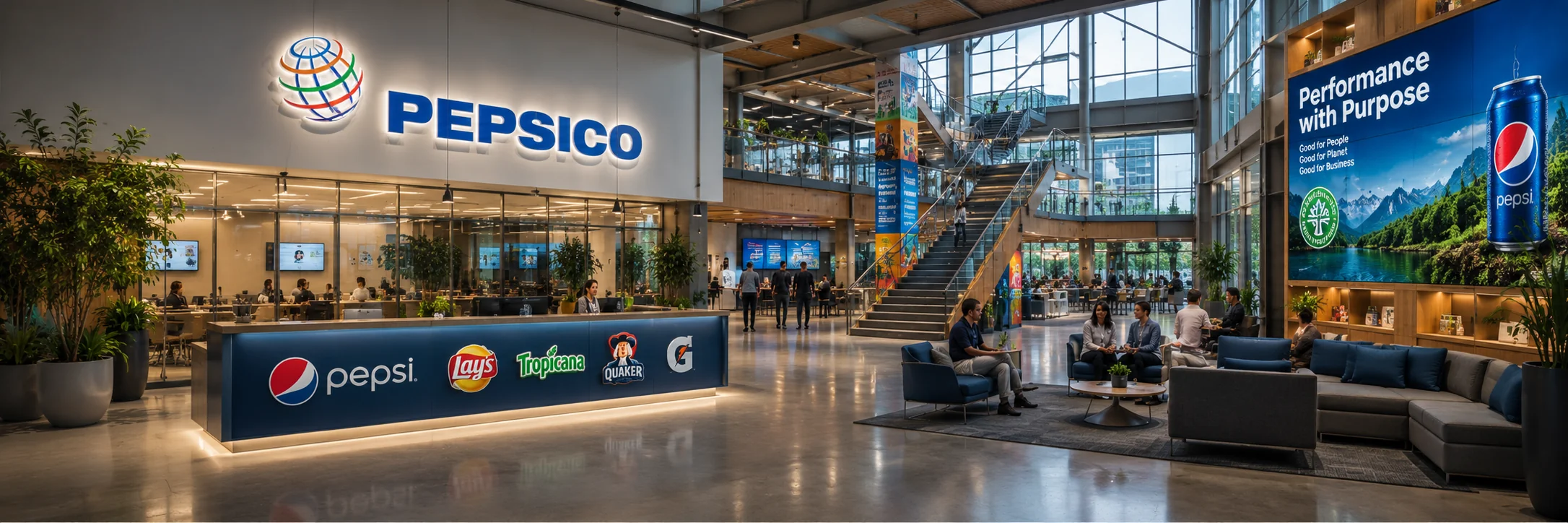
The combination of Frito-Lay's dominant salty snacks platform with a global beverage operation creates a dual engine where snack margins subsidize beverage competition and shared distribution breadth provides cost advantages neither business would have alone.
A structural look at how a beverage company became something different — a snack-and-drink system where Frito-Lay's salty snack dominance quietly became the more important half of a duopoly participant's portfolio.
The Snack Foundation
PepsiCo (PEP) is commonly understood as Coca-Cola’s rival in the carbonated soft drink wars. This framing is accurate at the surface level and profoundly misleading at the structural level. PepsiCo is not primarily a beverage company. It is a snack-and-beverage system where Frito-Lay, the dominant salty snacks business in North America, generates margins and cash flows that reshape how the entire enterprise competes.
The distinction is not semantic. Coca-Cola (KO) is a concentrate-and-brand company that owns no snack operations. PepsiCo is a vertically integrated food-and-beverage company that owns the farms-to-shelves supply chain for its snack products and operates a beverage business alongside it. These are fundamentally different structures with different economics, different risk profiles, and different competitive dynamics. Coca-Cola's asset-light franchise bottler model produces higher margins on beverages. PepsiCo's more integrated model produces lower beverage margins but compensates with a snack business that faces structurally less competition and generates returns that beverages alone cannot match. The comparison between the two companies is instructive precisely because it reveals how different structural choices — asset-light brand licensing versus vertically integrated portfolio breadth — produce different forms of durability.
The long-term story of PepsiCo is not the cola wars. It is the story of how portfolio breadth — the combination of beverages and snacks under one distribution system — created a form of structural resilience that pure beverage or pure snack companies do not possess. This combination was not inevitable. It was assembled through deliberate acquisitions, survived multiple attempts to disassemble it, and has proven durable across economic cycles, health trends, and competitive pressures spanning more than half a century. Understanding why the combination works — and where its structural limits lie — requires examining the system's architecture rather than its individual components.
The Long-Term Arc
How did Pepsi start as a distant second to Coca-Cola (1893 – 1965)?
Pepsi-Cola was invented in 1893 by Caleb Bradham, a pharmacist in New Bern, North Carolina. The early decades were turbulent — the company went through two bankruptcies, in 1923 and 1931 — before stabilizing under new ownership. For most of this period, Pepsi was a distant second to Coca-Cola in the American soft drink market. The company competed primarily on price, offering more product for less money during the Depression era with its famous "twice as much for a nickel" campaign. This positioning — more liquid for less money — was effective at building trial and volume but structurally disadvantageous. It framed Pepsi as the budget alternative to Coca-Cola's established brand premium.
Price competition in beverages is a race that benefits consumers more than producers. Coca-Cola had established brand premium, cultural embedding, and global distribution during decades when Pepsi was fighting for survival. Pepsi had none of this institutional depth. The structural gap in beverage positioning — Coca-Cola as the premium choice, Pepsi as the value alternative — would persist for generations. It was this gap, more than any single event, that made PepsiCo's eventual transformation into a food-and-beverage company structurally necessary rather than merely opportunistic.
By the 1960s, Pepsi had stabilized as the clear number two in American carbonated soft drinks. The "Pepsi Generation" campaign repositioned the brand from value to youth and modernity — a shrewd move that accepted the impossibility of displacing Coca-Cola's heritage positioning and instead targeted the demographic least attached to tradition. The campaign worked as marketing, but it did not change the structural reality. Pepsi remained the challenger in a category where the incumbent's advantages — distribution scale, fountain dominance, cultural embedding — were essentially unassailable through marketing alone. Being a strong number two in beverages was not, by itself, a path to structural differentiation. What changed everything was not a marketing campaign. It was a merger.
How did the Frito-Lay merger transform PepsiCo (1965 – 1977)?
In 1965, Pepsi-Cola merged with Frito-Lay to form PepsiCo. Frito-Lay was itself the product of a 1961 merger between the Frito Company — founded by Charles Elmer Doolin, who bought the recipe for corn chips from a Mexican restaurant in San Antonio in 1932 — and H.W. Lay & Company, a Southern potato chip distributor built by Herman Lay into the largest snack food operation in the American South. The combined Frito-Lay entity dominated salty snacks in North America, with brands including Fritos, Lay's, Cheetos, Doritos, and Ruffles. By the time of the Pepsi merger, Frito-Lay already controlled a commanding share of the US salty snack market — a position that would only strengthen over the following decades.
The merger's structural logic was distribution. Both companies sold products through direct-store-delivery (DSD) systems — a distribution model where company-employed drivers deliver products directly to retail shelves, bypassing centralized warehouses. DSD is expensive to operate — it requires a fleet of trucks, a workforce of delivery drivers who also serve as merchandisers, and route logistics that must be optimized across thousands of individual retail locations. But it produces structural advantages that warehouse distribution cannot replicate: fresher products with shorter time from factory to shelf, better shelf placement because drivers physically stock and arrange products, more responsive restocking because drivers observe inventory levels at each visit, and direct relationships with store managers who control the shelf space that determines whether products sell. Combining snack and beverage DSD routes created density and efficiency gains that neither company could achieve alone. A truck that delivered both Lay's chips and Pepsi bottles to the same convenience store covered fixed route costs with two revenue streams instead of one.
The Frito-Lay merger did something else that was not immediately apparent but would prove more important than the distribution efficiencies: it gave PepsiCo a structural anchor that was not subject to the same competitive dynamics as beverages. In carbonated soft drinks, PepsiCo faced Coca-Cola — a competitor with superior brand equity, deeper cultural embedding, a more efficient franchise bottler model, and a century of accumulated distribution infrastructure. In salty snacks, Frito-Lay faced no comparable rival. The salty snack category was and remains structurally different from beverages. Where beverages are characterized by a duopoly — two dominant players with roughly comparable positions surrounded by smaller competitors — salty snacks are characterized by a single dominant player with a collection of much smaller regional and niche competitors. Frito-Lay's position in salty snacks was not the mirror image of Pepsi's position in beverages. It was more akin to Coca-Cola's position in cola — but without a Pepsi to challenge it.
The category economics of salty snacks reinforced Frito-Lay's structural advantages in ways that would compound over decades. Salty snacks have high brand loyalty — consumers develop strong preferences for specific chip brands that resist substitution. Private-label penetration has historically been lower in salty snacks than in most grocery categories because the products' flavor profiles, textures, and brand associations are difficult for store brands to replicate convincingly. Shelf space allocation is self-reinforcing: Frito-Lay's market share justifies its dominant shelf presence, and that shelf presence reinforces the brand visibility that maintains market share. The DSD system creates an execution advantage that warehouse-delivered competitors cannot match — Frito-Lay's drivers stock shelves, manage freshness, and optimize product placement in ways that warehouse delivery leaves to store employees who have dozens of other categories to manage. Each of these advantages operated independently, but together they created a defensive position that has proven remarkably resistant to competitive attack for over sixty years.
Why did PepsiCo expand into restaurants (1977 – 1997)?
In the late 1970s and through the 1980s, PepsiCo embarked on an aggressive diversification strategy that extended beyond food and beverage into restaurant operations. The company acquired Pizza Hut in 1977, Taco Bell in 1978, and KFC in 1986. The logic was vertical — restaurants were channels for PepsiCo's beverages, and owning the channel would guarantee fountain placement that Coca-Cola could not displace. Fountain drinks are structurally important in the beverage business because they represent high-margin, high-visibility consumption occasions. A consumer who drinks Pepsi at their local Pizza Hut is being habituated to the brand in a social context. Owning the restaurant meant owning the fountain contract — permanently.
The strategy was coherent in theory but problematic in practice. Restaurant operations are capital-intensive, labor-intensive, and operationally complex in ways that are fundamentally different from packaged goods. Managing thousands of individual restaurant locations — each with its own staffing challenges, food safety requirements, real estate economics, equipment maintenance, and customer service dynamics — consumed management attention and capital that could have been deployed in the core snack and beverage businesses. A packaged goods company optimizes factories, supply chains, and marketing campaigns. A restaurant company optimizes individual locations, each of which is a small business with its own profit-and-loss dynamics. The operational DNA required for each is different enough that combining them under one corporate roof created managerial dissonance rather than synergy.
The restaurant division generated revenue but produced returns on capital that were structurally inferior to both beverages and snacks. Restaurant businesses tie up capital in real estate, equipment, and inventory that turns slowly. A bag of Doritos moves from factory to shelf to consumer in days or weeks. A restaurant location requires years of lease commitment and significant upfront investment before generating its first dollar of return. The capital allocation tension was real: every dollar invested in a new Taco Bell was a dollar not invested in Frito-Lay capacity or Pepsi marketing.
The restaurant ownership also created an unexpected competitive disadvantage that directly undermined the strategy's original rationale. Burger King, Wendy's, McDonald's, and other restaurant chains — all potential customers for PepsiCo's beverages — refused to carry Pepsi products because PepsiCo now owned their direct competitors. A Burger King franchisee would not serve Pepsi when PepsiCo also owned the Burger King restaurant down the street. Coca-Cola gained exclusive fountain deals at chains that might otherwise have been contested. The vertical integration that was supposed to guarantee channel access actually reduced the total addressable market for PepsiCo's fountain business, handing Coca-Cola a structural advantage in the critical away-from-home beverage channel that persists in residual form even today.
PepsiCo spun off its restaurant operations as Tricon Global Restaurants (later renamed Yum! Brands) in 1997. The divestiture was an acknowledgment that portfolio breadth has limits — not every combination of related businesses creates structural value. The snack-and-beverage combination worked because the two businesses shared distribution infrastructure, complementary consumption occasions, and similar operational requirements. The restaurant combination did not work because it introduced operational complexity without creating comparable synergies and actively damaged the beverage business's competitive position. The restaurant experiment was a costly but instructive episode that clarified where PepsiCo's structural boundaries actually lay — and the answer was food and beverage, not food service.
What did the Quaker Oats acquisition bring PepsiCo (2001)?
In 2001, PepsiCo acquired Quaker Oats for approximately $13.4 billion. The headline asset was Gatorade — the dominant sports drink brand with roughly 75 percent of the US sports drink market at the time of acquisition. Coca-Cola had attempted to acquire Quaker but its board rejected the deal, handing PepsiCo one of the most strategically consequential acquisitions in consumer goods history. But the deal also brought Quaker's oatmeal, granola bars, rice cakes, and other food products into PepsiCo's portfolio, extending the company's presence from salty snacks into breakfast and nutrition categories.
Gatorade filled a structural gap in PepsiCo's beverage portfolio that no amount of internal brand development could have addressed as quickly. Coca-Cola had Powerade, but Gatorade's brand dominance in sports drinks was comparable to Coca-Cola's dominance in cola — a position built through decades of institutional relationships with athletic programs, medical endorsements through the Gatorade Sports Science Institute, and deep cultural association with sports performance dating back to its 1965 origin at the University of Florida. The brand's credibility with athletes and coaches, its presence in professional and collegiate locker rooms, and its visibility during televised sporting events created a form of institutional embedding that advertising budgets alone could not replicate. Adding Gatorade gave PepsiCo a category-leading beverage brand that did not compete directly with Coca-Cola's core strength in carbonated soft drinks, providing competitive differentiation in a domain where PepsiCo could lead rather than follow.
The Quaker acquisition also demonstrated PepsiCo's emerging strategic identity: not a beverage company, not a snack company, but a food-and-beverage system organized around convenience consumption occasions. The portfolio was now structured around the moments when people eat and drink between formal meals or alongside informal activities — a salty snack with a soft drink while watching television, a sports drink after a workout, a granola bar during a morning commute, a bag of chips at a lunch break. This occasion-based portfolio logic would become PepsiCo's structural organizing principle for the next two decades, informing both product development and distribution strategy. The logic also had defensive properties: a competitor attacking any single product category — cola, sports drinks, potato chips — would only be attacking one part of PepsiCo's portfolio, while PepsiCo's revenue and margin structure drew from all of them simultaneously.
What defines PepsiCo's structure today (2001 — Present)?
Today, PepsiCo operates through several divisions — Frito-Lay North America, Quaker Foods North America, PepsiCo Beverages North America, Latin America, Europe, Africa/Middle East/South Asia, and Asia Pacific/Australia/New Zealand/China. The company generates annual revenue exceeding $90 billion, making it one of the largest food and beverage companies in the world. But the revenue figure obscures the structural reality that defines the company's economics: Frito-Lay North America, despite generating roughly a quarter of total revenue, contributes a disproportionately large share of operating profit due to its superior margins. The snack business's operating margins have consistently exceeded those of the beverage business by a significant spread — a reflection of Frito-Lay's category dominance, pricing power, and the absence of a Coca-Cola-equivalent competitor in salty snacks.
The beverage business operates differently than Coca-Cola's in ways that have direct economic consequences. Where Coca-Cola refranchised its company-owned bottling operations over the past two decades to become a fully asset-light concentrate company, PepsiCo retained significant bottling and distribution operations. This structural choice makes PepsiCo's beverage margins lower than Coca-Cola's — because PepsiCo's revenue includes the lower-margin bottling and distribution revenue that Coca-Cola has pushed off its consolidated financials — but gives the company more direct control over execution. PepsiCo can move faster on new product launches, coordinate beverage and snack distribution through shared routes, and align bottling operations with corporate strategy without negotiating with independent franchise partners. The tradeoff — lower margins for more control — has different implications depending on the market and the competitive moment. In North America, PepsiCo's integrated beverage operations coexist with some independent bottlers in a hybrid system that lacks the elegant simplicity of Coca-Cola's fully refranchised model but provides the operational flexibility that a multi-category food-and-beverage company requires.
Internationally, PepsiCo has steadily expanded both snack and beverage operations, with particular strength in markets like Mexico, India, Brazil, and the Middle East. The international expansion of Frito-Lay's snack brands has been notably successful — Lay's is now one of the most widely recognized snack brands globally, with localized flavor variants adapted to regional tastes (lime in Mexico, masala in India, seaweed in East Asia). This flavor localization is structurally important: it allows a global brand to operate with local relevance, creating the scale advantages of centralized brand management alongside the demand-generation benefits of local customization. The international business faces the same structural challenges all consumer goods companies encounter in emerging markets — currency volatility, infrastructure limitations, local competition, and regulatory complexity — but PepsiCo's dual portfolio provides a distinctive advantage: in markets where beverage competition is fierce, the snack business provides a profitable beachhead, and in markets where snack distribution is still developing, the established beverage business provides the retail relationships and logistics infrastructure to introduce snack products.
The relationship between PepsiCo and its beverage rival deserves structural clarity rather than narrative simplification. The Pepsi Challenge — the famous blind taste test campaign of the 1980s — demonstrated that in controlled conditions, many consumers preferred Pepsi's sweeter taste to Coca-Cola's. Yet Coca-Cola consistently maintained the larger market share. This apparent paradox illustrates a structural truth about consumer brands: purchase decisions in beverages are not made in blind taste test conditions. They are made in the context of shelf availability, brand associations, habit formation, cultural embedding, and distribution convenience. Coca-Cola's advantage operates on these structural dimensions, not on the dimension of taste. PepsiCo's structural response — building a portfolio that competed across multiple categories rather than fighting exclusively on cola taste — was an implicit acknowledgment of this reality. You cannot beat Coca-Cola at being Coca-Cola. You can build a different kind of company where cola is one revenue stream among many, and where the portfolio's collective strength exceeds what any individual brand could achieve.