 CompanyGraph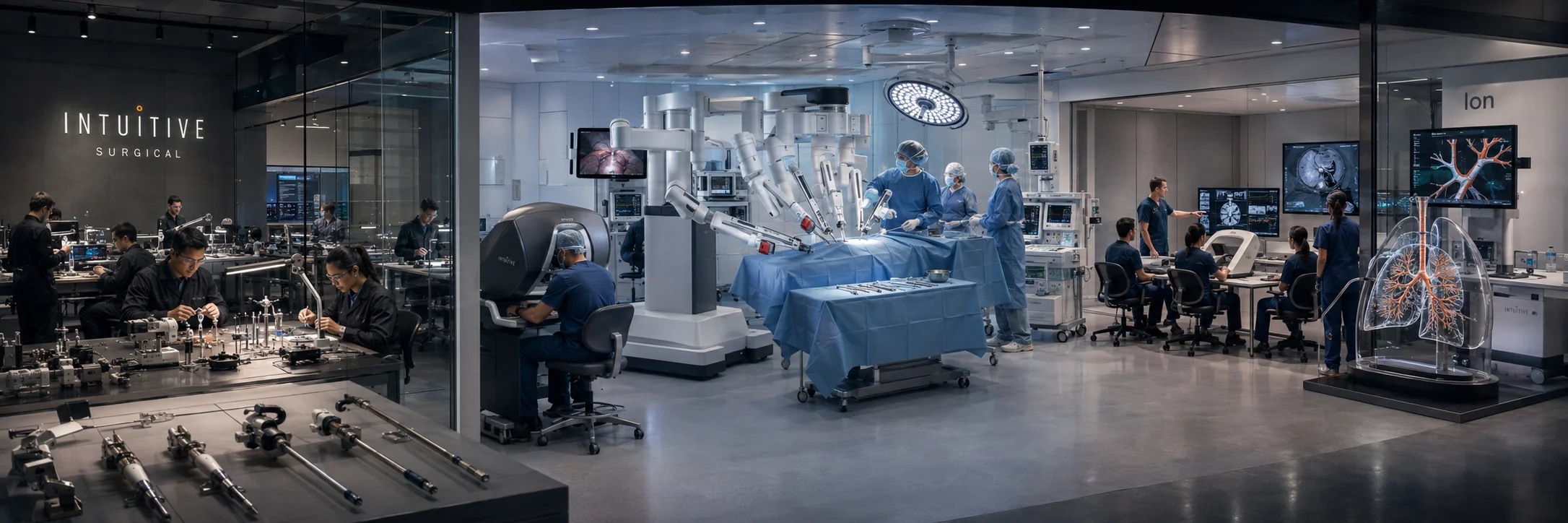
The da Vinci system becomes useful only when a cleared machine, trained team, sterile instruments, operating-room time, and clinical judgment meet in one procedure.
The robot is one part of the operation
Robotically assisted surgery does not replace the surgical decision. A surgeon selects a procedure, positions the patient, controls the instruments, interprets the anatomy, and decides how to respond when conditions differ from the plan. The hospital must also provide an operating room, anesthesia, nursing, sterilization, imaging where needed, and a pathway for postoperative care.
Intuitive's da Vinci system consists of a surgeon console or consoles, a patient-side cart, and a high-performance vision system. Those components form a controlled tool for a defined surgical workflow, not an autonomous actor. The FDA describes robotically assisted systems in the same way: computer and software technology moves instruments under a surgeon's control.
Clearance defines a permitted route
FDA clearance concerns a particular device, configuration, and intended use. The FDA's 2025 record for the da Vinci IS5000 describes a software-controlled electromechanical system designed to enable complex minimally invasive surgery. That establishes a regulatory route for the cleared device; it does not establish that every surgeon is trained, that every hospital has the right team, or that every patient will benefit.
New procedures and specialties require their own evidence, technique, training, and often additional regulatory work. A hospital can own a cleared system and still lack the case volume, staffing, or reimbursement needed to make a particular use dependable. Clearance enables an option; it does not complete the clinical program.
Placement creates a recurring supply route
Each procedure may require compatible instruments and accessories, many of them sterile and limited in use. The instruments must match the system and the procedure, be available at the right time, and be handled according to the hospital's infection-control process. A system that cannot receive the needed instrument is not ready for the operation it was purchased to support.
Intuitive's 2025 filings describe an ecosystem of systems, instruments, accessories, customer learning, customer support, and digital tools. At June 30, 2025, the company reported approximately 10,488 da Vinci systems in its installed base and $1.47 billion of instruments-and-accessories revenue for that quarter. The figures connect recurring supply to the installed fleet, but they do not establish how heavily every system is used or whether every hospital can afford every procedure.
Training turns equipment into team capability
A surgeon must learn the console and instruments. Nurses and technicians must prepare the room, manage the sterile field, exchange instruments, troubleshoot alerts, and recognize when the procedure is no longer following the expected path. Credentialing and supervision vary by hospital and jurisdiction, but the physical point is consistent: the system is usable only through a trained team.
Those skills accumulate with repeated cases. A team learns how to schedule the room, stock accessories, interpret system feedback, and coordinate with service. Another platform may offer similar functions, but switching requires time to train, reconfigure rooms, qualify staff, and rebuild confidence. The installed-base effect is therefore not only a contract or a patent. It is the practical history of people and procedures.
Hospitals finance a program, not a box
A hospital may purchase a system, lease it, or use a usage-based arrangement. It must also pay for instruments, accessories, service contracts, training time, room modifications, inventory, and staff. The return depends on procedure volume, reimbursement, scheduling, and whether the system supports cases the hospital can actually attract and perform.
Intuitive's results release describes systems placed under operating leases, including usage-based leases. The arrangement can reduce the upfront purchase boundary, but it does not remove the ongoing cost of each procedure or the need to keep a trained team available. A hospital under financial pressure may postpone an upgrade, reduce case volume, or choose another technique even when the device remains technically operable.
Digital records show parts of the procedure
A system log can record software state, instrument identity, alerts, or usage. A training record can show that a person completed a course. A service report can document maintenance. A procedure record can show that a system was used for a case. These records are important, but they do not by themselves establish the patient's outcome, the quality of every instrument movement, or whether a team responded correctly to an unexpected finding.
Feedback can begin in several places: a surgeon notices a control problem, a nurse sees an instrument fault, a biomedical engineer sees repeated alerts, or a patient experiences a complication. The correction path may involve the hospital, Intuitive's service organization, a regulator, a trainer, and the clinical team. A record becomes useful when the observation reaches the person who can change the device, the procedure, the training, or the decision to use it.
The installed base is a maintained clinical relationship
Intuitive describes customer learning and support as part of its ecosystem because the system's value grows with a hospital's ability to use it safely and consistently. The relationship is not automatic. Instruments must arrive, software and service must remain available, training must be refreshed, and evidence must keep pace with new procedures.
The platform also has alternatives. A hospital can use conventional laparoscopy, open surgery where appropriate, another robotic system, or no operation when a different treatment is better. The existence of an installed da Vinci system does not decide the patient's care. It makes one route more reachable when the clinical indication, trained team, resources, and evidence align.
A robotic program is complete only at the patient boundary
Intuitive Surgical's model is durable because it connects a high-cost system to repeated procedures, instruments, training, service, and learning. Those connections can lower the practical cost of adopting the next case and raise the cost of switching.
They also create responsibility beyond the machine. The useful result is not a placement count or an instrument sale. It is an appropriately selected procedure performed by a capable team with the right sterile tools, followed by evidence that can improve the next decision. A robotic system remains dependable only when money, training, supply, regulation, and clinical feedback stay connected to the people who can still change what happens in the operating room.
Inside CompanyGraph
The screen below shows companies whose recorded margins are elevated at all three levels - industry-benchmarked gross, operating, and net - the statement shadow of the pricing power this story describes.
Three Margin Ratios Elevated Across Gross, Operating, And Net Levels
Industry-benchmarked gross margin, operating margin (mapped against own scale), and industry-benchmarked net margin are all in elevated ranges
A match records current margins, not their durability or the mechanism that produced them.