 CompanyGraph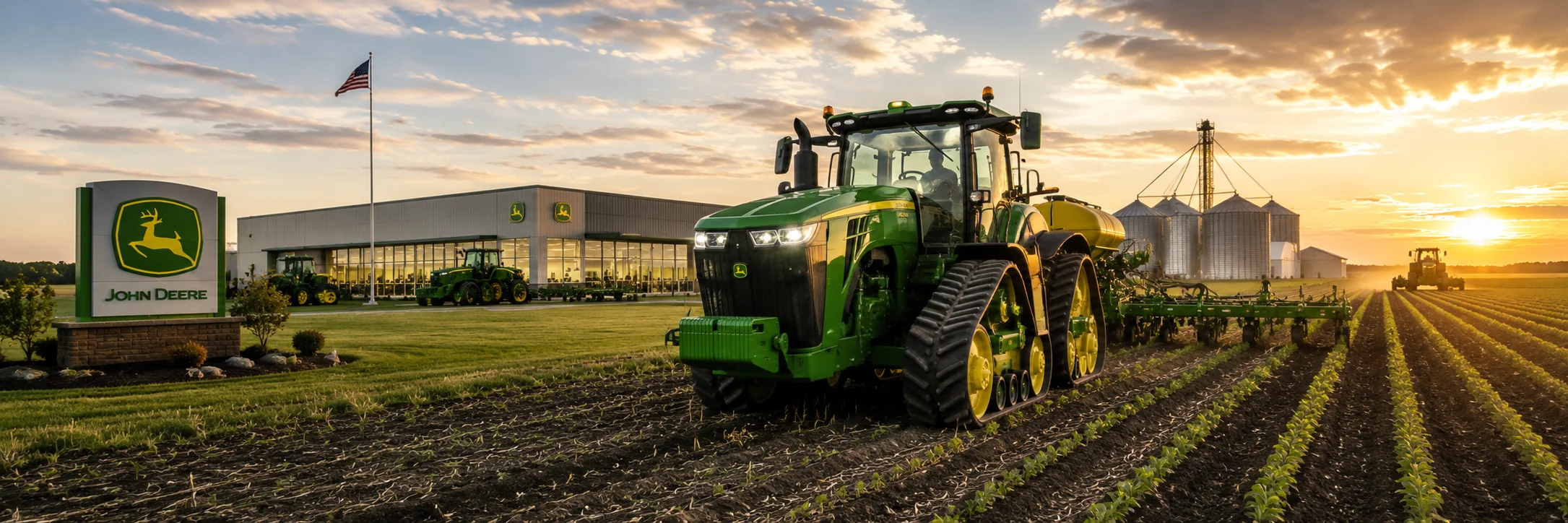
The machine is useful only when it reaches the field, performs the planned pass, and leaves information that improves the next decision before the season moves on.
The farmer buys a field operation
A farmer may need to plant a crop in a short window, apply fertilizer or crop protection at the right rate, harvest before weather changes, or move material without damaging soil and crop. A tractor, planter, sprayer, or combine contributes to that work but does not complete it. The farm also needs fuel, attachments, operators, parts, financing, agronomic decisions, and a route for service when a machine stops.
John Deere's 2025 Form 10-K describes production and precision agriculture, small agriculture and turf, construction and forestry, and financial services. The company sells equipment, but it also connects equipment owners, managers, and dealers to machines in the field.
A dealer turns a machine into local capacity
Equipment leaves a factory without becoming farm capacity until it reaches a region, is configured, and can be supported. Independent dealers provide sales, parts, technicians, training, financing arrangements, and knowledge of local crops and conditions. Their physical coverage affects how quickly a broken machine can return to work and whether a farm can risk buying a more complex system.
That network is a real capability, not a marketing label. A dealer can inspect a machine, identify a fault, stock a part, and advise a customer during a weather window. The same network can become a constraint when coverage is thin, technicians are unavailable, or the repair requires proprietary tools, software, or a part that is not locally stocked.
Finance arrives before harvest revenue
Farm equipment is expensive and its revenue arrives later, after planting, weather, crop growth, harvest, and sale. Deere's Financial Services segment finances dealer sales and leases of new and used equipment, provides wholesale financing to dealers, and offers related credit products. The financing route changes when a farm can acquire productive capacity, but it also ties the purchase to debt service, collateral, rates, and expected crop income.
A farm may know that a newer planter reduces missed rows or that a combine would finish harvest sooner, yet still be unable to carry the payment through a weak commodity year. A used machine, a repair, or a rented unit may be the reachable option. Financial availability therefore changes the physical set of machines and decisions that can enter a season.
Precision agriculture records the pass
John Deere Operations Center is an online farm-management system. Deere says it lets farmers plan work, monitor job quality and productivity, and analyse the season's results for the next crop. The system joins machine location, work data, agronomic information, and management decisions.
A display can record where a planter travelled. A telematics system can report location, fuel, utilization, performance, and maintenance. A map can show an applied rate. These observations are useful, but none alone proves emergence, yield, soil condition, or the economic result. A field may have been covered exactly as planned and still produce a poor crop because weather, pests, compaction, or an incorrect prescription changed what happened next.
Data can cross a mixed fleet, but not erase every boundary
Farms often use equipment from several manufacturers. Deere's Data Management tools describe wireless transfer of machine and agronomic data, and Data Stick can move exported files from third-party displays into Operations Center. The transfer can keep more of the farm's history in one place, but a file transfer does not guarantee that every field boundary, unit, timestamp, or prescription means the same thing across systems.
Data is valuable when it changes a decision: a route is adjusted, a rate is changed, a maintenance stop is scheduled, or a field result is compared with the next season. More data can also add subscription cost, setup work, connectivity requirements, and uncertainty about who may use it. The platform helps only when the farmer can understand and act on what it records.
Automation still meets a living field
Guidance, sensors, cameras, radar, machine learning, and job-execution tools can reduce overlap, rework, guesswork, or input use. Deere says it is applying these technologies across agriculture and construction. Their value depends on the conditions in which the recommendation is made: soil, slope, crop, weather, visibility, machine setup, and operator response.
A system can execute a route correctly while the route itself is wrong. A camera can detect an obstacle while a human must decide whether to stop. A prescription can be agronomically sensible while the field is too wet to enter. The record of an automated action is not proof that the resulting crop or soil condition was good.
Switching costs accumulate in the season's history
A farm changing equipment brands may need to retrain operators, replace displays and attachments, rebuild data connections, learn a new dealer relationship, change parts inventories, and decide what historical maps remain usable. Those costs are practical rather than purely contractual. A machine with a different control layout changes the operator's work; a digital platform with different file rules changes the manager's records.
The cost is not absolute. Deere's mixed-fleet tools and independent data standards can preserve some continuity, and other manufacturers provide competing equipment and software. But the more a farm has organized its passes, maintenance, financing, and staff around one system, the more time and money a switch consumes before the next season is ready.
When a record and a field disagree
A service log describes what was inspected. A telematics alert describes what a sensor reported. A field map describes what the system believes was applied. A yield monitor describes what passed through the machine. None alone establishes the whole agronomic result or the cause of a later failure.
Correction can begin with a farmer, operator, dealer technician, agronomist, or engineer. The observation must travel to the person who can repair the machine, revise the software, change the prescription, or question the underlying assumption. If the farm cannot afford the repair or the work window closes before support arrives, a recorded problem can become a crop or income loss.
The platform is useful only at the field boundary
John Deere's durable position comes from connecting a machine to the people, dealer, finance, parts, data, and decisions around it. Operations Center can make a season's work more visible, and the dealer can make a complex machine more usable. Those advantages are real only when the farm can pay for them and when the recorded information improves a physical decision.
The end point is not a connected tractor. It is a field pass completed at the right time, with the intended input and an outcome the farmer can evaluate. A precision system remains trustworthy when it preserves that connection across equipment, software, dealer support, money, and agronomic feedback. When those links break, a machine count or a map can hide how little capacity is actually available.