 CompanyGraph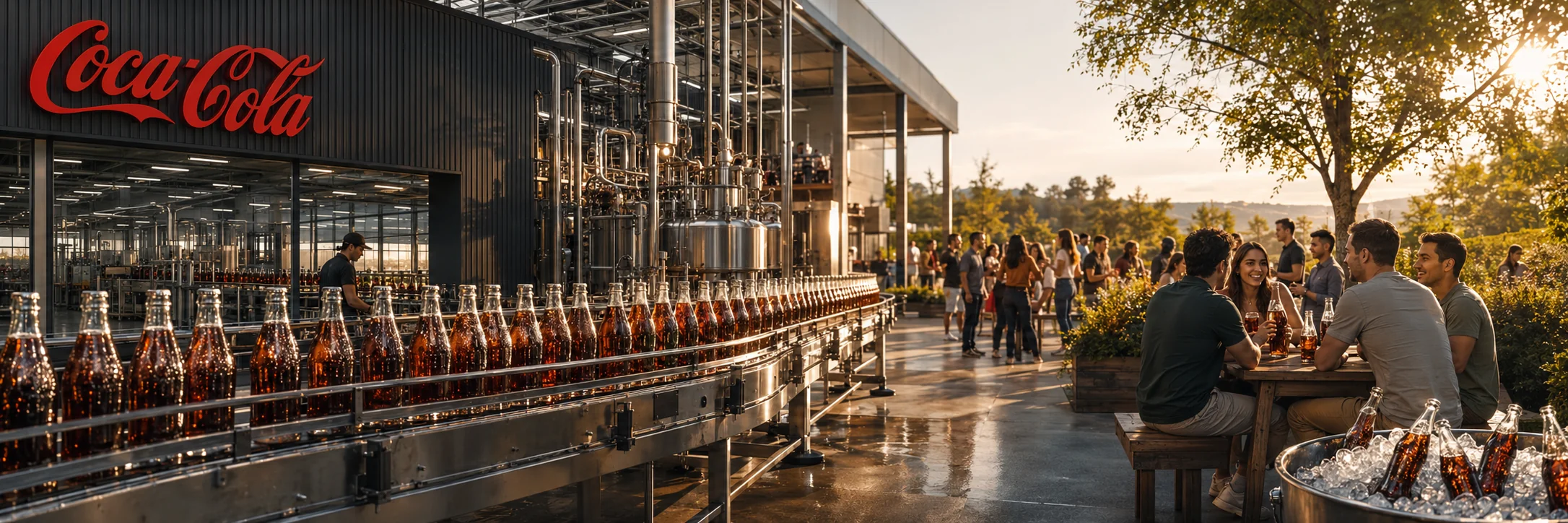
The Coca-Cola Company does not supply refreshment through a brand count or concentrate volume alone. Concentrate and syrup become a usable beverage only when bottlers add suitable water and sweeteners, package the drink, move it through local routes, and keep it available in the intended serving condition. The system's performance depends on the separate money, equipment, records, and corrective authority held by the Company, bottlers, retailers, and recovery systems.
A brand is not yet a serving
A branded beverage is useful only when it is the intended drink, in a sound package, available at a place and time where a person wants it. The Coca-Cola Company creates concentrates and syrups while independent bottling partners mix, bottle, package, and distribute finished beverages. The Coca-Cola System describes more than 200 bottling partners and 950 production facilities; a global count does not prove that a local serving is available.
The Company's 2025 Form 10-K distinguishes concentrate operations from finished-product operations. The filing describes both routes. This article follows a beverage from concentrate and syrup through water treatment, local bottling, packaging, distribution, retail, consumption, and packaging recovery.
Concentrate becomes a drink locally
The Company creates a concentrate or syrup whose flavor, sweetness, acidity, color, and other properties are specified. Bottlers combine those inputs with still or sparkling water and sweeteners as required, package the beverage in cans, glass, plastic, or fountain systems, and distribute it to retailers and food-service customers.
The local plant performs more than a filling step. Water must meet the plant's requirements. Syrup and concentrate must be proportioned. Carbonation, heat or other process controls, container forming, filling, sealing, coding, palletizing, and storage must work in sequence. A finished case still needs a route to a retailer, vending machine, restaurant, or home. Refrigeration and shelf space can be part of the promised experience without appearing in the concentrate specification.
The global brand depends on local bottlers
The Company markets the brand and supplies product requirements, while bottlers purchase local ingredients and packaging materials and deliver finished beverages through local businesses. The Company's system description calls the seed-to-sip journey local even when the brand is global.
This division creates reach and boundaries at the same time. A global campaign cannot add a missing local truck, water-treatment capacity, returnable-glass pool, refrigerator, or shelf. A bottler can keep a plant running while a retailer lacks cooler capacity or a consumer cannot afford the package. The brand remains recognizable while the physical serving varies with water, equipment, package, temperature, and handling.
Money decides which serving can be made
Money arrives at different times. The Company invests in concentrate plants, research, marketing, and brand support. Bottlers finance water treatment, lines, packaging, warehouses, vehicles, cooling equipment, labor, and inventory before retailers and consumers pay. Retailers finance shelf space, refrigeration, promotions, and unsold-stock risk. Packaging recovery requires collection and sorting systems that may be paid by a different organization.
The 2025 filing distinguishes concentrate sales to authorized bottling operations from finished-product sales through bottling and distribution. A bottler may have concentrate but not enough cans, bottles, sugar, drivers, or working capital for a promotion. A retailer may accept a shipment but lack the cooler capacity or turnover to sell it at the expected quality. The commercial split changes who can finance and correct each part of the route.
A bottle count is not the consumer's experience
A concentrate specification states intended properties. A syrup or beverage batch record documents a defined production run. A label communicates ingredients, warnings, and lot information. A pallet or case scan records movement. A retailer scan records sale. A complaint reports a consumer or retailer experience. A sustainability metric may describe a defined water, packaging, or emissions boundary. None alone proves the beverage's temperature, carbonation, package integrity, or consumer experience at the moment of drinking.
Feedback is distributed. A bottler may detect a filling or water-treatment problem. A driver may see repeated delivery damage. A retailer may see a cooler running warm. A consumer may report an off taste or leaking package. A packaging recycler may see contamination that prevents recovery. Correction becomes possible only when the signal reaches the participant with the relevant batch identity, equipment, inventory, contract authority, and money to change the next production or route.
What the Coca-Cola system remains responsible for
The Coca-Cola system supplies more than a logo: it coordinates formula, bottling, packaging, distribution, retail execution, and the conditions in which a drink is consumed. Yet production, shipment, sale, temperature, package condition, consumption, and recovery remain different events. A bottle count can be accurate while a local serving is unavailable, damaged, warm, unaffordable, or never recovered.
CompanyGraph can map the relationships among The Coca-Cola Company, concentrate suppliers, bottlers, water systems, packaging producers, distributors, retailers, consumers, and recovery services. It can show where formula, batch identity, money, and corrective authority cross organizational boundaries. It cannot by itself observe a drink's temperature at consumption, a local water constraint, an unopened package's condition, or whether the container entered an effective recovery route.
Inside CompanyGraph
The screen below shows companies whose recorded margins are elevated at all three levels - industry-benchmarked gross, operating, and net - the statement shadow of the pricing power this story describes.
Three Margin Ratios Elevated Across Gross, Operating, And Net Levels
Industry-benchmarked gross margin, operating margin (mapped against own scale), and industry-benchmarked net margin are all in elevated ranges
Three Margin Ratios Elevated Across Gross, Operating, And Net Levels
→operating income margin
ratio income gross profit
ratio income net profit
A match records current margins, not their durability or the mechanism that produced them.