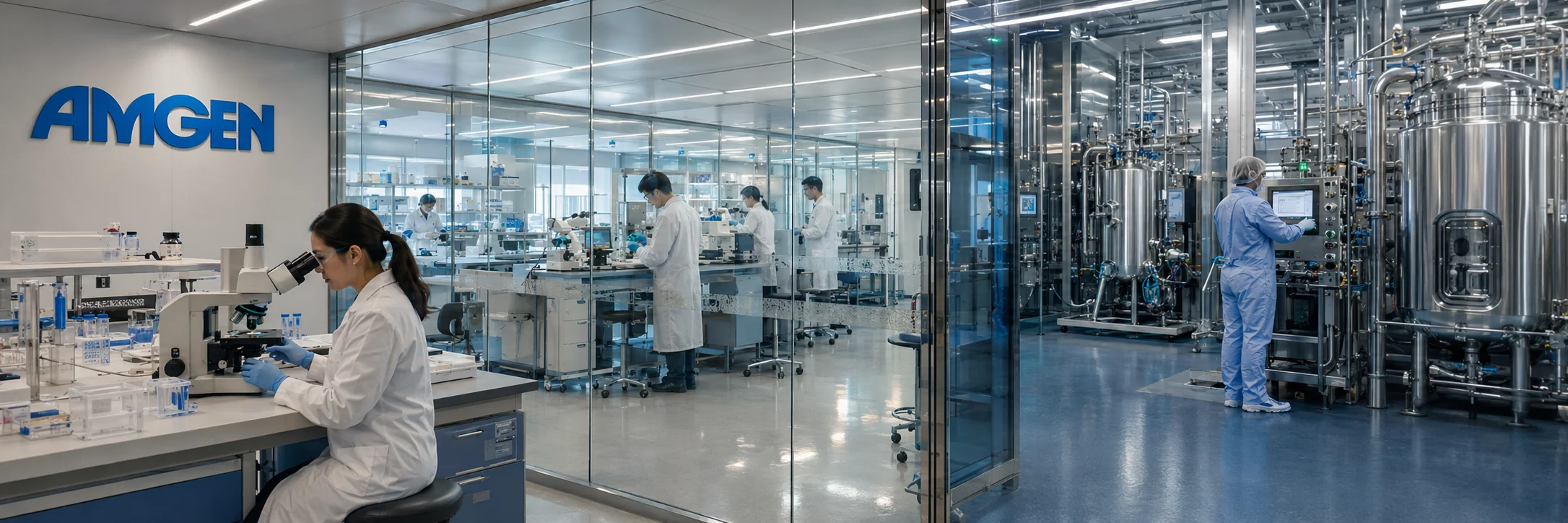
Pioneer biologics franchises built on recombinant DNA technology generate durable revenue streams because biological complexity creates manufacturing barriers that small-molecule generics do not face, but maturation shifts the structural challenge from discovery to capital allocation.
A structural look at how one of biotechnology’s founding companies navigates the tension between defending legacy franchises and finding new growth.
Introduction
Amgen (amgn) occupies a distinctive structural position in pharmaceuticals. It is not merely a large biotechnology company — it is one of the companies that created biotechnology as a commercial enterprise. Founded in 1980 in Thousand Oaks, California, Amgen was among the first to demonstrate that recombinant DNA technology could produce therapeutically viable proteins at commercial scale. Epogen and Neupogen were not incremental improvements. They were entirely new categories of medicine, manufactured through biological processes that traditional pharma had neither the infrastructure nor expertise to replicate. That founding-era achievement established Amgen as a defining company in life sciences and set the structural trajectory it has been navigating ever since.
This origin matters structurally. Biologics manufacturing created a moat fundamentally different from patent-based exclusivity. When a traditional pharmaceutical patent expires, generic manufacturers reproduce the molecule with straightforward chemistry. When a biologic patent expires, replicating the product requires mastering complex living-cell manufacturing, navigating a distinct regulatory pathway, and convincing physicians that a product from a different biological process is truly equivalent. The difference between copying a chemical formula and copying a biological manufacturing process has defined Amgen's competitive position for decades.
Understanding Amgen's long-term arc requires examining how the company built this biologics moat, how it has navigated the inevitable transition from growth-stage biotech to mature pharmaceutical enterprise, and how its capital allocation decisions — particularly the most aggressive share repurchase program in pharma history and the $28 billion Horizon Therapeutics acquisition — reflect the structural imperatives of a company managing the tension between legacy franchise defense and future growth creation. The story is not one of unbroken ascent but of a bounded coordination system continuously adapting to the feedback loops of patent cycles, competitive entry, pipeline productivity, capital deployment, and the emerging question of whether MariTide — its obesity drug candidate — can redefine the company's structural trajectory in the way that Epogen once did.
The Long-Term Arc
Amgen's history traces a path that several biotechnology pioneers have attempted but few have completed successfully: the transition from research-stage startup to commercial biotech to diversified pharmaceutical company. Each phase imposed different structural demands on the organization, and the transitions between phases reveal the dynamics that govern biotechnology maturation. Companies like Gilead (gild) have navigated similar transitions with varying degrees of success; Amgen's version of this journey is notable for its duration, its scale, and the degree to which capital allocation — rather than purely scientific breakthroughs — has shaped the latter chapters.
How did Amgen begin commercializing recombinant DNA (1980 - 1993)?
Amgen — originally named Applied Molecular Genetics — was founded in Thousand Oaks, California, in 1980. The same year saw Genentech's initial public offering signal Wall Street's sudden interest in molecular biology as a commercial enterprise. Thousand Oaks, located in Ventura County north of Los Angeles, was an unconventional choice for a biotechnology startup. The emerging biotech clusters of the San Francisco Bay Area and the Boston-Cambridge corridor offered denser networks of academic talent and venture capital. But Thousand Oaks offered lower costs, proximity to UCLA and Caltech research talent, and space to build the large-scale manufacturing facilities that would eventually become central to Amgen's competitive advantage. The location choice reflected a pragmatic orientation that would characterize the company's decision-making across decades — function over prestige, infrastructure over signaling.
The company's early years were characterized by the structural uncertainty common to all biotechnology startups of that era: promising science, no revenue, and the fundamental question of whether recombinant DNA technology could produce drugs that worked in patients, could be manufactured at scale, and could navigate regulatory approval. Amgen explored multiple scientific directions in its first years, including work on chicken growth hormone and indigo dye production — tangents that illustrate how uncertain the path from molecular biology to pharmaceutical commercialization truly was in the early 1980s.
The answer came with erythropoietin. Amgen's scientist Fu-Kuen Lin cloned the gene for human erythropoietin — a hormone that stimulates red blood cell production — and the company developed a process to produce it using recombinant DNA technology in Chinese hamster ovary cells. Epogen received FDA approval in 1989 for the treatment of anemia associated with chronic kidney disease, particularly in dialysis patients. The product addressed a clear medical need — dialysis patients frequently required blood transfusions to manage anemia, with all the associated risks of transfusion-transmitted disease and iron overload — and the clinical benefit was unambiguous. Epogen transformed Amgen from a research company into a commercial enterprise almost overnight, generating over $100 million in its first full year of sales and reaching $1 billion within a few years.
Neupogen followed in 1991. This granulocyte colony-stimulating factor — a protein that stimulates the production of white blood cells — addressed chemotherapy-induced neutropenia, a dangerous side effect that limited the intensity of cancer treatment and exposed patients to life-threatening infections. Like Epogen, Neupogen filled a clear therapeutic gap with a biologically manufactured protein that had no small-molecule equivalent. Together, these two products established Amgen as the most commercially successful biotechnology company of its generation and demonstrated that biologics could generate pharmaceutical-scale revenues.
The structural significance of these early products extended beyond their individual commercial success. They proved that biologics manufacturing — the complex, capital-intensive process of growing proteins in living cells — could be scaled to meet commercial demand. Amgen invested heavily in manufacturing infrastructure during this period, building large-scale production facilities in Thousand Oaks and later in Puerto Rico and other locations. These facilities gave Amgen a structural advantage over competitors who had the science but lacked the production capability. This manufacturing investment created a barrier to entry that persisted long after the underlying patents expired — a dynamic that would repeat across Amgen's product portfolio and across the broader biologics industry.
How did Amgen expand its franchises after Epogen and Neupogen (1993 - 2006)?
With Epogen and Neupogen generating substantial cash flow, Amgen entered a phase of franchise expansion that demonstrated both the strengths and the structural tensions of the biologics business model. The company developed second-generation versions of its core products — Aranesp (darbepoetin alfa, a longer-acting erythropoietin) and Neulasta (pegfilgrastim, a longer-acting version of Neupogen) — that extended the commercial life of its foundational biology while offering genuine clinical improvements in dosing convenience.
Aranesp, approved in 2001, allowed less frequent dosing than Epogen for anemia patients — every two to three weeks rather than three times per week. Neulasta, approved in 2002, required a single injection per chemotherapy cycle rather than the daily injections that Neupogen demanded. These products were not mere patent extensions masquerading as innovation — they represented meaningful advances in patient convenience and compliance — but they also served the structural purpose of maintaining Amgen's franchise positions as the original products aged. The lifecycle management strategy of developing improved formulations on a common biological platform became a template that Amgen and the broader biologics industry would repeat. It reflected an understanding that in biologics — where the manufacturing process is as important as the molecule — incremental innovation on proven biology can be as commercially valuable as entirely novel discovery.
The acquisition of Immunex in 2002 for approximately $16 billion marked Amgen's entry into inflammation and autoimmune disease through Enbrel (etanercept), one of the first tumor necrosis factor (TNF) inhibitors. Enbrel treated rheumatoid arthritis, psoriasis, psoriatic arthritis, and ankylosing spondylitis, and it rapidly became one of the best-selling drugs in the world. At peak, Enbrel generated over $5 billion in annual U.S. revenue for Amgen — making it one of the highest-revenue pharmaceutical products ever sold. The Immunex acquisition transformed Amgen's revenue composition from concentrated dependence on the erythropoietin and colony-stimulating factor franchises to a more diversified portfolio anchored by three distinct biological platforms: erythropoietin biology, colony-stimulating factors, and TNF inhibition.
The Enbrel franchise also introduced Amgen to the competitive dynamics of the TNF inhibitor class, where it competed against AbbVie's (abbv) Humira (adalimumab) and Johnson & Johnson's Remicade (infliximab). This competitive triad — Enbrel, Humira, and Remicade — dominated the autoimmune disease market for over a decade and collectively generated tens of billions of dollars in annual revenue. The dynamics among these three products illustrated how biological drugs with different mechanisms of action and dosing profiles could coexist in a market without the winner-take-all dynamics typical of small-molecule competition. Physicians selected among them based on patient-specific factors, insurance formulary positioning, and clinical experience, creating a competitive equilibrium that sustained all three franchises simultaneously.
During this period, Amgen's competitive position was reinforced by the structural characteristics of biologics competition — or rather, the absence thereof. Unlike small-molecule pharmaceuticals, where generic entry upon patent expiration is swift and devastating to the originator's market share, biological products faced no equivalent pathway for rapid competitive entry. The regulatory framework for biosimilars was undeveloped in the United States — the Biologics Price Competition and Innovation Act would not be signed into law until 2009, and the first U.S. biosimilar approval would not occur until 2015. Even in Europe, where biosimilar pathways existed earlier, the complexity of demonstrating biological similarity and physician reluctance to switch patients from originator products slowed competitive entry substantially. Amgen's products maintained pricing power and market share years beyond their original patent expirations, a structural advantage that no small-molecule pharmaceutical company could replicate.
What forced Amgen to confront the limits of growth (2006 - 2017)?
The mid-2000s brought a structural shift that forced Amgen — and the broader erythropoietin market — to confront the limits of growth. In 2007, the FDA added black box warnings to erythropoietin-stimulating agents (ESAs), including Epogen and Aranesp, citing increased cardiovascular risks and tumor progression at higher hemoglobin targets. Medicare implemented more restrictive reimbursement policies. Clinical practice guidelines were revised downward, targeting lower hemoglobin levels that required less drug. The resulting decline in erythropoietin usage was not a temporary market fluctuation but a permanent structural contraction of the addressable market. Revenue from the erythropoietin franchise, which had been a pillar of Amgen's business for nearly two decades, entered a sustained decline from which it would never recover.
This period exposed the core tension of Amgen's structural position: the company had built its enterprise on a small number of high-revenue biological franchises, and as those franchises matured or contracted, the system needed new growth drivers to replace them. The pipeline delivered several important products during this era — Prolia and Xgeva (denosumab) for osteoporosis and bone metastases, Kyprolis (carfilzomib) for multiple myeloma, Blincyto (blinatumomab) for acute lymphoblastic leukemia, and Repatha (evolocumab) for cholesterol reduction — but none achieved the transformative commercial scale of the earlier blockbusters. Denosumab came closest, with Prolia and Xgeva together generating several billion dollars in annual revenue, establishing a meaningful position in bone disease. But the individual revenue contributions of these newer products could not match what Epogen, Neulasta, or Enbrel had delivered at their respective peaks.
Repatha, in particular, illustrated a structural challenge that would recur in pharmaceutical markets: clinical efficacy does not automatically translate into commercial success. The PCSK9 inhibitor demonstrated clear ability to reduce LDL cholesterol beyond what statins could achieve, and the FOURIER cardiovascular outcomes trial showed reduction in cardiovascular events. Amgen invested heavily in the launch and competed directly against Regeneron's (regn) Praluent (alirocumab), creating a two-player market for PCSK9 inhibition. But payer resistance to high-priced specialty drugs, combined with the availability of inexpensive generic statins that provided adequate cholesterol reduction for most patients, created a structural ceiling on Repatha's market penetration. Amgen was forced to cut Repatha's price significantly — from approximately $14,000 per year to roughly $5,800 — a rare concession in an industry accustomed to annual price increases. The episode revealed that even clinically validated drugs face structural barriers when the economic incentives of the healthcare system — payer budgets, step therapy requirements, utilization management — work against adoption. It also foreshadowed the pricing debates that would intensify across the pharmaceutical industry in subsequent years.
Simultaneously, Amgen began building its own biosimilar business, recognizing that the emerging biosimilar market represented both a threat to its originator products and an opportunity to leverage its manufacturing expertise offensively. The company developed biosimilar versions of several major biologics, including Amjevita (biosimilar adalimumab, referencing AbbVie's Humira), Mvasi (biosimilar bevacizumab, referencing Roche's Avastin), and Kanjinti (biosimilar trastuzumab, referencing Roche's Herceptin). This dual positioning — defending originator franchises while simultaneously attacking competitors' originator products with biosimilars — reflected a pragmatic assessment of where the biologics market was heading. The biosimilar business would grow to generate over $1 billion in annual revenue, but it also embodied the tension of a company competing against the very economic forces that threatened its own legacy products.
During this transition, Amgen's identity shifted perceptibly. The company was no longer a high-growth biotech generating revenue curves that bent upward with each new product launch. It was becoming something more closely resembling a mature pharmaceutical company — generating substantial cash flows from established franchises, returning capital to shareholders through dividends and buybacks, and struggling to find pipeline products that could inflect the growth trajectory. This maturation was not a failure; it was the predictable structural evolution of a biotechnology company whose foundational products had aged and whose market opportunities had been partially absorbed. But it changed how the market valued the company and what the company could credibly promise about its future. The comparison with Regeneron (regn) — a younger biotechnology company still in its growth phase, propelled by Eylea's dominance in ophthalmology and Dupixent's expansion across multiple inflammatory indications — made the contrast particularly visible.
How did capital allocation become Amgen's main strategy (2017 - 2023)?
As revenue growth moderated, Amgen's capital allocation became its most visible strategic expression — the primary mechanism through which management communicated its view of the company's value and future direction. The company had been repurchasing shares since the early 2000s, but the pace and scale of buybacks intensified dramatically as organic growth slowed. Between 2010 and 2023, Amgen reduced its diluted share count from approximately 1.05 billion to roughly 535 million — a reduction of nearly 50%. This is among the most aggressive share repurchase programs in pharmaceutical history, comparable in scale and proportion to the buyback programs of companies like Apple and IBM, and its structural effect was to concentrate the company's per-share economics even as total enterprise growth slowed.
The buyback program served multiple structural functions simultaneously. It supported earnings-per-share growth when revenue growth alone could not deliver it — a mathematical effect that is powerful in its simplicity. If the share count declines by 5% annually and the business grows modestly, per-share earnings can grow at rates that look impressive even when the underlying enterprise is not expanding meaningfully. The program returned cash to shareholders in a tax-efficient manner relative to dividends. And it signaled management's view that the company's shares were undervalued relative to future cash flows — an observation that carried weight given management's information advantage regarding pipeline prospects and franchise durability.
But the buyback program also carried structural costs that became increasingly apparent as the program's cumulative scale grew. The debt-funded portion of repurchases increased Amgen's leverage significantly. Net debt rose from relatively modest levels to over $30 billion, and then climbed further with the Horizon acquisition financing to levels exceeding $55 billion. This leverage was manageable given Amgen's cash generation — biologics franchises with high margins and established market positions produce predictable cash flows — but it reduced the company's financial flexibility at precisely the moment when transformative investments might be needed to reinvigorate growth. The contrast with companies like Regeneron (regn), which maintained a net cash position while investing aggressively in R&D, highlighted the trade-off between returning capital today and preserving optionality for tomorrow.
The dividend program complemented the buyback strategy. Amgen initiated its dividend in 2011 and grew it annually, reaching over $8 per share. The combination of buybacks and dividends meant that Amgen was returning substantially all of its free cash flow — and sometimes more, financed with debt — to shareholders. This capital return profile attracted a shareholder base oriented toward income and total return rather than growth, further reinforcing the company's identity as a mature cash-flow-generating enterprise.
The tension between returning capital and investing for growth defined this period. Every dollar spent on share repurchases was a dollar not spent on acquisitions, pipeline investment, or manufacturing expansion. The market rewarded the buyback-driven earnings growth with a relatively stable share price, but the underlying question persisted: could Amgen sustain its competitive position through capital allocation alone, or would it eventually need to deploy capital toward growth assets that could change the company's trajectory?
Why did Amgen acquire Horizon Therapeutics (2023 - Present)?
Amgen answered the growth question in December 2022 by announcing the acquisition of Horizon Therapeutics for approximately $28 billion — its largest deal ever and one of the largest pharmaceutical acquisitions of the 2020s. The deal closed in October 2023 after clearing regulatory scrutiny from the FTC, which initially challenged the transaction before reaching a consent agreement. Horizon brought a portfolio of rare disease drugs, anchored by Tepezza (teprotumumab) for thyroid eye disease and Krystexxa (pegloticase) for uncontrolled gout. These products operated in markets characterized by small patient populations, high per-patient pricing, limited competition, and strong clinical differentiation — structural features that align with the specialty pharmaceutical model Amgen had been evolving toward.
The Horizon deal represented a strategic pivot in several dimensions. It diversified Amgen's revenue base into rare disease, an area with structural pricing advantages and less payer resistance than the mass-market therapeutic categories where Amgen had historically competed. Tepezza, in particular, addressed an orphan indication — thyroid eye disease — where it was the only approved therapy, giving it a monopoly position with pricing power that Amgen's mass-market products could not match. The acquisition brought immediately accretive revenue — Horizon was already generating over $3.5 billion in annual sales at the time of acquisition. And it demonstrated that Amgen's management recognized the limitations of share repurchases as the primary growth engine and was willing to deploy significant capital toward transformative business development, accepting the increased leverage that the deal required.
The integration of Horizon into Amgen's organizational structure — absorbing Horizon's Dublin-headquartered operations, its commercial teams, and its clinical development programs — tested Amgen's ability to execute large-scale M&A while simultaneously managing its existing business. The Immunex integration two decades earlier provided a successful precedent, but the pharmaceutical industry's track record with large acquisitions is decidedly mixed, and each deal carries its own execution risks.
Simultaneously, Amgen's internal pipeline produced what may become its most consequential molecule since the founding era: MariTide (maridebart cafraglutide, previously known as AMG 133), a bispecific antibody targeting both the GIP receptor (as an antagonist) and the activin type II receptor for the treatment of obesity. MariTide represents a fundamentally different approach to the GLP-1 drug class that Eli Lilly (lly) and Novo Nordisk (nvo) have dominated — an antibody-based formulation that could potentially require only monthly dosing rather than the weekly injections required by competing products like tirzepatide and semaglutide. The molecule's mechanism — combining GIP receptor antagonism with activin pathway modulation — is biologically distinct from existing approaches, and early clinical data showed meaningful weight loss with a potentially differentiated safety and tolerability profile.
If clinical development succeeds through Phase 3 trials and regulatory approval, MariTide would position Amgen in the obesity market — one of the largest addressable therapeutic opportunities in pharmaceutical history, potentially exceeding $100 billion globally — with a structurally differentiated product that leverages the company's core biologics manufacturing expertise. The monthly dosing frequency, if confirmed in pivotal studies, could provide a meaningful convenience advantage over weekly injectables, and Amgen's decades of experience in large-scale antibody manufacturing would be directly applicable to commercial production. The obesity opportunity also connects structurally to Amgen's existing cardiovascular and metabolic portfolio, creating potential synergies in commercial infrastructure and medical education.
The combination of the Horizon acquisition for near-term diversification and MariTide for long-term growth potential reframes Amgen's structural narrative. The company is no longer solely a mature biologics franchise managing decline; it is positioning itself as a diversified pharmaceutical company with optionality in the largest emerging drug market. Whether this positioning delivers on its structural promise depends on clinical trial outcomes, competitive dynamics in an obesity market that is attracting investment from dozens of pharmaceutical companies, manufacturing scale-up execution, and the resolution of pricing and access questions that will determine how broadly obesity drugs are used. These variables remain unresolved, and the distance between structural positioning and realized value is measured in years of execution.