 CompanyGraph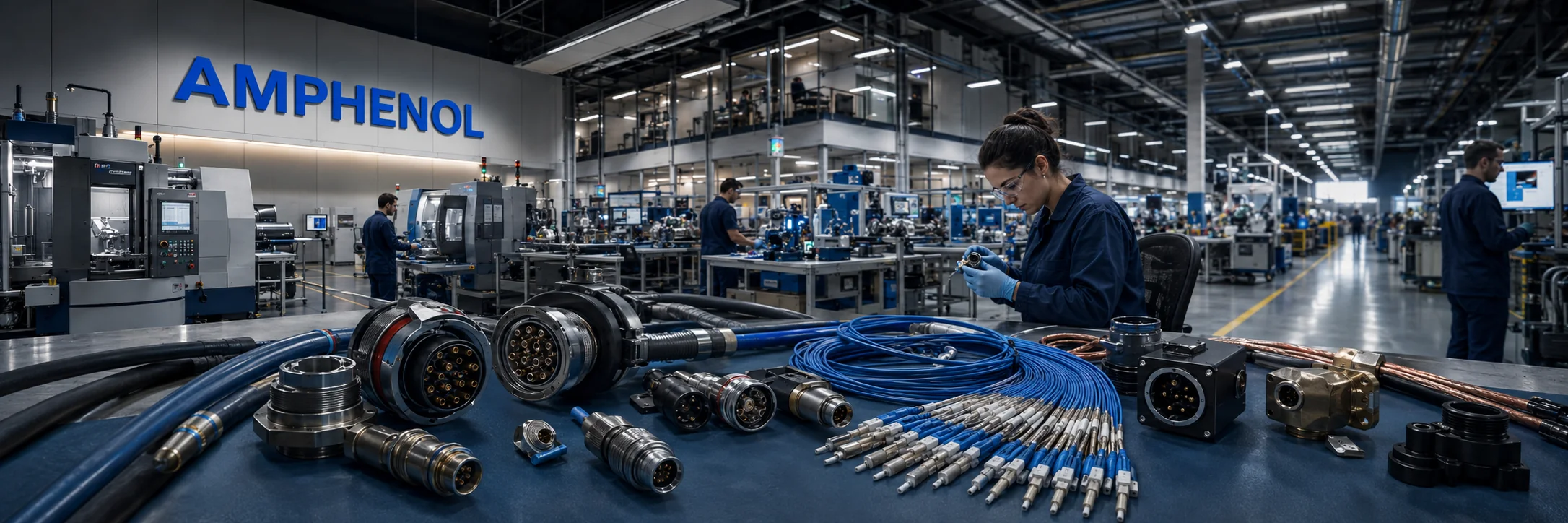
Amphenol turns materials and drawings into qualified interfaces that carry power, signals, light, and sensor information through real equipment.
The system needs a connection, not a connector count
A vehicle, aircraft, data centre, communications network, or factory needs power and information to cross a boundary without unacceptable loss, heating, leakage, vibration damage, or signal distortion. It needs a connection that fits the mating parts, survives its environment, and can be installed and serviced in the available space. Counting connector bodies does not establish that the required interface exists.
Amphenol makes electrical and electronic connectors, fiber-optic interconnects, antennas, sensors, cable assemblies, and related systems for communications, automotive, aerospace and defense, industrial, and other markets. Its 2025 Form 10-K describes a broad portfolio, but a reported product category does not reveal the qualification, mating geometry, or installed condition of a particular connection.
Materials become an interface through process history
Copper alloys, aluminum, polymers, ceramics, elastomers, glass, plating chemicals, and sensing elements enter product-specific processes. Stamping, machining, moulding, plating, crimping, soldering, sealing, shielding, and cable assembly turn a drawing into a part that must mate at defined force and carry a defined electrical or optical load.
Small differences matter. Plating thickness and surface condition affect contact resistance and corrosion. Crimp geometry affects pull-out strength and current flow. Insulator dimensions affect creepage, clearance, and signal behaviour. A latch or seal has to remain usable after vibration, thermal cycling, moisture, salt, chemicals, and repeated service.
The installed assembly continues the history. A connector can be damaged by excessive mating force, a bend tighter than the cable allows, contamination, a misplaced seal, vibration, or an unrecorded field repair. A production lot can be correct while the installed interface is not.
A drawing is not qualified supply
A drawing states the required geometry and performance. It does not by itself create dies, moulds, plating capacity, trained operators, inspection equipment, or a customer-approved process. A qualified route combines those things with materials, test methods, records, and evidence that the part works in the intended system.
That is why a factory building or a general connector catalogue cannot substitute automatically for a particular part. The same nominal contact may have different plating, sealing, keying, impedance, temperature range, or mating cycle requirements. A new supplier may need tooling, first-article samples, environmental tests, signal-integrity tests, and customer approval before the line can use it.
Qualification can protect a system from untested substitutions, but it also creates a time and cost boundary. When an aircraft harness or data-centre board is already designed around an interface, changing it can require engineering work far beyond the purchase price of the connector.
Decentralization preserves routes and creates shared exposure
Amphenol's businesses cover many product families and markets. Local teams can retain application knowledge about a particular vehicle, aircraft, network, or industrial machine while using the wider company for materials, testing, and capital. That can make an acquisition useful for more than its reported sales: it may bring customer approvals, tooling, process knowledge, and a route into a specialized market.
In 2025 Amphenol announced an agreement to acquire CommScope's Connectivity and Cable Solutions business. The announcement describes products and customer routes that expand Amphenol's connectivity position. It does not mean that integration is automatic. Facilities, suppliers, systems, product records, customer approvals, and employees still have to remain usable while ownership changes.
Decentralization is not immunity from concentration. Several local units can depend on the same copper alloy, plating chemistry, specialist toolmaker, test laboratory, or end market. A network of businesses can therefore carry both local resilience and correlated exposure.
Money decides whether a second route can be reached
A connector is often inexpensive beside the machine it enables, but a substitute is not. The supplier must finance resin, metal, plating, tooling, work-in-process, inspection, and inventory before a customer accepts the result and pays. The customer may hold buffer stock because a missing connector can stop an entire line; a smaller supplier may not have the working capital to hold that stock or wait through a long qualification cycle.
Capital can fund a second tool, a duplicate plating route, environmental testing, a new plant, or an acquisition. It cannot fund all of those at once. When the cash boundary is tight, the technically available option may be a longer lead time, a narrower approved range, or a decision to keep using a single qualified source even when the system would be safer with redundancy.
Records observe different parts of the connection
A drawing describes required dimensions. A process qualification establishes a defined manufacturing route. A first-article or lot test observes selected samples. A shipment record establishes custody. An installed-system test observes one assembly under one set of conditions. A field-return analysis can identify a failure mode if the part, lot, mating equipment, and service history can still be connected.
None of these records alone proves the present condition of every connection. A continuity test can pass before vibration breaks a crimp. A certificate can be authentic while a field repair uses the wrong seal. A serial number can identify a part without showing whether it was over-torqued, contaminated, or installed outside its allowed bend radius.
Controls reduce specific risks
Plating specifications, crimp-height checks, pull tests, continuity tests, high-speed measurements, environmental qualification, incoming inspection, lot traceability, and corrective-action reports each make a particular failure more visible. They do not make the whole installed system safe by themselves.
Feedback becomes corrective only when someone can identify the failed interface, obtain it for analysis, connect it to the drawing and process, and change the tool, material, installation instruction, supplier, or maintenance practice. If the failed connector is discarded, the repair is undocumented, or the customer and supplier cannot share evidence, the next production cycle may repeat the same failure.
Retirement can preserve a connection or only its materials
When equipment is retired, an intact harness, connector assembly, or sensor may retain useful function if its identity, condition, and mating context can be established. Reuse can preserve completed installation work. Remanufacturing can preserve a housing or contact after inspection and replacement. Material recovery may keep copper, aluminum, and polymers while destroying the geometry and qualification that made the assembly useful.
The physically available next route depends on what remains documented and what the next system accepts. A recovered metal stream is not automatically a qualified aerospace contact; a connector that looks clean is not automatically fit for a safety-critical installation.
Amphenol's position depends on connected evidence
Amphenol's breadth can make specialized interfaces available across changing markets, and its acquisitions can add qualified products and customer knowledge. The same breadth creates obligations: preserve process capability, fund tooling and testing, maintain supplier routes, integrate acquired records, and return field failures to the people who can change the next build.
Two questions remain open: how much qualification and field history can move across a decentralized group without losing local detail, and how much completed installation work can be preserved when equipment is redesigned or retired. CompanyGraph can map product families, materials, plants, toolmakers, customers, approvals, installed systems, and feedback handoffs. It cannot by itself observe a connector's hidden field damage, an undocumented repair, or which organization still has the money and authority to correct a failure.