 CompanyGraph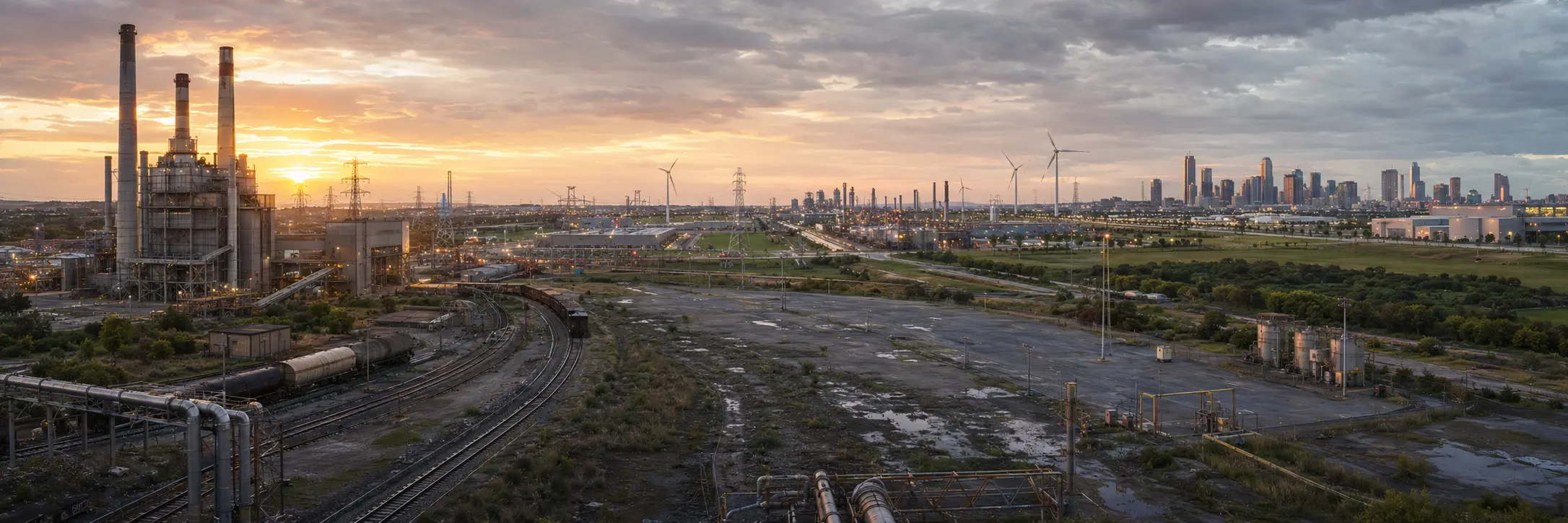
Infrastructure built for one energy regime does not automatically survive into the next.
The Structural Question
What happens to energy infrastructure when the conditions it was built for no longer hold? A coal plant designed for 40 years of operation in a world where coal is the cheapest fuel source becomes a different kind of asset in a world where solar and wind undercut it on marginal cost and regulation penalizes its emissions. The plant still works. The boiler still heats water. The turbine still spins. The generator still produces electricity. But the financial logic that justified building it no longer applies.
This is stranding — the state where infrastructure retains physical capability but loses economic viability. It is a structural consequence of building long-lived assets in a system where the conditions that justify those assets can change faster than the assets themselves age.
What Stranding Actually Means
Stranding is sometimes described as though it is a binary state — an asset is either stranded or not. In practice, stranding is a spectrum. At one end, an asset operates profitably under all plausible future scenarios. At the other end, an asset cannot cover its operating costs under any scenario and should be shut down immediately. Most assets at risk of stranding fall somewhere in between: they can still operate profitably under some conditions (high demand periods, favorable regulation, high commodity prices) but cannot earn enough over their remaining lifetime to justify their continued existence as an investment.
The financial definition of stranding focuses on whether remaining future cash flows justify the asset's book value. If they do not, the asset must be written down — its recorded value reduced to reflect the reality that it will not generate the returns originally expected. This write-down is an accounting event, but it reflects a physical reality: the infrastructure is still there, still functional, but the world it was built for has changed.
Infrastructure Lock-In
The core mechanism behind stranding risk is infrastructure lock-in. Energy infrastructure is capital-intensive, geographically fixed, and purpose-built. A coal plant cannot be converted to a solar farm. A natural gas pipeline cannot transmit electricity. A refinery configured for heavy crude cannot easily process light shale oil. The specificity that makes infrastructure effective at its designed purpose makes it inflexible when conditions change.
Lock-in operates at multiple levels. The physical asset is locked in to its function. The workforce is locked in to its skills. The supply chain is locked in to its relationships. The community is locked in to its economic dependence. When stranding occurs, all of these levels are affected simultaneously, which is why stranding creates political and social resistance even when it may be economically rational at the system level.
The timescale of lock-in matters enormously. A gas turbine with a 25-year expected life faces less lock-in risk than a coal plant with a 40-year expected life, simply because fewer things can change in 25 years than in 40. Shorter-lived infrastructure is inherently less vulnerable to regime change, though it has its own costs (more frequent replacement, as described elsewhere).
Where Stranding Risk Concentrates
Why do coal plants carry the largest stranding risk?
Coal plants represent the most immediate and largest concentration of stranding risk in the current energy system. Globally, approximately 2,100 GW of coal generation capacity exists, much of it built with 40-year design lives. In many markets, new renewable generation now produces electricity at lower cost than existing coal plants' operating costs — meaning it is cheaper to build new solar or wind than to continue burning coal in an already-built plant.
The geographic distribution of coal stranding risk is uneven. In the United States and Europe, coal capacity is declining and many plants are already operating at reduced capacity factors as they are displaced in the merit order by cheaper gas and renewables. In China and Southeast Asia, large fleets of relatively new coal plants (built in the 2000s and 2010s) face potential stranding over the coming decades if climate regulation tightens or renewable costs continue to fall. The average age of China's coal fleet is approximately 14 years — these are young plants with decades of remaining physical life.
Where does pipeline stranding risk come from?
Natural gas pipeline networks represent enormous embedded capital — trillions of dollars globally — built with 50-60 year design lives. These pipelines face potential stranding from two directions: electrification of heating and cooking (reducing residential and commercial gas demand) and displacement of gas generation by renewables plus storage (reducing power sector gas demand).
The stranding risk for pipelines is more gradual than for coal plants because gas plays multiple roles in the energy system — heating, power generation, industrial process heat, chemical feedstock — and not all of these roles face immediate displacement. But the fixed-cost nature of pipeline networks means that as volume declines, the cost per unit of gas delivered increases, potentially accelerating further demand reduction in a reinforcing cycle.
Why are refineries not equally exposed to stranding?
Oil refineries are among the most complex and capital-intensive industrial facilities, with individual plants costing $5-15 billion and designed for 40-50 year operational lives. Refineries face stranding risk from the potential decline in liquid fuel demand as transportation electrifies. But refineries are not homogeneous — they are configured for specific crude grades and optimized for specific product slates (gasoline-heavy, diesel-heavy, petrochemical-heavy). A refinery optimized for gasoline production in a market where gasoline demand declines faces a different stranding risk than one optimized for petrochemical feedstocks, where demand may continue to grow.
What makes nuclear stranding distinctive?
Nuclear plants face a distinctive stranding dynamic. Their design lives of 40-60 years are among the longest in the energy system, and their construction costs are among the highest. Nuclear stranding can occur from two directions simultaneously: economic stranding (when the cost of nuclear generation exceeds alternatives, making continued operation financially unviable) and regulatory stranding (when evolving safety requirements impose costs that exceed the value of continued operation).
The cost of nuclear decommissioning adds a dimension to nuclear stranding that other energy systems do not face to the same degree. A stranded coal plant can be shut down relatively cheaply. A stranded nuclear plant requires decades-long decommissioning at costs that can exceed the original construction cost. This means that nuclear stranding has consequences that extend far beyond the asset owner and the operating period.
Community Dependence and System Effects
Energy infrastructure is not just an asset — it is the economic foundation of communities. A coal plant employs hundreds of workers directly and supports thousands of indirect jobs through its supply chain. It generates property tax revenue that funds schools and services. It creates economic identity — communities become known as coal towns, refinery towns, pipeline towns.
When stranding threatens this infrastructure, the economic effects extend far beyond the balance sheet of the asset owner. Workers face job loss in specialized skills that may not transfer easily to other industries. Tax revenue declines, affecting public services. Property values fall as the economic base contracts. These cascading effects create political resistance to stranding regardless of whether stranding is economically rational at the system level.
Path Dependency
Once energy infrastructure is built, it creates constituencies. Workers depend on it for employment. Suppliers depend on it for revenue. Communities depend on it for tax base. Politicians depend on it for economic performance in their jurisdictions. These constituencies resist abandonment of the infrastructure regardless of system-level efficiency calculations, because their interests are concentrated and immediate while the benefits of transition are diffuse and future.
This path dependency means that the energy mix at any point in time is not simply the result of current technology and economics — it is the cumulative result of all previous infrastructure decisions and the constituencies those decisions created. The installed base of fossil fuel infrastructure worldwide represents not just physical assets but social and political structures that have co-evolved with those assets over decades.
Path dependency is not permanent, but it creates inertia. Systems change when the forces favoring change overcome the resistance created by existing constituencies. In energy, this happens when the economic advantage of new systems becomes large enough to create new constituencies (renewable energy workers, solar manufacturers, battery producers) that can counterbalance the constituencies of the old system. The speed of transition depends on how quickly this balance shifts.
The Timing Problem
Building energy infrastructure requires committing capital today based on demand assumptions that span decades. If demand grows as expected, the infrastructure earns its return. If demand grows faster than expected, there is a shortage. If demand grows slower than expected — or declines — the infrastructure is stranded.
The timing problem is asymmetric: the consequences of building too much infrastructure (stranding) and building too little (shortages) are not equivalent. Stranding destroys capital that has already been spent. Shortages create immediate economic pain but can be addressed with new construction. This asymmetry means that rational actors may prefer to under-build and risk shortages rather than over-build and risk stranding — but this preference depends on the cost structure of each energy system and the political tolerance for shortages versus financial losses.
Where This Appears Across Energy Systems
Stranding risk manifests differently across the energy system, but the underlying mechanism is consistent: long-lived assets built for one set of conditions encounter different conditions before the end of their physical lives.
Mining operations: Coal mines face stranding as coal demand declines. Unlike power plants, mines also face environmental remediation obligations that persist after closure — the stranding cost includes not just the lost asset value but the ongoing cost of managing the environmental legacy.
LNG export terminals: Liquefied natural gas terminals built for 30-40 year lifetimes face potential stranding if gas demand in importing countries declines faster than expected due to electrification and renewable deployment.
Transmission infrastructure: Transmission lines built to connect centralized power plants to demand centers may face partial stranding as distributed generation (rooftop solar, local batteries) reduces the volume of electricity flowing through the transmission network, increasing the cost per unit delivered.
Automotive manufacturing: Vehicle manufacturing facilities optimized for internal combustion engines face stranding as production shifts to electric vehicles — different drivetrain components, different assembly processes, different supply chains. This is infrastructure stranding in an adjacent system, driven by the same energy transition.
Diagnostic Boundaries
Analysis of stranding risk has clear limits that should be acknowledged explicitly:
Prediction vs. observation: Identifying which assets face stranding risk is observation — it involves examining cost structures, competitive dynamics, and regulatory trends. Predicting when specific assets will actually strand involves forecasting, which this analysis does not attempt. The timing of stranding depends on variables (technology cost trajectories, political decisions, demand patterns) that are not reliably predictable over the multi-decade timescales relevant to infrastructure.
Stranding is not inevitable: An asset identified as facing stranding risk may never actually strand. Technology trajectories may slow, regulation may reverse, demand patterns may shift. Risk identification describes vulnerability, not destiny.
Valuation complexity: The financial magnitude of stranding depends on accounting assumptions, discount rates, and regulatory frameworks that vary across jurisdictions. Estimates of global stranding exposure — which range from $1 trillion to $10+ trillion — are highly sensitive to these assumptions.
Transition complexity: Stranding analysis focuses on what happens to existing infrastructure but says little about what replaces it. The replacement infrastructure has its own costs, constraints, and vulnerabilities — the analysis of stranding does not imply that the replacement is structurally superior in all respects.