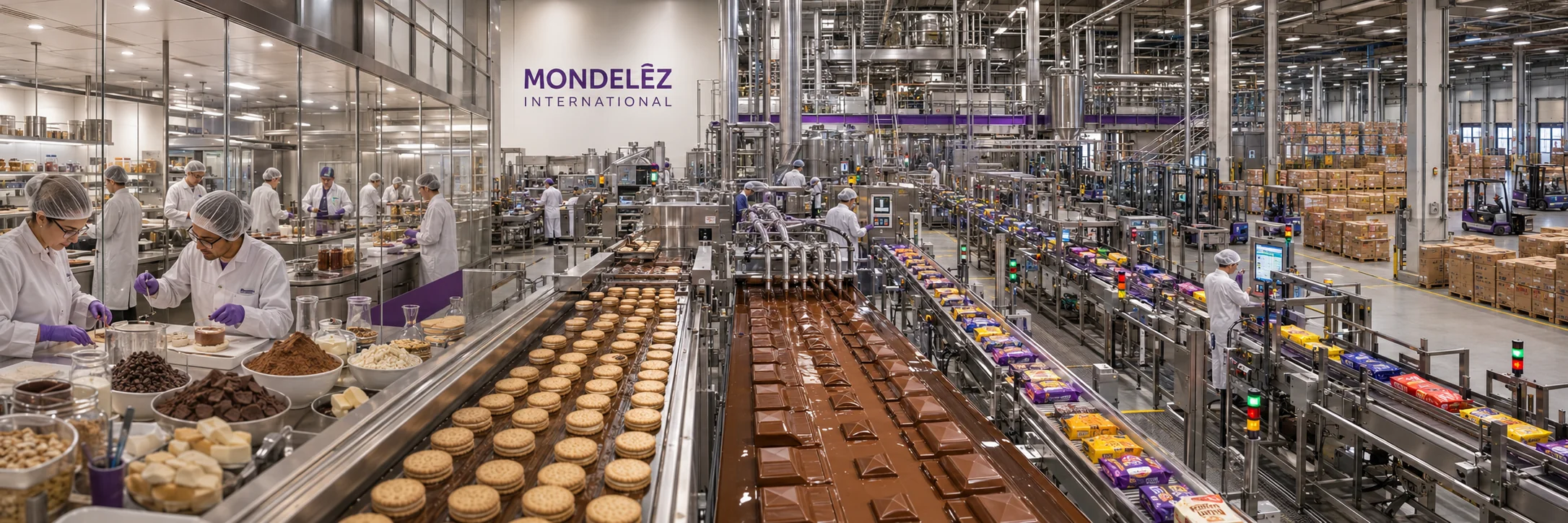
Separating global snacking from North American grocery concentrated the portfolio on categories where emerging market consumption growth, brand scalability, and impulse purchase economics compound at rates that staple food categories structurally cannot.
A structural look at how the Kraft Foods split created a pure-play global snacking company where brand power and cocoa supply concentration define the operating reality.
The Snacking Separation
Mondelez International (MDLZ) is commonly described as one of the world’s largest snack food companies. Structurally, it is the product of a deliberate corporate separation designed to isolate the economics of global snacking from the economics of North American grocery.
When Kraft Foods split in October 2012, the decision embodied a structural thesis — that snacking and grocery are fundamentally different businesses with different growth profiles, margin structures, and capital allocation requirements.
The brands that came with Mondelez — Oreo, Cadbury, Toblerone, Milka, Trident, Tang, belVita, Ritz — are not merely well-known. They occupy specific structural positions in their categories and geographies. Oreo is the world's best-selling cookie. Cadbury dominates chocolate in the United Kingdom, India, Australia, and much of the former British Commonwealth. Milka holds a leading position in European chocolate. Toblerone carries global recognition disproportionate to its revenue contribution. These brands are embedded in consumer routines across more than 150 countries, creating a distribution footprint whose scale is rivaled by only a handful of food companies globally — Nestlé being the most direct comparison, with PepsiCo (pep) and its Frito-Lay salty snack division competing for many of the same snacking occasions through an entirely different product set.
Understanding Mondelez requires examining why snacking as a category possesses structural advantages over traditional meal categories, how the Kraft separation was designed to unlock those advantages, why emerging market exposure — approximately 40 percent of revenue — creates both a growth engine and a persistent source of currency and political risk, and how the company navigates the tension between global brand consistency and the operational complexity of selling biscuits in Lagos, chocolate in Mumbai, and gum in São Paulo simultaneously. It also requires understanding the constraints the company operates under: concentrated cocoa supply chains vulnerable to disruption, evolving regulatory environments around sugar and nutrition labeling, activist investor pressures that reshaped corporate governance, and the inherent difficulty of growing volumes rather than relying on price increases in a category where consumers are willing to pay more but not necessarily willing to eat more.
The Long-Term Arc
Mondelez's history is unusual because the company in its current form is relatively young — it has existed as an independent entity only since 2012 — but the brands it carries are decades or in some cases more than a century old. The arc is not a single continuous corporate narrative but a story of assembly, merger, separation, and strategic refinement spanning multiple corporate identities.
How were the Mondelez brands assembled from Kraft?
The brands that became Mondelez were assembled over decades through some of the largest acquisitions in food industry history. James L. Kraft founded a wholesale cheese business in Chicago in 1903. Over the following century, the company bearing his name — through mergers with National Dairy Products, acquisitions of brands like Philadelphia cream cheese, Oscar Mayer, and Maxwell House, and eventually the 1988 acquisition by Philip Morris — grew into one of the largest food companies in the world. Philip Morris's ownership of both Kraft and General Foods, and the subsequent merger of these into Kraft General Foods, created a massive but unwieldy food conglomerate whose logic was financial rather than operational.
The Philip Morris era introduced a structural dynamic that would shape the company for decades: portfolio assembly driven by financial logic rather than operational coherence. The resulting entity contained brands spanning cheese, coffee, cereals, meats, snacks, beverages, and confectionery — categories with fundamentally different growth characteristics, competitive dynamics, and geographic opportunities. A block of Philadelphia cream cheese sold in an American supermarket and a Cadbury chocolate bar sold at a kiosk in Mumbai share a parent company but share almost nothing in terms of consumer behavior, distribution requirements, competitive positioning, or growth potential. The conglomerate held together because conglomerate structures in the food industry were considered normal — diversification was the strategy, and nobody questioned whether the diversified entity was the right unit of competition.
When Philip Morris spun off Kraft Foods in 2001 as a publicly traded entity, the company was enormous but unfocused. It was the second-largest food company in the world by revenue but lacked a coherent strategic identity. Was it a North American grocery company? A global snacking company? A coffee company? The honest answer was that it was all of these simultaneously, and the lack of clarity made capital allocation, talent allocation, and strategic planning a perpetual exercise in compromise.
What did the Cadbury acquisition give Kraft?
In 2010, Kraft Foods completed a hostile acquisition of Cadbury for approximately $19 billion — one of the largest transactions in the food industry's history and one of the most structurally significant. Cadbury brought a portfolio of chocolate and confectionery brands with deep penetration in markets where Kraft's existing snack brands had limited presence: the United Kingdom, India, Australia, South Africa, and throughout the former British Commonwealth. The combination of Kraft's biscuit and snack strength — particularly Oreo, which was already globalizing rapidly — with Cadbury's chocolate dominance in high-growth emerging markets created a global snacking portfolio of unprecedented breadth.
The Cadbury acquisition was controversial at the time. The hostile approach, the financing structure (which included some asset sales), and the cultural clash between Cadbury's British heritage and Kraft's American industrial management style generated significant public and political criticism, particularly in the United Kingdom. The closure of the Somerdale factory near Bristol — after Kraft had initially suggested it would remain open — became a symbol of the tensions inherent in cross-border food industry consolidation. Roger Carr, then Cadbury chairman, publicly criticized Kraft's approach, and the episode prompted changes to UK takeover rules designed to give target company boards more time and information during hostile bids. But structurally, the acquisition accomplished precisely what it was designed to accomplish: it gave Kraft a chocolate and confectionery portfolio with global reach, particularly in emerging markets where chocolate consumption was growing at multiples of developed market rates.
The Cadbury acquisition also made the structural tension within Kraft Foods impossible to ignore. The combined company now contained two fundamentally different businesses. One was a slow-growth North American grocery portfolio — cheese, meats, coffee, cereals — competing in mature categories where private-label penetration was rising and volume growth was negligible. The other was a high-growth global snacking portfolio — biscuits, chocolate, confectionery, gum — competing in categories with structural tailwinds from urbanization, rising incomes in emerging markets, and the secular shift toward snacking occasions. Combining these two businesses in a single entity forced capital allocation compromises that served neither optimally. Every dollar invested in maintaining the North American cheese business was a dollar not invested in expanding Oreo distribution in China or Cadbury distribution in rural India.
What did Nelson Peltz push Kraft to do?
The tension between the two businesses did not go unnoticed by the investment community. Nelson Peltz and his firm Trian Fund Management took a significant stake in Kraft Foods beginning in 2012 and pushed aggressively for structural changes — including the separation of the company into two entities. Peltz's thesis was straightforward: the conglomerate discount was real and measurable, the two businesses required different strategies and different management approaches, and shareholders would be better served by two focused companies than by one diversified entity trying to serve two masters.
Peltz's activist campaign was not the sole cause of the split — management had been considering the separation independently — but it accelerated the timeline and intensified the pressure to execute. Peltz eventually joined the Mondelez board, where he continued to push for margin improvement, cost discipline, and strategic focus. His presence on the board through the mid-2010s was a persistent source of pressure on management to demonstrate that the post-split entity could deliver not just top-line growth from its advantaged category position but also the margin expansion necessary to translate revenue into shareholder returns. The Peltz campaign illustrated a broader pattern in the food industry during this period: activist investors identifying conglomerate structures as sources of value destruction and pushing for separations that had been discussed internally but not acted upon.
Peltz's influence extended beyond the split itself. His emphasis on operational efficiency and margin expansion helped shape the restructuring programs that followed the separation. The multi-year supply chain transformation, the focus on cost discipline, and the relentless attention to operating margin — all hallmarks of Mondelez's post-split strategy — bore the imprint of activist pressure even after Peltz eventually reduced his involvement. Whether this pressure was beneficial or merely extracted short-term returns at the expense of long-term investment remains a matter of debate. What is clear is that the activist campaign changed the company's trajectory and accelerated structural decisions that might otherwise have taken years longer to execute.
How did the 2012 split divide Kraft's businesses?
In October 2012, Kraft Foods split into two independent publicly traded companies. Kraft Foods Group retained the North American grocery portfolio — brands like Kraft Macaroni & Cheese, Oscar Mayer, Maxwell House, Jell-O, and Velveeta. Mondelez International inherited the global snacking portfolio — Oreo, Cadbury, Toblerone, Trident, Tang, Ritz, belVita, and dozens of other brands sold across more than 150 countries. The name "Mondelez" — derived from the Latin "mundus" (world) and "delez" (suggesting delicious) — was invented for the occasion, a linguistic construction that carried no historical weight but signaled the company's intended identity: a global snacking company, not an American food conglomerate.
The structural thesis behind the split was explicit. Snacking and grocery are not merely different product categories — they are different businesses with different investment requirements. The grocery business needed margin defense, cost efficiency, and portfolio rationalization in a low-growth domestic market. The snacking business needed investment in emerging market distribution, brand building in high-growth categories, and the operational agility to compete across dozens of countries simultaneously. A single management team, a single capital allocation framework, and a single organizational structure could not optimize both simultaneously. The split was an admission that conglomerate structure in food — once considered an advantage for its diversification benefits — had become a structural impediment to both businesses reaching their potential.
The subsequent trajectory of both companies confirmed the structural logic. Kraft Foods Group merged with Heinz in 2015 to create Kraft Heinz — a combination driven by cost-cutting logic under 3G Capital's management, which subsequently struggled with brand reinvestment and wrote down billions in goodwill. Mondelez pursued a growth-oriented strategy focused on expanding snacking share in emerging markets, investing in power brands, and extracting operational efficiencies through a supply chain transformation program. The two companies, once joined, were now pursuing strategies so different that their separation seemed, in retrospect, inevitable. The divergence in both strategic direction and shareholder returns in the years following the split became one of the clearest case studies in the food industry of why structural clarity matters.
Why did Mondelez need a margin expansion program after the split?
After the split, Mondelez embarked on a multi-year restructuring and margin expansion program. The company inherited a cost structure that reflected decades of acquisition-driven growth without corresponding operational integration. Factories were suboptimal — many were legacy facilities designed for local markets rather than for efficient production at scale. Supply chains were fragmented by geography and legacy organizational boundaries. Selling, general, and administrative costs consumed a larger share of revenue than peers like Nestlé or PepsiCo's (pep) Frito-Lay division.
The restructuring — internally framed as a transformation rather than mere cost-cutting — involved consolidating manufacturing facilities, automating production lines, rationalizing product assortments, and investing in a modernized supply chain network. The goal was to bring Mondelez's operating margins closer to peer levels, freeing resources for reinvestment in growth — particularly brand investment in emerging markets and innovation in snacking categories. By the mid-2020s, the company had expanded operating margins substantially from post-split levels, narrowing the gap with best-in-class peers, though the full margin potential continued to be debated by analysts who disagreed about where the ceiling lay.
Simultaneously, Mondelez sharpened its portfolio focus around what it termed "power brands" — the subset of its portfolio that generated disproportionate revenue and growth. Oreo, Cadbury, Milka, Toblerone, belVita, Ritz, and a handful of others received the majority of marketing investment and innovation attention. Smaller, less scalable brands were deprioritized or divested. This power brand strategy reflected a structural insight: in global snacking, a small number of brands with deep consumer connections across multiple geographies generate most of the value. Spreading investment thinly across hundreds of local brands dilutes returns; concentrating it on brands with global scalability compounds them. The discipline required to maintain this focus — to resist the temptation to invest in a beloved local brand that will never scale — is one of the less visible but more important aspects of Mondelez's post-split evolution.
Why did Mondelez bid for Hershey?
In 2016, Mondelez made an unsolicited bid to acquire Hershey (hsy) — reportedly valued at approximately $23 billion. The strategic logic was apparent: combining Mondelez's global chocolate and biscuit portfolio with Hershey's dominant North American chocolate position would create the world's largest confectionery company, with unmatched scale in both developed and emerging markets. For Mondelez, the deal would have addressed a persistent structural gap — its relatively modest chocolate market share in the United States, where Hershey's dominance through brands like Reese's, Hershey's Kisses, and the licensed US Kit Kat created a category position that was nearly impossible to replicate organically.
The Hershey Trust — which controls the majority of Hershey's voting shares and exists to fund the Milton Hershey School — rejected the approach. Without a path to acquiring voting control, Mondelez withdrew. The episode revealed a structural constraint on consolidation in the food industry: not all targets are available regardless of price. Governance structures, trust provisions, and cultural resistance to foreign ownership can block transactions that make strategic sense on paper. For Mondelez, the failed bid meant that its US chocolate position would need to be built organically or through smaller acquisitions — a slower and less certain path than the transformative deal it had sought.
The failed Hershey bid also reflected a broader strategic question facing Mondelez: whether to pursue consolidation within its existing categories (chocolate, biscuits, confectionery) or to expand into adjacent snacking categories. The company's subsequent moves — including investments in healthier snacking, premium chocolate, and digital direct-to-consumer channels — suggested a preference for category evolution over mega-mergers, though the possibility of further large-scale acquisitions was never foreclosed. The bid attempt itself, however, was informative: it revealed what Mondelez's management considered its most significant structural weakness, and the withdrawal revealed the kinds of barriers that financial resources alone cannot overcome.
What is the tension between volume and price for Mondelez?
A defining challenge of Mondelez's post-split era — and one shared by many branded consumer staples companies — has been the tension between volume growth and price-driven growth. The company has demonstrated consistent ability to raise prices, particularly during inflationary periods when input costs rise and consumers accept higher shelf prices as part of a broader inflationary environment. But price increases without corresponding volume growth represent a structurally different kind of business than one growing through both channels. Price-driven growth is real and valuable — it flows directly to margin — but it is also inherently limited. Prices cannot increase indefinitely, and consumers eventually adjust their behavior, either by purchasing less frequently, trading down to smaller sizes, or switching to alternatives.
The volume question is particularly acute in developed markets — Europe and North America — where per-capita snacking consumption is already high and population growth is modest. In these markets, volume growth depends on market share gains, category expansion through innovation, or shifts in consumption occasions. In emerging markets, the volume opportunity is more structural: rising incomes and urbanization bring new consumers into the branded snacking market for the first time. Mondelez's geographic mix — with meaningful emerging market exposure — provides access to this structural volume growth, but it also means that the company's volume trajectory is partially a function of economic development patterns in countries like India, Brazil, and Indonesia, patterns that are uneven and subject to setbacks.
Management has consistently framed the company's growth algorithm as a combination of volume, price, and mix — where mix improvement means selling more premium or higher-margin products within the existing portfolio. This three-legged approach is sensible in theory, but in practice, quarterly results reveal which leg is doing the work. Periods of strong pricing and weak volume invite the question of whether the company is harvesting brand equity or investing in it. Periods of strong volume but modest pricing suggest that the company is competing on affordability rather than brand premium. The tension between these modes is not a problem to be solved but a permanent feature of operating in branded consumer goods at global scale.
What is Mondelez's structural position today?
Today, Mondelez International operates as a focused global snacking company with a portfolio concentrated in biscuits, chocolate, gum and candy, and adjacent snacking categories. The company generates revenue across more than 150 countries, with a revenue mix that is more geographically diversified than most American-headquartered food companies — approximately a third from Europe, a quarter from North America, and the remainder from Latin America, Asia Pacific, the Middle East, and Africa. This geographic diversification is the structural inheritance of the Cadbury acquisition and decades of international brand building.
The company's competitive position varies substantially by category and geography. In biscuits, Mondelez holds the global leadership position, with Oreo as the category's most recognized brand worldwide. In chocolate, the company holds strong positions in Europe (through Milka and Cadbury brands), in India (through Cadbury Dairy Milk, which commands a dominant market share), and in several other emerging markets, but faces intense competition from Mars, Nestlé, Ferrero, Hershey (hsy), and Lindt across different geographies. In gum and candy, structural challenges in the gum category — where consumer interest has declined in several developed markets as habits shifted — have offset growth in candy. The portfolio's strength lies not in dominance across every category and geography but in the breadth of its presence and the depth of its strongest brand-market combinations.
The competitive set varies depending on the lens applied. In chocolate globally, Mondelez competes with Mars, Nestlé, Ferrero, Hershey (hsy), and Lindt. In biscuits globally, the competition includes local and regional players in nearly every market. For the broader snacking occasion — the moment when a consumer decides to eat something between meals — PepsiCo's (pep) Frito-Lay division is perhaps the most formidable competitor, not because it sells the same products but because it competes for the same consumption moment. A consumer reaching for a snack may choose between an Oreo and a bag of Doritos, making the competitive boundary much wider than product category definitions suggest.