 CompanyGraph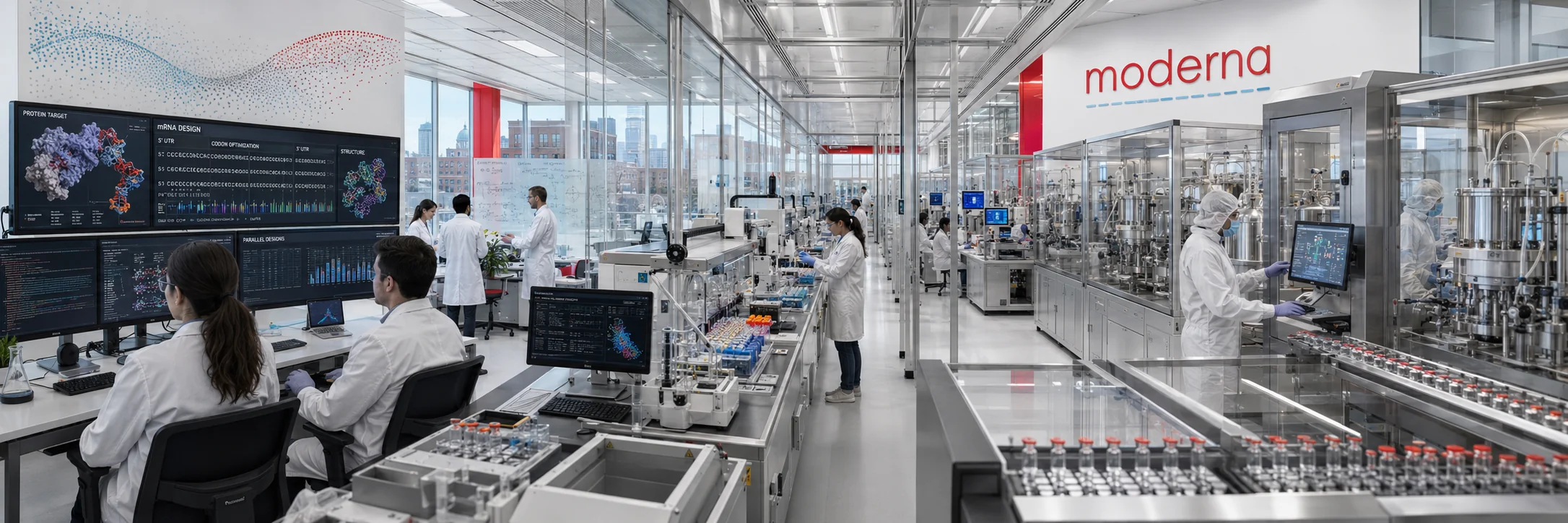
A platform becomes a medicine only when a particular sequence, formulation, evidence package, manufacturing route, and patient need meet.
The platform existed before the product
Messenger RNA is an instruction molecule, not a treatment by itself. A therapeutic or vaccine must protect and deliver the RNA, cause the intended cells to produce a protein, generate the desired immune or biological response, and do so safely for a defined population. The platform can make some steps repeatable, but it does not make every sequence, indication, dose, or outcome interchangeable.
Moderna spent most of its first decade building research, delivery, manufacturing, and clinical capabilities without an approved commercial product. That period was not an empty prelude. It was infrastructure financed against uncertain evidence. But infrastructure is not proof of a medicine. A candidate can fail because the target is wrong, the response is weak, the dose is unsafe, the formulation is unstable, or the manufacturing route cannot support the required scale.
The pandemic shortened several clocks
Emergency demand, public purchasing, accelerated trials, and global manufacturing investment allowed Moderna's COVID vaccine to reach people at a speed that ordinary development rarely permits. The event created a commercial product and a large operating system at the same time: suppliers, fill-finish capacity, cold-chain distribution, regulators, clinicians, and public-health programs all had to align.
The extraordinary market also hid some normal uncertainty. A pandemic can create a large synchronized buyer and urgency that pays for capacity before long-term seasonal demand is known. When the market becomes endemic, manufacturers must forecast timing, variant updates, competition, reimbursement, and wastage without the same emergency purchasing structure.
Each product needs its own evidence
Moderna's 2025 Form 10-K reports three commercial products: Spikevax and mNEXSPIKE for COVID-19 and mRESVIA for RSV. It also describes a pipeline across infectious disease, oncology, and rare disease. The list shows a platform moving into products; it does not show that an early candidate will become an approved treatment.
A clinical trial observes a defined population under a protocol. Regulatory review evaluates the submitted evidence for a specified indication and use. A manufacturing record shows what was made and tested. A vial shows that a product reached a site. An administered dose and a patient's later immune or clinical result are different observations. FDA post-market monitoring exists because approval does not reveal every outcome that appears after broad use.
Manufacturing must follow demand it cannot fully see
mRNA production needs controlled raw materials, enzymatic reactions, purification, formulation, sterile filling, testing, packaging, and cold-chain or stability management. Some equipment and process knowledge can serve several products; the exact sequence, dose, release test, and regulatory file remain product-specific. A plant can have room while lacking a qualified route for the next candidate.
Money arrives before certainty. Moderna funds research, clinical trials, manufacturing, and regulatory work before a product has approval or reliable sales. In 2025 the company reported $1.9 billion in revenue, largely from COVID vaccines. That revenue can finance the pipeline and cost reductions, but it cannot guarantee that the pipeline will produce a replacement product at the required time.
From windfall to seasonal portfolio
COVID vaccine demand was tied to a global event. Seasonal respiratory products face different purchasing calendars and a different relationship between supply and actual administration. A manufacturer may have a viable dose while a clinic lacks appointments, a payer has not covered it, or demand arrives later than the filling schedule. Wasted inventory is not necessarily a manufacturing defect; it can arise from presentation, timing, and session design.
Moderna is therefore trying to carry a platform from one dominant product into multiple indications. Oncology, rare disease, influenza, RSV, and combination vaccines require different trials, partners, patient populations, and commercial routes. The platform can share delivery and manufacturing learning, but each product must earn its own clinical function.
Feedback continues after administration
Adverse-event reports, effectiveness studies, lot records, supply data, and clinical practice can reveal a problem or a useful signal. A report is not automatically a causal finding, and a temperature record is not automatically proof of potency. To correct a problem, the signal must be connected to the right product, batch, patient group, process, and organization with authority to investigate and change the next run or recommendation.
The company can change formulation, manufacturing, trial design, or guidance. Regulators can change labeling or requirements. Clinics and public-health systems can change scheduling and distribution. Patients can report outcomes, but they cannot by themselves correct a production or reimbursement decision. The route remains distributed even when the platform is centralized.
What Moderna must preserve
Moderna's durable capability is not the word “platform.” It is the maintained connection from sequence design to a qualified product, evidence-based use, supply at the right time, and learning after administration. The pandemic proved that the organization could move through that route quickly under exceptional conditions. The post-pandemic test is whether it can finance and operate several ordinary routes before the previous windfall has disappeared.
That is a harder problem than repeating a successful launch. It requires enough evidence, capacity, money, and patient demand to remain connected while every disease, season, and regulatory path imposes a different clock.