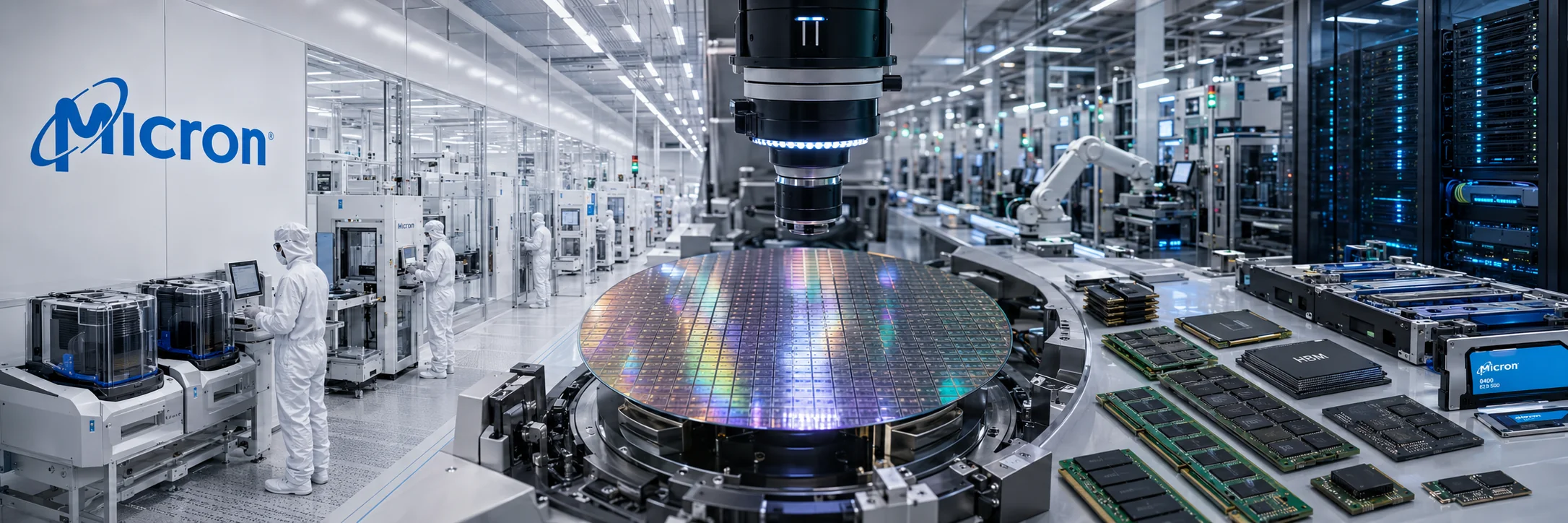
Memory supply is measured in qualified bandwidth and timing, not only in wafers, bits, or factory space.
The useful product is a memory function
A computer does not need a tonne of semiconductor. It needs memory that can store and move data at the speed, density, power level, interface, and reliability required by a processor and its software. DRAM, NAND, high-bandwidth memory, modules, and packages perform different jobs. A large inventory of one type cannot automatically replace a shortage of another.
This gives Micron a peculiar position. Memory cells are often priced as if they were interchangeable bits, yet making those bits requires advanced lithography, materials, yield control, packaging, testing, and years of process learning. The company is both exposed to commodity cycles and dependent on frontier engineering.
From wafer to qualified memory
Silicon wafers pass through repeated deposition, patterning, etching, implantation, cleaning, and inspection steps. A wafer contains many dies, but not every die works, and a working die is not automatically a sellable product. DRAM and HBM also require packaging and test. HBM stacks memory dies and connects them to a wide interface; the stack, package, thermal behavior, and system design must all meet a customer's requirements.
A factory's installed tools therefore do not establish qualified output. Process generation, product design, yield, packaging capacity, test equipment, and customer validation all narrow the result. The same fab can have room on the floor while lacking the process or package needed for a particular HBM configuration.
AI changes the narrow end of the market
AI accelerators move large volumes of data and can be constrained by memory bandwidth rather than arithmetic alone. Micron's fiscal 2025 materials report $10 billion of combined revenue from HBM, high-capacity DIMMs, and LP server DRAM, more than five times the prior fiscal year. That growth shows a change in mix, not the end of memory cyclicality.
HBM is not simply DRAM with a new label. It adds stack assembly, advanced packaging, thermal and power requirements, and qualification with a particular accelerator and system. A customer can want more HBM while having no immediate use for another DRAM density or interface. The bottleneck moves from “how many bits exist?” to “which qualified bits can pass through the required package and system?”
Capital arrives long before the next wafer
Memory makers must decide on equipment, clean-room space, utilities, materials, engineering teams, and suppliers before demand is fully known. Micron's 2025 filing describes a Boise fab whose first DRAM wafer output is projected for the second half of calendar 2027, along with plans in New York, Virginia, Singapore, Japan, Taiwan, and elsewhere. That timetable demonstrates the physical delay between a capacity decision and qualified output.
Public incentives and customer commitments can make a project financeable, but they do not remove construction, yield, qualification, or demand risk. During a downturn, a new fab can add depreciation and cash needs before prices recover. During an upswing, existing capacity can be sold while a future fab is still concrete and steel.
The cycle is built into the route
When prices rise, customers order more and manufacturers invest. By the time new capacity qualifies, customers may have reduced orders, redesigned systems, or shifted to a different generation. When prices fall, producers cut starts and delay equipment, which eventually tightens supply again. The cycle is not only investor psychology; it follows from long construction times, uncertain demand, yield learning, and the fact that memory products change faster than buildings.
Inventory is another partial observation. A distributor may hold memory, but the item can be committed to a customer, an older interface, or a system that is no longer in production. A bit-shipment number records volume; it does not establish that the right package will be available when an engineer's qualification window closes.
Records and feedback preserve the product identity
Wafer maps, lot records, test results, package identity, customer qualification, and field failure reports connect a die's history to a system's behavior. A test can establish performance under defined conditions, not every future workload. A purchase order can establish what was requested, not whether the delivered memory was installed correctly or remains reliable after years of heat.
When a failure appears, correction may belong to Micron, a package supplier, a board designer, an accelerator maker, or a system integrator. If the lot and configuration survive, the cause can travel backward. If they are lost in a module or inventory record, the industry can see a failure without knowing which process to change.
What Micron's position preserves
Micron's durable capability is the connection from process technology to qualified memory at the moment a customer needs it. The company benefits from scale and from the concentration of memory production, but it remains exposed to the physical facts that make memory difficult: huge capital requirements, long lead times, changing interfaces, yield, packaging, and a market that can treat a highly engineered product as a commodity.
AI may create a longer period of scarcity in some memory products. It does not repeal the cycle. The next result depends on which capacity is being built, when it qualifies, which customers can use it, and whether the money to keep investing arrives before the physical route changes again.
Inside CompanyGraph
View this perspective inside CompanyGraph.
 CompanyGraph