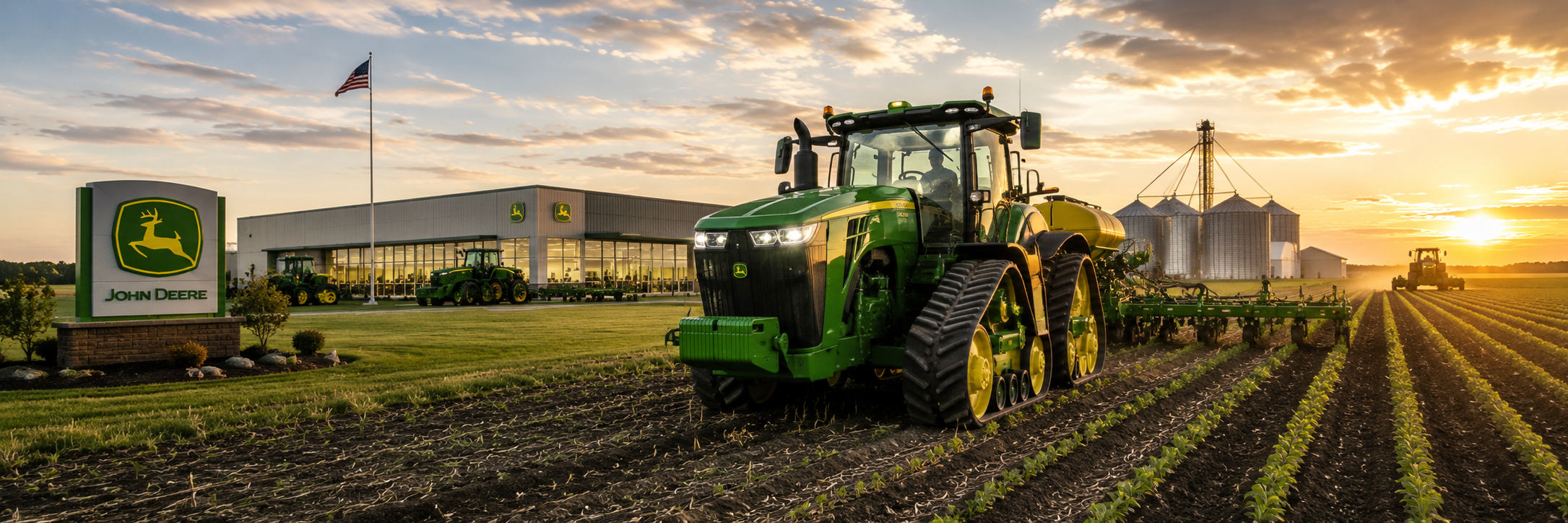
A dealer network moat combined with precision agriculture data creates dual-layer switching costs where mechanical equipment dependency is reinforced by digital workflow lock-in that compounds with every season of field data accumulated on the platform.
A structural look at how a plow company built layered competitive advantages where each generation of technology deepens the moat rather than displacing it.
Introduction
What appears from a distance to be a straightforward equipment manufacturer reveals, on closer examination, a layered structural position. Deere (DE) & Company—universally known as John Deere—makes the machines that feed the world, but the physical equipment is only the most visible layer. Beneath it sits a dealer network that provides service, parts, and financing—a distribution system that took over a century to build and that competitors cannot replicate in any reasonable timeframe. And on top of both sits a newer layer: precision agriculture technology that collects field-level data, optimizes planting and application decisions, and creates digital switching costs that compound the mechanical ones.
Tractors, combines, planters, and sprayers bearing the leaping deer logo operate on farms across every major agricultural region. The company's equipment is essential infrastructure for modern food production, converting labor and fuel into planted seeds and harvested crops at industrial scale.
Understanding Deere's arc reveals how competitive advantages can be layered across physical, institutional, and digital dimensions—and how the tensions between technology control and customer autonomy can emerge even in industries far from Silicon Valley.
The Long-Term Arc
How did a blacksmith's steel plow start John Deere?
John Deere the man was a blacksmith in Grand Detour, Illinois, who in 1837 developed a steel plow that could cut through the heavy, sticky prairie soil of the American Midwest. Cast iron plows—designed for the sandy soils of the eastern seaboard—failed in prairie conditions. The steel plow solved a specific, urgent problem for farmers expanding westward, and demand followed immediately.
The company that grew from this invention expanded through the late nineteenth and early twentieth centuries into a full-line agricultural equipment manufacturer. Tractors, harvesting equipment, and implements joined the product line. Each addition deepened the relationship with farmers who preferred to source equipment from a single trusted manufacturer. The brand accumulated meaning—reliability, durability, and suitability for serious agricultural work.
Critically, Deere built its dealer network during this foundational period. Independent dealers—often family businesses passed through generations—established local presence in farming communities. These dealers sold equipment, provided service, stocked parts, and arranged financing. They were embedded in the social and economic fabric of rural life in ways that a corporate sales force could never replicate.
What drove Deere's industrial scaling and global expansion?
Through the mid-twentieth century, Deere scaled manufacturing and expanded internationally. The mechanization of agriculture in North America, Europe, and eventually South America and Asia created sustained demand for equipment. Farm sizes grew, labor costs rose, and the economic logic of mechanization strengthened with each decade.
Deere's competitive position solidified during this period through a structural feedback loop. Larger market share supported larger dealer networks. Larger dealer networks provided better parts availability and service coverage. Better service coverage attracted more customers. The loop was difficult for smaller competitors to enter—without the installed base, they could not justify the dealer network, and without the dealer network, they could not grow the installed base.
The company also diversified into construction and forestry equipment, creating additional revenue streams that partially offset agricultural cyclicality. This diversification shared manufacturing capabilities and dealer infrastructure across end markets, improving utilization of fixed assets.
How did precision agriculture change Deere's equipment?
Beginning in the late 1990s and accelerating through the 2010s, Deere added a technology layer to its equipment business. GPS-guided steering systems, variable-rate planting and application technology, yield monitoring sensors, and data management platforms transformed tractors and combines from purely mechanical tools into data-collecting, software-driven systems.
The acquisition of precision agriculture companies—most notably Blue River Technology in 2017 for its computer vision and machine learning capabilities—signaled the strategic importance of this layer. Deere's Operations Center platform aggregates field data across equipment, enabling farmers to analyze yields, optimize inputs, and plan operations based on accumulated data from their specific fields.
This technology layer creates a new category of switching costs. A farmer who has accumulated years of field-level data in Deere's ecosystem—planting records, yield maps, soil variability data, input application histories—faces significant friction in moving to a competitor's platform. The data itself becomes a reason to stay, independent of the mechanical quality of the equipment. Physical switching costs and digital switching costs now reinforce each other.
Where does John Deere stand today?
Today, Deere is the world's largest agricultural equipment manufacturer by revenue and market capitalization. The company holds dominant positions in large tractors and combines in North America and significant share in South America and Europe. The dealer network spans thousands of locations globally. Precision agriculture technology is integrated into the majority of new equipment.
The financial structure reflects the layered business model. Equipment sales drive the majority of revenue but carry cyclical volatility. Parts and service revenue—flowing through the dealer network—provides more stability. Financial services—equipment loans and leases—generate interest income and deepen customer relationships. And increasingly, technology subscriptions and data services add a recurring revenue component that did not exist a generation ago.
 CompanyGraph