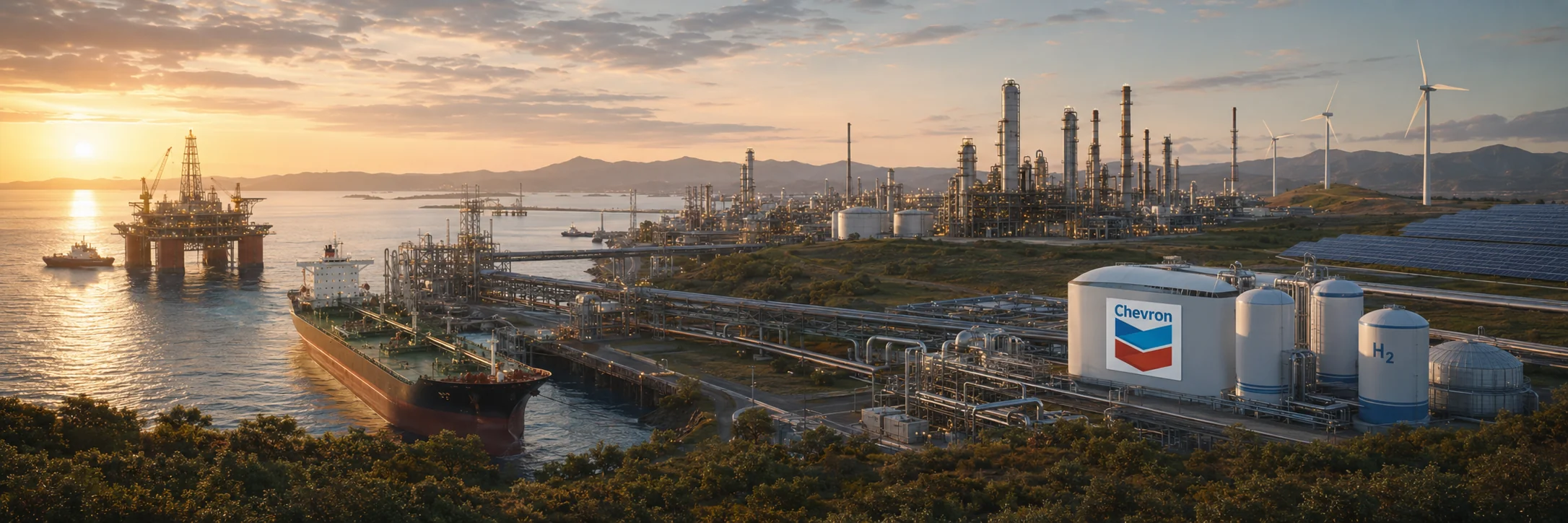
Disciplined capital allocation through commodity cycles preserves balance sheet strength that enables opportunistic investment when competitors are capital-constrained, while the Permian Basin position provides low-cost production that sustains returns across price environments.
A structural look at how an integrated architecture creates internal hedges across commodity price regimes that allow a century-old oil company to endure what would break a less diversified operator.
Introduction
Chevron (CVX) is the second-largest publicly traded oil and gas company in the United States by market capitalization, trailing only ExxonMobil. Its operations span the full hydrocarbon value chain — exploration and production of crude oil and natural gas, refining those raw materials into fuels and lubricants, transporting and marketing finished products, and manufacturing petrochemicals. This integrated architecture is not incidental. It is a structural design that creates internal hedges across commodity price regimes, enables capital efficiency through shared infrastructure, and generates the kind of cash flow durability that allows the company to maintain dividends through downturns that would break less diversified operators.
Chevron's lineage traces to the same industrial origin as ExxonMobil. Standard Oil of California — one of the 34 fragments created by the 1911 Supreme Court antitrust ruling against John D. Rockefeller's Standard Oil Trust — evolved through a series of mergers and name changes into the Chevron that exists today. The 2001 merger with Texaco, itself a descendant of The Texas Company founded in 1901, created a combined entity with global upstream positions, substantial refining capacity, and a presence in LNG that would become increasingly important as natural gas markets globalized. Understanding Chevron requires understanding this accumulated geological, operational, and organizational capital — assets that took over a century to assemble and that cannot be replicated by writing a check.
What makes Chevron structurally interesting is not merely its size but the particular configuration of its asset base and the philosophy that governs how capital moves through the system. The company has concentrated its upstream portfolio around a smaller number of large, high-quality resource positions — the Permian Basin, the deepwater Gulf of Mexico, liquefied natural gas projects in Australia and elsewhere, and legacy positions in Kazakhstan and West Africa. This concentration is a deliberate choice. It trades optionality for depth, betting that owning the best rocks and operating them with discipline generates better long-term returns than spreading capital across a wider set of marginal opportunities. Whether this structural bet proves correct depends on variables — commodity prices, regulatory regimes, the pace of energy transition — that unfold over decades, not quarters.
The Long-Term Arc
How did Standard Oil of California become a global operator?
Standard Oil of California, commonly known as SoCal, inherited the western operations of Rockefeller's empire after the 1911 breakup. While other Standard Oil fragments focused on refining and distribution in the eastern United States, SoCal's asset base pointed outward — toward exploration in California, the Middle East, and eventually Southeast Asia. This geographic orientation was consequential. SoCal participated in the discovery of oil in Bahrain in 1932 and Saudi Arabia in 1938, becoming one of the founding members of the Arabian-American Oil Company (Aramco). These early Middle Eastern positions gave SoCal — and later Chevron — access to some of the lowest-cost hydrocarbon reserves on the planet.
The Middle Eastern concessions shaped Chevron's organizational DNA in ways that persist today. Operating in sovereign nations where the host government controls the resource requires diplomatic skill, long-duration commitment, and the ability to navigate political complexity that purely domestic operators never encounter. The relationship between international oil companies and host governments is inherently asymmetric — the geology is immobile, but the terms of access are not. SoCal learned early that resource access is as much a political achievement as a geological one. Governments grant concessions, revise fiscal terms, and occasionally nationalize assets outright. This capability — managing relationships with sovereign entities that control what lies beneath their surface, adapting to shifting political conditions without losing access — remains relevant today in Kazakhstan, Nigeria, Angola, and other jurisdictions where Chevron operates substantial upstream positions.
The Gulf Oil acquisition in 1984 was the first of the transformative mergers that built modern Chevron. Gulf, itself a Standard Oil fragment with origins in the Spindletop gusher of 1901, brought substantial reserves, refining assets, and a presence in West Africa that complemented SoCal's existing portfolio. The deal was, at the time, the largest corporate merger in American history. It established the pattern that would define Chevron's growth strategy for the next four decades: acquiring entire portfolios of upstream assets through corporate combinations rather than assembling positions field by field. The Gulf acquisition also introduced Chevron to the politics of hostile takeovers — Gulf had been under pressure from corporate raider T. Boone Pickens, and Chevron emerged as the white knight. The episode foreshadowed an industry where consolidation would become the primary mechanism for reserve replacement.
What did the Texaco merger bring Chevron?
Chevron's 2001 acquisition of Texaco created ChevronTexaco — later simplified back to Chevron — and represented the second major reconsolidation of Standard Oil fragments. Texaco brought deepwater Gulf of Mexico positions, international upstream operations, a substantial downstream refining and marketing network, and a consumer-facing brand with recognition across the American gasoline market. The combination created a genuinely global integrated company with the scale to compete in an industry where project sizes had grown to require tens of billions in capital.
The merger occurred during a period of industry consolidation driven by structural economics. Oil and gas projects were growing larger, more technically complex, and more capital-intensive. Deepwater developments in water depths exceeding 5,000 feet, LNG liquefaction plants processing billions of cubic feet of gas per day, and heavy oil extraction projects requiring specialized steam injection and upgrading infrastructure — all demanded capital commitments that only the largest companies could fund. The supermajor model — a small number of very large, vertically integrated companies — emerged as the industry's structural response to these capital requirements. Chevron, ExxonMobil, Shell, BP, and TotalEnergies became the five Western companies capable of deploying the capital, technology, and project management expertise required by the industry's most complex undertakings.
Within this peer group, Chevron carved out a distinct identity. Where ExxonMobil pursued maximum scale and operational efficiency across an even larger asset base, and Shell invested aggressively in LNG and later pivoted toward renewable energy and power trading, Chevron emphasized capital discipline and shareholder returns. The company's rhetoric and resource allocation consistently prioritized returning cash to shareholders over pursuing growth for its own sake. This was not merely corporate messaging. It reflected a structural calculation about the oil industry's maturity and the diminishing returns available from incremental investment in an industry facing long-term demand uncertainty. Among the supermajors, Chevron positioned itself as the one most explicitly aligned with shareholders seeking cash returns rather than production volume growth — a positioning that would prove consequential during the capital discipline reckoning of the late 2010s.
How did Chevron build its Permian Basin position?
Chevron's position in the Permian Basin — the vast oil-producing formation spanning western Texas and southeastern New Mexico — is arguably the single most important asset in its portfolio. The company holds approximately 2.2 million net acres in the Permian, making it one of the largest acreage holders in the basin alongside ExxonMobil. This position was not acquired through a single dramatic transaction. It accumulated over decades, through legacy holdings inherited from Standard Oil of California's early California and Texas operations, augmented by the Texaco merger which added Texaco's own Permian acreage, and supplemented by targeted bolt-on acquisitions that filled in gaps across the company's existing footprint.
The Permian Basin possesses characteristics that make it structurally distinct from most other oil-producing regions on the planet. Multiple stacked geological formations — the Wolfcamp, Bone Spring, Spraberry, and other zones — lie beneath the same surface acreage, meaning a single lease can access multiple layers of hydrocarbon-bearing rock at different depths. This stacking effect multiplies the recoverable resource beneath each acre, extending the productive life of each lease far beyond what a single-zone formation could support. The geology is well understood after more than a century of drilling activity in the basin, reducing exploration risk to near zero — an operator in the Permian knows, with high confidence, what lies beneath the surface before drilling begins. Existing infrastructure — gathering pipelines, processing plants, trunk pipelines to Gulf Coast refineries, roads, water disposal systems, sand mines for hydraulic fracturing — is already in place, reducing the capital required to bring new wells online. And the breakeven cost of production is among the lowest in the world, meaning Permian barrels remain profitable at commodity prices that render production in other basins uneconomic.
Chevron has invested heavily in applying manufacturing-style efficiency to Permian drilling. Rather than treating each well as a unique engineering project, the company has standardized well designs, optimized drilling sequences across multi-well pads, reduced the number of days required to drill and complete each well, and applied data analytics to improve well placement and completion design. This operational approach transforms shale extraction from a series of individual projects into a repeatable industrial process where marginal costs decline with accumulated experience — a learning curve effect similar to what semiconductor manufacturers experience in chip fabrication. The result is a production base that generates substantial free cash flow across a wide range of oil price scenarios — a structural characteristic that supports the company's shareholder return commitments even during periods of commodity price weakness. By the mid-2020s, the Permian had become Chevron's largest single source of oil production, and the company's plans called for continued growth from the basin for the remainder of the decade.
What makes up the downstream half of Chevron's integration?
While upstream exploration and production attracts the most attention — because it is where the commodity price leverage lives — Chevron's downstream operations constitute the other structural pillar of the integrated model. The company operates refineries in the United States, primarily on the Gulf Coast and the West Coast, as well as international refining operations. These facilities convert crude oil into gasoline, diesel, jet fuel, lubricants, and petrochemical feedstocks. The downstream segment also encompasses the marketing and distribution network — the Chevron and Texaco branded retail stations where consumers interact with the company's products.
Refining economics operate on a fundamentally different logic than upstream production. Upstream profitability depends on the spread between the cost of extraction and the commodity price of crude oil. Downstream profitability depends on the crack spread — the difference between the price of crude oil inputs and the price of refined product outputs. These two margins often move in opposite directions. When crude prices collapse, upstream earnings suffer, but refiners benefit from cheaper feedstock while gasoline and diesel prices decline more slowly. When crude prices surge, upstream profits expand, but refining margins compress as input costs rise faster than product prices adjust. This structural opposition is the foundation of the natural hedge that integration provides.
Chevron's refining footprint is smaller than ExxonMobil's — a deliberate choice that reflects the company's preference for upstream-weighted returns and its calculation that refining, as a business, generates lower returns on capital than upstream production in most market environments. The company has rationalized its refining portfolio over time, exiting lower-performing facilities and concentrating capacity in locations with logistical advantages. The Richmond refinery in California, for example, operates with the structural advantage of proximity to the West Coast market, where limited refining capacity and stringent fuel specifications create pricing power that refiners in more competitive regions do not enjoy. This selective approach to refining — operating fewer, better-positioned facilities rather than maximizing refining volume — mirrors the upstream philosophy of concentration over diversification.
Why did Chevron invest in Australian LNG?
Chevron's investment in liquefied natural gas represents a structural bet on the long-term growth of natural gas as a global energy source. The company operates two of the world's largest LNG projects — Gorgon and Wheatstone — on the northwest coast of Australia. These facilities liquefy natural gas extracted from offshore fields in the Carnarvon and Browse basins, cool it to negative 260 degrees Fahrenheit to reduce its volume by a factor of 600, load it onto specialized cryogenic tankers, and ship it to customers in Japan, South Korea, China, and other Asian markets where demand for gas as a power generation fuel and industrial feedstock has grown substantially.
LNG projects are among the most capital-intensive undertakings in the energy industry. Gorgon alone cost approximately $54 billion to build — a figure that exceeded initial estimates by tens of billions and illustrates the construction risk inherent in projects of this complexity. The Wheatstone project added approximately $34 billion more. The economics of LNG are characterized by enormous upfront capital expenditure, long construction timelines — typically five to seven years from final investment decision to first production — and then decades of production under long-term supply contracts with price formulas linked to oil or gas benchmarks. Once operational, LNG facilities generate revenue with relatively predictable cost structures, transforming the economic profile from high-risk construction phase to steady-state cash generation. The transition from capital destruction during construction to cash generation during operation is one of the most dramatic economic phase shifts in any industrial sector.
The strategic logic of Chevron's LNG position extends beyond the project economics. Natural gas produces roughly half the carbon emissions of coal when used for electricity generation, positioning it as a bridge fuel during the energy transition — a source of power that reduces emissions relative to the incumbent while the world builds out zero-carbon alternatives. As Asian economies — particularly in Southeast Asia, where hundreds of millions of people still rely on coal-fired power — grow and seek to reduce coal dependence, LNG demand is expected to grow even as oil demand faces long-term structural pressure. Chevron's Australian LNG assets provide exposure to this natural gas growth trajectory while serving customers in the world's fastest-growing energy markets. Whether natural gas genuinely functions as a bridge fuel or merely as another fossil fuel facing eventual displacement depends on technology development, policy decisions, and the relative economics of renewables plus storage versus gas-fired generation — questions that remain unresolved and will likely remain so for decades.
Why can few competitors match Chevron's deepwater expertise?
Chevron's deepwater operations — primarily in the Gulf of Mexico but also in West Africa and other frontier basins — represent the technically demanding end of oil and gas production. Deepwater drilling requires specialized drillships and semi-submersible rigs costing upward of $500,000 per day to operate, subsea equipment designed to function at pressures and temperatures that would destroy conventional hardware, and engineering capabilities that combine geophysics, materials science, and remote robotics in ways that few organizations in any industry can match. The capital requirements are enormous — individual deepwater developments can cost $5 billion to $15 billion — and the timeline from discovery to first production often spans a decade or more. These barriers to entry create a structural advantage for companies like Chevron that have the technical expertise, capital base, and organizational patience to execute projects of this scale and duration.
The Gulf of Mexico remains one of Chevron's most important producing regions. Projects like Jack/St. Malo, Big Foot, and the Anchor development — the industry's first high-pressure deepwater project — demonstrate the company's willingness to push technical boundaries into domains where few competitors can follow. Anchor, which began production in 2024, operates at pressures of 20,000 pounds per square inch, requiring entirely new equipment designs, metallurgical innovations, and engineering approaches that took years to develop and qualify. This kind of technical leadership is not merely operational capability. It is a competitive moat built on decades of accumulated knowledge, specialized equipment, and institutional learning that cannot be acquired through a single investment decision. The geological formations accessible only at these extreme conditions contain substantial hydrocarbon resources that less capable operators simply cannot reach, effectively reserving them for the handful of companies — Chevron, Shell, TotalEnergies, and a small number of others — with the technical depth to operate at the frontier.
However, deepwater operations also concentrate risk in ways that distinguish them from most other industrial activities. The Deepwater Horizon disaster in 2010 — which occurred at a BP-operated well but affected the entire deepwater industry through regulatory shutdowns, increased compliance requirements, and heightened public scrutiny — demonstrated that the consequences of failure in deepwater environments are catastrophic in both human and financial terms, and that the reputational and regulatory aftermath persists for years. Chevron's own operations have not experienced a comparable incident, but the structural risks of operating in high-pressure, deep-ocean environments remain inherent to the business. The margin between normal operations and catastrophic failure is narrower in deepwater than in most industrial contexts, and the complexity of these systems means that failure modes are not always predictable from prior experience.
Why does Chevron prioritize cash returns over production growth?
Chevron's approach to capital allocation has, over the past decade, become one of its defining structural characteristics — perhaps more central to its investment identity than any individual asset or geographic position. The company has consistently communicated — and largely executed — a framework that prioritizes returning cash to shareholders through dividends and share buybacks over pursuing production growth. This philosophy is rooted in a structural observation about the oil industry: that the era of rewarding companies for production growth has ended, replaced by investor demand for capital discipline and cash returns in a mature industry whose long-term demand trajectory is uncertain.
The shift was not unique to Chevron, but the company embraced it more explicitly than most peers. The entire U.S. oil industry experienced a painful reckoning during the 2014-2016 oil price downturn, when years of debt-funded production growth during the shale revolution collided with a global supply glut partly engineered by Saudi Arabia's decision to defend market share rather than prices. Companies that had pursued volume at the expense of returns — borrowing to drill, drilling to grow, growing to sustain equity valuations — saw their equity values collapse as oil prices halved. Balance sheets that had been stretched to fund growth became liabilities. The lesson was structural and industry-wide: in a mature commodity industry facing long-term demand uncertainty, investors value companies that generate free cash flow and return it rather than companies that reinvest aggressively in production growth that may never generate adequate returns on capital.
Chevron internalized this lesson as an operating identity rather than a temporary posture. The capital allocation framework operates as a hierarchy with explicit ordering. First priority: sustain and grow the dividend. Second priority: fund capital expenditures that meet return thresholds — primarily in the Permian Basin and other low-cost positions. Third priority: repurchase shares with remaining free cash flow, reducing the share count and concentrating per-share economics. Production growth is a consequence of this framework, not its objective. If growth occurs within the capital discipline constraints, it is welcomed. If it requires sacrificing returns or shareholder distributions, it is deferred.
Chevron's dividend history reinforces this identity in tangible terms. The company has increased its dividend for over 35 consecutive years, qualifying it as a Dividend Aristocrat — a designation that matters not for its formal classification but for what it reveals about the company's internal capital allocation priorities and the implicit commitment it signals to income-oriented investors. Maintaining and growing the dividend through the 2014-2016 downturn and the 2020 pandemic-driven collapse required reducing capital expenditures to bare maintenance levels, suspending share buybacks entirely, and accepting lower production volumes. The company made the structural choice to protect the dividend even at the cost of near-term operational metrics. This revealed the hierarchy of priorities with clarity that corporate presentations alone cannot convey: dividend commitment sits above production growth in Chevron's operating logic. The share buyback program, restarted aggressively during the 2021-2022 commodity price recovery, added a second return channel that has delivered tens of billions of dollars back to shareholders.
What made Hess worth $53 billion to Chevron?
Chevron's 2023 announcement of its intention to acquire Hess Corporation for approximately $53 billion represented the company's largest deal since the Texaco merger and the most consequential portfolio decision in decades. The strategic logic centered on Hess's 30% stake in the Stabroek block offshore Guyana — one of the largest and most economically attractive oil discoveries of the past two decades. The Stabroek block, operated by ExxonMobil, has yielded over 30 separate discoveries since 2015, with recoverable resources estimated at over 11 billion barrels of oil equivalent and still growing. Multiple floating production, storage, and offloading vessels are already operating or under construction, with plans for additional phases that could bring total production capacity to over one million barrels per day.
For Chevron, Guyana offered something the Permian Basin could not: decades of high-quality production growth in a greenfield basin with low operating costs and a favorable fiscal regime. The Permian, while enormously productive, is a mature basin where the best acreage has been drilled and the pace of per-well productivity improvement is decelerating. Guyana's offshore resources are in early stages of development, with a production growth trajectory that could extend well into the 2040s. Adding this growth engine to Chevron's portfolio would have complemented the Permian's near-term cash generation with long-duration production growth — a structural pairing that few other acquisition targets could provide.
The transaction also highlighted the structural challenge of reserve replacement through acquisition. Rather than exploring for new resources in frontier basins — an activity with high geological risk and uncertain timelines — Chevron sought to acquire proven reserves through corporate combination. This approach mirrors ExxonMobil's Pioneer Natural Resources acquisition and reflects a broader industry pattern: the largest oil companies have concluded that acquiring reserves through corporate deals is more capital-efficient and less risky than finding them through exploration. Whether this strategy sustains itself depends on the continued availability of acquisition targets with high-quality resource bases — a supply that is, by definition, finite and diminishing with each completed transaction.
The Hess deal faced legal complications that introduced substantial uncertainty. ExxonMobil, which operates the Stabroek block and holds a 45% stake, asserted preemptive rights over Hess's 30% interest under the joint operating agreement, initiating an arbitration process. This complexity illustrates a reality of major corporate acquisitions in the oil industry: the assets being acquired are often entangled with existing commercial relationships, joint venture agreements, and sovereign government interests that introduce risks beyond the financial terms of the deal itself. The resolution of this dispute carries implications not only for Chevron's portfolio but for the broader question of how joint venture partners can control the transfer of interests in shared assets.
How does Chevron's energy-transition approach differ from European peers?
Chevron's approach to the energy transition has been notably more cautious than that of European supermajors like Shell and TotalEnergies, which invested substantially in renewable energy, electric vehicle charging infrastructure, and power trading during the late 2010s and early 2020s. Chevron has instead focused its lower-carbon investments on areas adjacent to its existing capabilities — carbon capture and storage, renewable fuels produced from biological feedstocks, and hydrogen production. The company established Chevron New Energies as a business division to house these activities, but the capital allocated to lower-carbon initiatives remains a small fraction of total investment — typically in the range of $2-3 billion per year compared to total capital budgets of $14-16 billion.
This restraint reflects a structural assessment that distinguishes Chevron from several of its peers. Chevron's competitive advantages — subsurface geological expertise, large-scale project management in remote and hostile environments, global logistics networks, and decades-long relationships with sovereign resource holders — are specific to hydrocarbons. Wind farms, solar installations, and battery manufacturing operate under different economics with different competitive dynamics, different regulatory frameworks, and different risk profiles. Chevron possesses no obvious structural advantage in those domains. The company has chosen to invest where its existing capabilities create differentiation rather than entering new markets where it would compete against specialists with deeper expertise and lower costs of capital. This is a defensible structural logic, though it carries the corresponding risk that if the transition accelerates faster than expected, Chevron will have less optionality than peers who built positions in alternative energy earlier.
Carbon capture, utilization, and storage (CCUS) represents the clearest connection between Chevron's existing capabilities and the lower-carbon economy. The company's experience operating the Gorgon carbon dioxide injection system — designed to capture and reinject CO2 produced during LNG processing into a deep saline aquifer — provides operational knowledge in a technology area where few companies have real-world experience at commercial scale. The Gorgon system has experienced operational challenges and has not met its original injection targets, which itself provides valuable learning about the technical difficulties of subsurface CO2 storage. If CCUS becomes a significant industry — driven by carbon pricing, regulatory mandates, or industrial demand for carbon removal from sectors like cement and steel that cannot easily electrify — Chevron's early operational experience could translate into competitive positioning. This remains speculative. CCUS economics depend on policy frameworks and carbon prices that have not yet matured to the point where large-scale deployment is commercially viable without direct government support, and the technology faces legitimate questions about long-term storage integrity and monitoring costs.
Renewable fuels represent another area where Chevron has invested with structural logic. The company converted its El Segundo refinery to partially process renewable feedstocks — used cooking oils, animal fats, and soybean oil — into renewable diesel and sustainable aviation fuel. This leverages existing refining infrastructure and operational expertise rather than building entirely new capabilities, and targets fuel markets — particularly aviation and heavy transport — where electrification is technically difficult or economically distant. The volumes remain small relative to traditional refining output, but the approach illustrates Chevron's broader energy transition strategy: adapt existing assets and capabilities to lower-carbon applications rather than building new businesses from scratch in domains where the company has no competitive advantage.