 CompanyGraph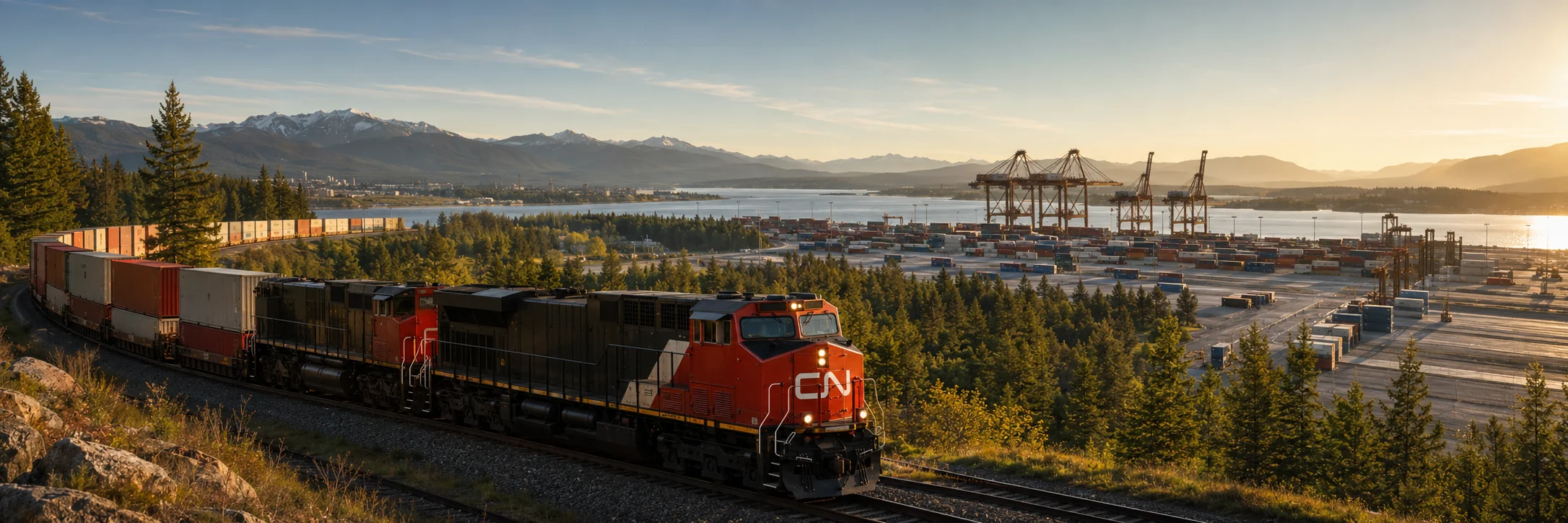
Canadian National Railway connects shipper demand, cars, crews, locomotives, yards, tracks, ports, terminals, and empty returns into freight service. Track miles, locomotive counts, bookings, or arrival scans cannot establish usable delivery; the exact equipment, slot, cargo condition, timing, money, and corrective authority determine whether the shipment reaches its purpose.
A shipper does not need track miles or a locomotive count. It needs grain loaded before a harvest window closes, a container at a port connection, fuel at a refinery, or a component at a factory before the next production step. Canadian National Railway supplies part of that result by coordinating cars, crews, locomotives, yards, dispatch, tracks, terminals, ports, and customer handoffs.
CN's 2025 annual report describes its network, operating systems, safety, capital, and freight markets. Its grain supply-chain material states that farmers, grain companies, railroads, ports, and steamship lines all have to work together. A booking or track total is not the useful output. The useful output is a shipment that arrives with the right cargo, timing, and condition for the receiving operation.
A commodity becomes a train plan
A shipper begins with a commodity, origin, destination, volume, loading equipment, delivery window, and consequence of delay. A grain elevator, mine, refinery, factory, or container terminal loads a car. CN inspects and assembles cars, assigns locomotives and crews, dispatches the train, and moves it over a network that may include interchanges with other carriers.
The journey continues after the locomotive arrives. A grain terminal must unload, store, and transfer product to a ship. A factory must receive the right material in the right order. Empty cars must return to the next loading point. A train is one interval in a longer operating loop, not the complete delivery.
Network density creates capacity and dependency
Shared yards, tracks, locomotives, crews, and ports let many shipments use common infrastructure. That density can lower the cost of a route and make small or distant shipments possible. It also means a blocked siding, crew shortage, weather event, locomotive failure, or terminal queue can propagate beyond the place where it began.
A railway may have capacity in aggregate while lacking the exact covered hopper, tank car, crew, slot, or unloading window one customer needs. A loaded car can wait because the destination is full. An empty car can be in the wrong region. A train can arrive at a port while the vessel or storage bin is unavailable. Usable capacity is therefore a relationship among equipment, timing, and the next handoff.
Money and maintenance run on different clocks
Railways spend money on track, bridges, signals, locomotives, cars, yards, fuel, crews, safety, maintenance, and information systems before freight revenue arrives. Shippers pay for loading, storage, demurrage, rail service, port handling, and penalties for missed delivery windows. A customer may need the train before it can invoice its own customer or keep a plant operating.
A grain shipper may need cars during harvest and have no practical storage while waiting. A mine may have a long-term rail contract but still need locomotives, port slots, and an unloading loop. A factory may pay for expedited trucking when rail misses its window, transferring cost and material demand to another route. CN can add track, sidings, yards, or equipment, but construction takes money and time before capacity appears.
A maintenance possession can reduce service now to preserve the line later. The cheapest dispatch decision for one train can create a queue or empty-car imbalance that makes the next customer's movement unavailable. Financial and operating decisions become physical before a new track or locomotive is visible in the accounts.
A shipment record answers a defined question
A booking states intended service. A waybill identifies cargo, origin, destination, and terms. A train plan records an operating arrangement. Locomotive and track telemetry observe defined equipment or conditions. An arrival scan records a milestone. A port or plant receipt records handover. An invoice records a financial transaction. None alone proves that cargo stayed in specification, arrived within the production window, or can immediately be used.
A scan can show that a car passed a point while leaving the cause of delay unknown. A delivery note can show handover while a receiver still lacks storage, power, or labour to unload. A waybill can identify a commodity while a contamination or temperature problem remains invisible. Records make a discrepancy actionable, but they do not replace the physical cargo and route.
Controls turn delay into correction
Dispatching, train inspection, track geometry testing, crossing controls, crew qualification, hazardous-material procedures, maintenance records, weather restrictions, and incident investigations address different risks. A delay may be visible in a scan while its cause belongs to a yard, locomotive, track, terminal, or connecting carrier.
Feedback becomes corrective only when the observation reaches the team with authority and money to alter the next train, maintenance window, loading plan, or customer commitment. The shipper may discover the missing car first. CN may control dispatch or equipment. A port may control unloading. A connecting railway may control the next segment. The delivery result depends on all of them and on the time remaining.
Line changes do not erase its obligations
A rail line, car, yard, or terminal can change owner, operator, route, or use while maintenance, safety, environmental, and customer records remain relevant. A car may be repaired, reassigned, retired, or scrapped. Track removal can preserve salvageable steel while ending a route that a community or shipper still depends on. Retirement is another physical and financial decision, not the disappearance of responsibility.
Canadian National Railway is therefore a networked timing and handoff system. CompanyGraph can map its tracks, yards, locomotives, crews, shippers, ports, connecting railways, terminals, regulators, and freight records. It cannot by itself observe a hidden cargo condition, an unrecorded crew shortage, a terminal queue, or the authority available to change a delivery before its window closes.
Inside CompanyGraph
The screen below shows the statement shape of infrastructure-carried service: a high machinery share, a well-depreciated asset base, and sales measured against the non-current assets that produce them.
High Machinery Share, High Accumulated Depreciation Share, And Elevated Sales-To-Non-Current-Assets
Machinery and equipment is a large share of non-current assets while accumulated depreciation is a large share of total assets and sales-to-non-current-assets is high
High Machinery Share, High Accumulated Depreciation Share, And Elevated Sales-To-Non-Current-Assets
→accumulated depreciation to total assets
fixed asset turnover
machinery and equipment weight
A match records what the balance sheet carries, not the permits, density, or contracts that make such infrastructure hard to reproduce.