Positioning at the intersection of electrification, digitization, and energy transition converts three secular trends into compounding demand for energy management and industrial automation products whose installed base generates recurring software and service revenue.
A structural look at how a nineteenth-century industrial conglomerate shed its legacy businesses and built a dominant position where physical electrical infrastructure meets digital control.
Introduction
Schneider (SBGSY) Electric occupies a structural position in the global economy that few companies can match: its products sit at the physical layer where electricity enters a building or facility and is distributed, controlled, measured, and optimized. The company manufactures and supplies electrical distribution equipment, industrial automation systems, and building management technology used in virtually every type of facility—from data centers and factories to hospitals, office buildings, and residential developments.
What makes Schneider Electric structurally distinctive is not any single product category but the breadth of its presence across the entire chain of energy management. Circuit breakers, switchgear, uninterruptible power supplies, building automation controllers, industrial programmable logic controllers, software platforms for energy monitoring—these are not glamorous products, but they are embedded in the infrastructure of modern civilization. The company’s installed base is enormous and replacement cycles are long, creating a persistent demand pattern that is largely independent of economic cycles.
The more remarkable story, however, is how Schneider Electric arrived at this position. The company that exists today bears almost no resemblance to the one that existed forty years ago. The transformation from a heavy industrial conglomerate focused on steel, mining, and shipbuilding into a focused technology company for energy management and automation represents one of the most thorough corporate reinventions in European industrial history. Understanding this transformation reveals how deliberate strategic repositioning—sustained over decades—can move a company from a declining structural position to an expanding one.
The Long-Term Arc
What was Schneider before it became an electrical company?
Schneider was founded in 1836 as a steel and mining company at Le Creusot in Burgundy, France. For over a century, the company was a classic heavy industrial conglomerate—producing steel, armaments, locomotives, and ships. The Schneider family name was synonymous with French industrial power through both World Wars and the post-war reconstruction period.
By the 1970s, the structural economics of European heavy industry were deteriorating. Steel production faced global overcapacity. Shipbuilding migrated to lower-cost Asian producers. Mining operations required increasing capital with diminishing returns. The conglomerate model itself was losing coherence as diversified industrial groups traded at persistent discounts to the value of their parts. Schneider’s existing portfolio was positioned in industries with declining structural attractiveness.
How did Schneider pivot into electrical equipment?
The transformation began in the early 1980s when new leadership initiated a systematic exit from legacy heavy industries and a reorientation toward electrical equipment. The acquisition of Merlin Gerin in 1975 and Telemecanique in 1988 established the core of what would become the modern company. These were manufacturers of electrical distribution equipment and industrial controls—low-voltage circuit breakers, contactors, motor starters, and related products.
The logic of the pivot was structural. Electrical distribution equipment occupied a position in the economy that was growing rather than shrinking. Every building, factory, and piece of infrastructure required electrical distribution. The products were standardized enough to manufacture at scale but technical enough to sustain meaningful margins. Replacement cycles were long but inevitable—installed bases generated recurring demand. The competitive landscape favored large players with broad product portfolios, established distribution relationships, and global reach.
Through the 1990s and 2000s, Schneider systematically divested its remaining non-electrical businesses and made dozens of acquisitions to build breadth across electrical distribution, industrial automation, and building controls. The company renamed itself Schneider Electric in 1999, signaling the completion of its identity transformation.
Which acquisitions assembled Schneider's energy-management coverage?
Schneider Electric’s acquisition strategy was not opportunistic but architectural. Each major acquisition filled a specific structural gap in the company’s coverage of the energy management and automation landscape. The acquisition of Square D in 1991 provided dominant market share in North American electrical distribution. American Power Conversion—acquired in 2007—added uninterruptible power supplies and data center infrastructure. Invensys—acquired in 2014—brought industrial automation and process control capabilities. AVEVA—in which Schneider built a majority stake—added industrial software.
The cumulative effect was a company that could offer solutions spanning the entire energy value chain within a building or industrial facility: from the point where utility power enters the premises, through distribution and control, to monitoring, optimization, and automation. No competitor matched this breadth across both energy management and industrial automation. The acquisition strategy created a structural position that would have been nearly impossible to build organically.
What did the digital layer add to Schneider's products?
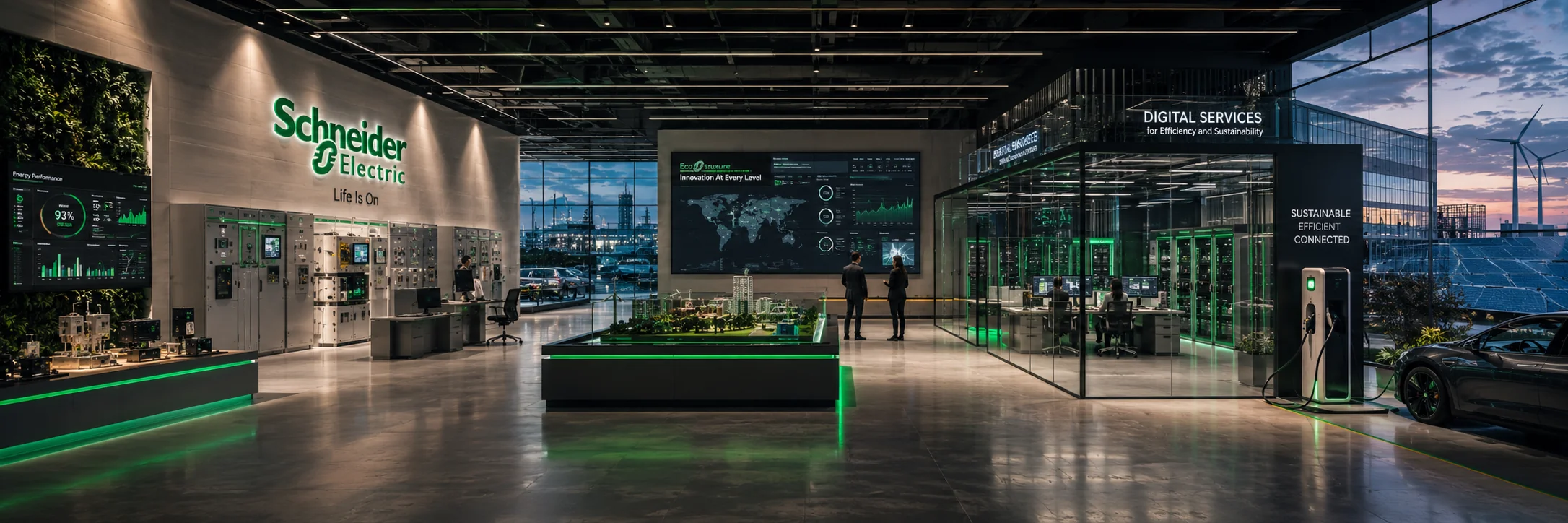
The most recent phase of Schneider Electric’s evolution involves layering digital capabilities on top of its physical product infrastructure. The EcoStruxure platform—launched as an organizing concept for the company’s IoT and software offerings—connects physical devices to cloud-based analytics, monitoring, and optimization tools. Sensors embedded in switchgear, power meters on distribution panels, and controllers in building automation systems feed data upward to software platforms that enable energy optimization, predictive maintenance, and operational efficiency.
This digital layer transforms the relationship between Schneider Electric and its customers. Physical products are sold and installed on long replacement cycles. Software subscriptions and digital services generate recurring revenue between those replacement events. The combination of physical infrastructure with digital services creates a stickier customer relationship and a more predictable revenue profile than either layer alone would provide.
The structural tailwinds facing Schneider Electric in this phase are substantial. The electrification of transportation, heating, and industrial processes increases demand for electrical distribution equipment. Data center construction—driven by cloud computing and artificial intelligence workloads—requires massive electrical infrastructure. Regulatory requirements for energy efficiency in buildings create demand for monitoring and control systems. The energy transition, broadly defined, runs directly through Schneider Electric’s product portfolio.