 CompanyGraph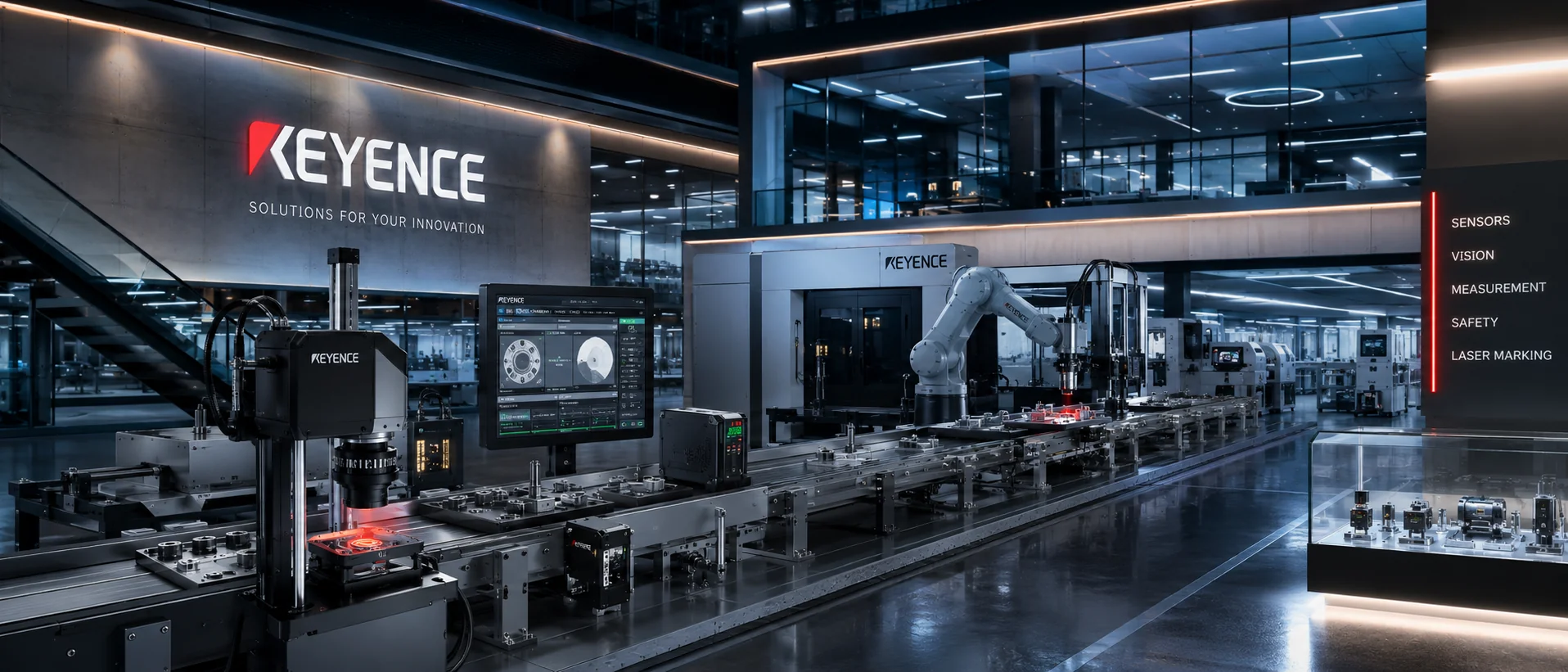
A factory does not buy a sensor for its casing. It buys a reliable way to detect, measure, identify, or control a production condition before a defect or delay becomes expensive.
The product begins with a production decision
On a line, the question may be whether a part is present, whether a weld is in the right position, whether a package is sealed, whether a surface has the required profile, or whether a code can be read at speed. A sensor, camera, laser marker, barcode reader, microscope, or measuring instrument is only one part of that decision. Lighting, distance, mounting, vibration, software, line speed, material variation, and operator response determine whether the measurement can be used.
KEYENCE describes its products as industrial automation and inspection equipment, including code readers, machine vision, measurement systems, microscopes, sensors, and static eliminators. The company’s actual offering is therefore an application route: understand the problem, select or adapt a standard instrument, install it, and help the customer use the result.
Direct sales keeps the problem in view
KEYENCE sells through its own technically trained staff rather than relying primarily on distributors. Its description of direct sales says application knowledge helps identify potential needs and guide standard-product development. A sales engineer can visit a site, demonstrate a device, test a sample, and learn why a proposed solution works or fails. That contact is different from receiving a purchase order that names a model number but not the production condition.
The route can improve fit without making the product custom-built for one customer. A standard instrument can be used across automotive, electronics, food, pharmaceutical, and other lines when the application team knows how to configure it. The information loop is valuable only if the observation survives handoff to design, quality, training, and support. A conversation at a factory is not yet a verified improvement in yield or safety.
Standard products leave room for local variation
KEYENCE says it develops products for broad fields rather than making each one a bespoke machine. Standardization lets a design, test procedure, software base, and spare-parts route serve many customers. It also means the application work moves to the boundary: the correct lens, field of view, lighting, mounting, trigger, threshold, and data interface must be chosen for the line in front of the engineer.
A catalog specification establishes a defined performance under stated conditions. A demonstration shows how a particular sample behaved in a particular setup. A production measurement records what happened on one line at one time. Those observations are related but not interchangeable. A correctly shipped instrument can still produce a misleading result if the material changes, the lens is contaminated, the mounting moves, or the threshold no longer matches the process.
Fabless does not mean responsibility-free
KEYENCE’s supply-chain description says it uses a fabless system in which much production is outsourced to subcontract plants around Japan. It also says KEYENCE provides assembly drawings and materials and works with production technology, planning, and quality-control departments. The arrangement keeps design and application knowledge inside the company while production capacity is supplied by external plants.
That can avoid the cost of owning every factory, but it does not remove manufacturing work. Components must be procured, assemblies made consistently, calibration and inspection performed, and changes controlled. A supplier interruption, quality deviation, or obsolete component can affect a product that the customer experiences as a KEYENCE instrument. The company can respond through alternate capacity or redesign only if those options have been qualified and funded before the line needs them.
Fast delivery moves inventory responsibility upstream
KEYENCE promotes a global same-day shipping system so customers do not need to hold as much extra stock. The promise is a logistics capability, not just a warehouse statistic. It requires inventory positioned near demand, reliable suppliers, order visibility, packaging, transport, and technical support that can answer questions after delivery.
For a customer, buying a high-priced instrument can be financially sensible when it prevents scrap, rework, manual inspection, or a line stoppage. But the purchase price is not the whole route. The customer may need a mounting fixture, electrical work, software integration, operator training, calibration, and time to validate the result. A same-day shipment can shorten the waiting period while leaving those installation tasks untouched.
Quality is decided at the line, not at the shipping dock
KEYENCE’s customer-support pages describe demonstrations, application testing, trial units, installation assistance, training, and technical support. Those services help turn a product into an operating measurement. They also create evidence about the customer’s actual conditions: glare, vibration, speed, tolerances, contamination, and the consequences of a false reading.
A factory acceptance record may establish that an instrument passed a test. It does not establish that every future batch will remain within the same range. A maintenance log can show that a lens was cleaned or a sensor replaced. It does not prove that the threshold is still appropriate after a material change. Feedback becomes corrective only when it reaches the person who can alter the product, application, training, process, or maintenance schedule.
The customer can choose another route
Manufacturers can use another sensor supplier, an integrated machine builder, an internal engineering team, manual inspection, or a different process. These alternatives are real, but they require their own design, testing, software, training, spare parts, and approval. The cheapest unit price may not be the lowest cost of keeping the line within specification, while the most capable instrument may be inaccessible if the customer cannot finance integration or downtime.
Direct technical contact can make a KEYENCE solution easier to reach for a particular problem, but it does not eliminate substitution. A customer can still decide that a different measurement principle, process change, or human inspection is more suitable. The relevant comparison is the complete operating result: reliable information at the right speed, followed by an action that protects quality, throughput, or safety.
What the model maintains
KEYENCE’s structure joins four activities that are often separated: finding the problem in the field, designing a standard product, coordinating outsourced production, and supporting the installation. Direct sales can return practical knowledge to development. Fabless production can keep capital focused on design and support while making supplier control essential. Same-day logistics can reduce customer inventory while making the company’s own planning and continuity more important.
The company’s result is not a sensor count or a margin percentage. It is a measurement that a production team can trust enough to make the next decision. That result remains available only while the instrument, application, supply route, records, training, and correction path stay connected.
Inside CompanyGraph
The screen below shows companies whose recorded margins are elevated at all three levels - industry-benchmarked gross, operating, and net - the statement shadow of the pricing power this story describes.
Three Margin Ratios Elevated Across Gross, Operating, And Net Levels
Industry-benchmarked gross margin, operating margin (mapped against own scale), and industry-benchmarked net margin are all in elevated ranges
A match records current margins, not their durability or the mechanism that produced them.