 CompanyGraph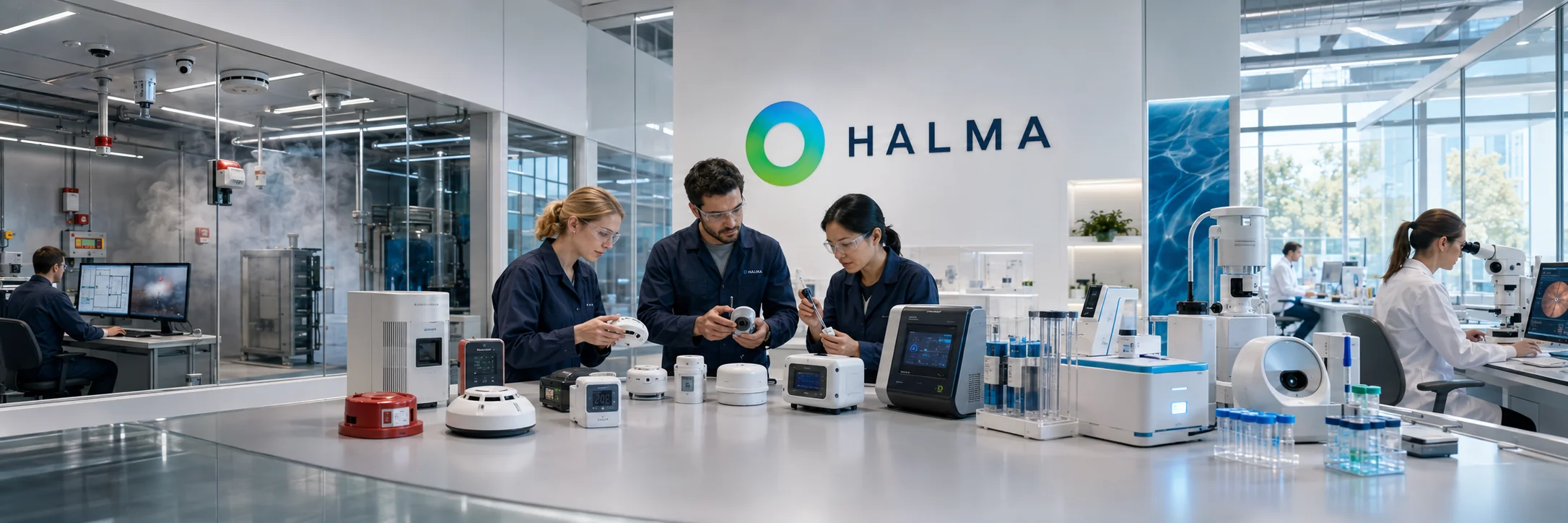
Halma joins specialist companies that detect hazards, measure critical conditions, protect people and assets, and support diagnosis. Its centre supplies capital, governance, and a long investment horizon while operating companies retain product knowledge and customer relationships. Regulation and the cost of failure can support demand, but safe outcomes still depend on correct specification, installation, calibration, maintenance, data interpretation, and response. As products become connected, the model must preserve decentralised expertise while sharing quality, cybersecurity, and incident learning quickly enough.
A safety product has to work inside a larger response
A building owner needs more than a fire detector. The detector must suit the hazard, be installed where smoke or heat can reach it, communicate with an alarm system, be tested, and trigger an action that people can understand. A utility needs more than a water-quality sensor: sampling, calibration, data handling, thresholds, and maintenance determine whether the reading protects a water supply.
Halma’s companies operate across safety, environmental analysis, and healthcare. Its portfolio includes fire detection, worker protection, corrosion monitoring, pipeline inspection, optical and photonic measurement, and clinical instruments. The common function is not a shared component. It is helping a customer detect or control a condition where a wrong or late decision can matter.
The company began as a listed owner of specialist businesses
Halma listed on the London Stock Exchange in January 1972. The company’s history describes a series of mechanical, electrical, and electronic engineering acquisitions and a long-term approach that developed through organic growth and careful capital allocation.
That history matters because Halma did not try to make every subsidiary into one product line. An alarm company, a water analyzer, and a medical-monitoring business serve different buyers and require different approvals, sales channels, service routines, and technical knowledge. The centre can decide where to invest and which company to acquire; it cannot replace the local engineering and customer history that made the target valuable.
Regulation creates a floor, not a guarantee
Fire codes, workplace rules, environmental permits, medical-device requirements, and insurance practices can make detection and monitoring difficult to omit. They can also create a reason to replace or recalibrate equipment when a standard changes. But the legal requirement is only one part of the path. A compliant product can be wrong for a specific hazard, installed badly, left untested, or ignored by a person responsible for the response.
The cost of the device may be small compared with a fire, contamination event, industrial injury, or missed diagnosis. That asymmetry can make the purchase economically defensible, but it does not make demand price-insensitive or non-cyclical in every market. Construction can be delayed, utilities can defer upgrades, and hospitals can lack capital for replacement even when the need is real.
Small acquisitions preserve narrow expertise
Halma’s model is to acquire companies in specialist markets where technical knowledge, installed relationships, and evidence matter. A target may know how to detect a particular gas, test a particular cable, inspect a buried pipeline, or measure a patient’s condition under motion. The product is often a small part of the customer’s total cost, but its qualification and service history can make substitution difficult.
Halma’s 2025/26 results report five acquisitions for £447 million of consideration, alongside £123 million of R&D investment. Those figures show that the model requires money both to buy new capability and to keep existing capability current. An acquisition is not complete when ownership changes; the group must retain engineers, maintain approvals, fund inventory, and let the business keep serving customers while the centre learns what it has bought.
Decentralisation keeps the operating company close to the hazard
Halma leaves substantial responsibility with its operating companies. A local team may know which detector fails in a humid environment, which utility needs a different sampling arrangement, or which clinical workflow makes a measurement useful. Removing that knowledge in the name of uniformity could make the portfolio easier to report while making the product less fit for its actual use.
The model has a boundary. Halma’s health-and-safety policy assigns responsibility for local compliance to each operating-company board while requiring group monitoring and independent reviews at least every three years. That arrangement shows local accountability with a central learning mechanism. It does not prove that every incident is reported at the same speed or that one company can immediately reuse another’s corrective action.
Installed products create a second business
A detector, analyzer, or medical monitor continues to need testing, calibration, software updates, consumables, replacement parts, and trained service. The installed base therefore creates work after the initial sale. It also creates evidence: serial numbers, calibration histories, firmware versions, maintenance records, and reports that help determine whether a reading or alarm can be trusted.
That evidence is valuable but limited. A calibration certificate observes a defined test under defined conditions. It does not establish that a sensor remained calibrated after vibration, contamination, or a power interruption. A service contract can make a technician reachable; it does not prove that the technician arrived before a dangerous condition changed. A customer’s compliance record can satisfy an audit while leaving the actual response chain weak.
Digital connection adds capability and exposure
Halma is moving beyond isolated instruments toward connected monitoring, analytics, and software. Continuous water data can reveal a change sooner than a periodic sample. A connected fire system can report faults before a scheduled inspection. A medical device can place a trend in a clinician’s workflow rather than leaving it on a local display.
The same connection creates new dependencies. Sensors need networks, data standards, secure updates, power, and people who know which alert requires action. A cloud dashboard can make a measurement visible while still failing to establish that the underlying sample was representative or that anyone had authority to intervene. Cybersecurity becomes part of the safety path, not a separate IT feature.
Money decides which protection is reachable
Halma must fund research, certification, production equipment, field service, acquisitions, and the people who maintain specialist knowledge. Customers must fund installation, inspection, replacement, training, and the temporary shutdowns needed to change a system. An inexpensive detector may be unavailable in practice if the building cannot pay for wiring, commissioning, and a compliant alarm panel. A higher-performing analyzer may be deferred if the utility cannot finance the sampling and laboratory work around it.
The timing of payment matters as well. Halma spends on an acquisition before the target’s future cash flow arrives. A customer may pay for a device before the value of its measurement appears, while the operating company remains responsible for warranty, support, and corrective work. Those cash boundaries determine whether a technically available action can happen before a failure, not merely whether a product has a list price.
Growth does not prove a safe outcome
Halma’s 2025/26 results report £2.582 billion of revenue, £594.5 million of adjusted EBIT, and a 23rd consecutive year of adjusted profit growth. These are group-level observations. They show that a portfolio and capital-allocation model has produced financial growth; they do not show that a particular alarm operated when demanded, a water reading prevented contamination, or a clinical measurement improved a patient outcome.
Halma’s advantage is therefore not simply that regulation forces customers to buy. It is the ability to keep specialist knowledge, capital, installed relationships, and evidence connected across many small businesses. The model remains conditional. As the products become more digital, the group must share cyber and quality learning without stripping away the local understanding that makes the products useful.
CompanyGraph can map Halma, its operating companies, products, certifications, customers, service contracts, suppliers, regulators, and corrective reports. It cannot by itself observe a badly placed detector, a contaminated sample, an unpatched device, or an ignored alarm. The practical question is where a measured hazard becomes an intervention—and whether the people able to make that intervention have the evidence, equipment, authority, time, and money to act.
Inside CompanyGraph
The screen below shows the balance-sheet shape acquisition-built companies tend to carry: intangibles, goodwill, and goodwill-to-equity all elevated together.
Intangible Concentration
Intangibles are a large share of total assets, goodwill is a large share of total assets, and goodwill is large relative to shareholders equity
Intangible Concentration
→goodwill to assets
goodwill to equity
intangible assets weight
A match records what past acquisitions left on the balance sheet, not whether the acquired capabilities still work as this story describes.