 CompanyGraph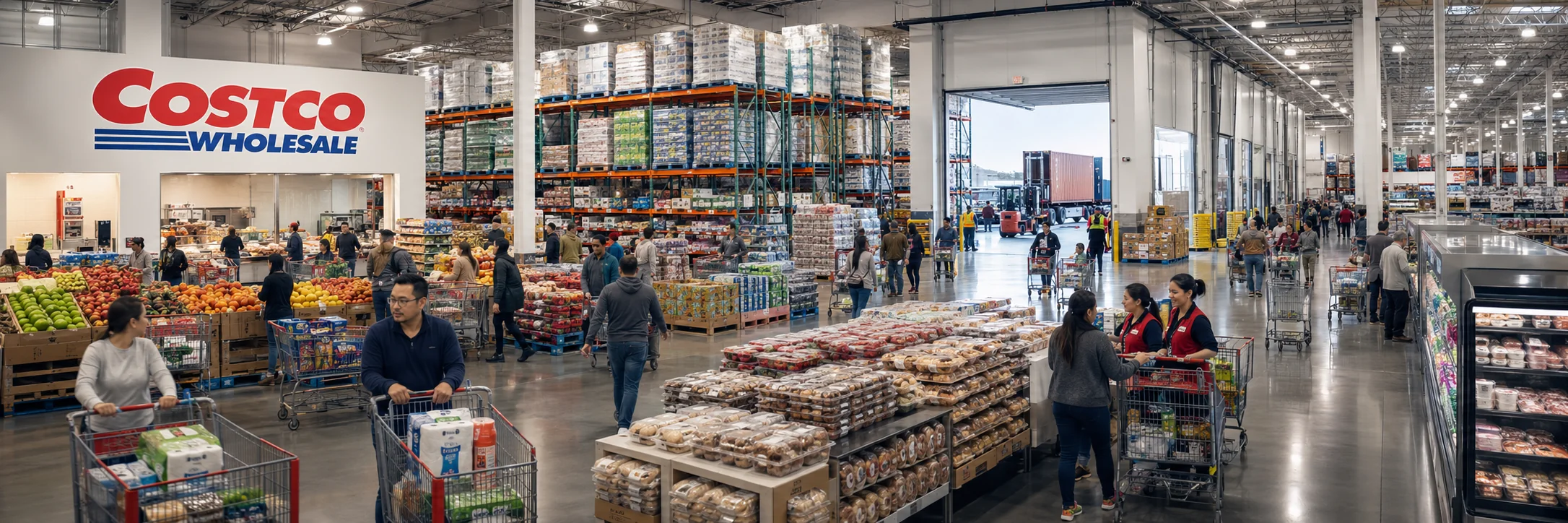
Costco supplies more than low-priced merchandise. It combines a selected assortment, purchasing and distribution, warehouse execution, member access, and an annual fee into a repeatable shopping service. A shelf price, inventory count, receipt, or renewal rate observes one part of that service; household value depends on availability, package size, travel, storage, quality, and use.
A low shelf price is not the complete service
A member does not need a pallet or a low unit price in isolation. The useful result is a suitable product that is available, affordable in the required quantity, and practical to buy, transport, store, and use. Costco's fiscal 2025 filing describes membership fees, warehouses, merchandise margins, operating costs, and renewal rates. The filing describes the business, but a shelf price does not prove that a particular household receives the expected value.
This article follows selected goods from suppliers through purchasing, distribution, a warehouse, member payment, use, complaint, return, and renewal. The financial and membership examples are principally U.S.-based; the physical distinction between an offer and a usable household result is broader.
Goods become useful through a warehouse route
Costco buys products, moves them through distribution and warehouses, and presents a deliberately narrow assortment. Pallet quantities and concentrated purchasing can reduce some handling and unit costs, while the warehouse format reduces display and storage complexity. The member still has to travel, pay the fee, select a package, transport it, store it, and use it before the price becomes useful household value.
Costco's filing says its format is designed to reinforce member loyalty and continuing fee revenue, and that membership growth, Executive penetration, and renewal rates materially influence profitability. Membership is therefore part of the operating route, not a detachable charge added after retailing.
Limited assortment is a physical operating choice
A limited assortment can concentrate purchase volume, simplify replenishment, reduce shelf and forecasting complexity, and make search faster. It also makes each selected item more consequential. If the only available size, brand, or package is unsuitable, a member cannot recover the missing option by choosing among dozens of substitutes in the same warehouse.
Kirkland Signature adds another layer. A common private-label identity can coordinate specifications and give members a repeatable signal, but the label still depends on supplier qualification, formulation, packaging, testing, transport, and use. A quality complaint or recall concerns a particular product and lot; a renewal concerns a continuing relationship with the warehouse system. Neither observation substitutes for the other.
Membership fees and operating money keep the route open
Costco pays for buildings, refrigeration, labor, inventory, distribution, information systems, supplier commitments, and waste before a member renews. Members pay an annual fee and then buy goods; suppliers are paid under terms that can make volume, packaging, delivery windows, and quality requirements feasible or difficult. A warehouse can have purchasing power and still lose the option to stock a product if transport, labor, cold storage, or supplier capacity is unavailable.
The 2024 U.S. and Canadian membership-fee increase shows the mechanism. Costco's membership conditions set the annual payment and renewal relationship, while its filings identify membership-fee revenue and renewal as central to profitability. A higher fee can support the operating system only if members continue to judge the combined price, assortment, and service worth renewing. The fee is not the whole value; it is money that keeps the route available.
A selected product still carries supplier and use history
A supplier specification states a required product condition. A receiving inspection records a defined check. A price label records an offer. An inventory system records a count at a time. A receipt records a purchase. A recall notice identifies a product or lot under a defined action. None alone proves that the product suited a particular household, that a stockout was avoided, or that a member received the expected value after travel, storage, and use.
Private-label consistency can make a product easier to recognize and compare, but it does not erase variation in manufacture, shipping, storage, or household handling. A member may need a smaller package, a different formulation, or a product available closer to home. The warehouse system can select and distribute an option; it cannot make every option suitable for every person.
Renewal is feedback, not a complete result
A membership record establishes payment and renewal. A return establishes that a member rejected or could not use a purchase. A complaint records a reported problem. A stockout record shows that the system did not offer an item at a particular place and time. Sales and renewal rates aggregate many experiences but do not reveal which household absorbed travel, spoilage, storage, or unused quantity.
Feedback is distributed. A member may find that a product is unavailable or too large to use. A warehouse worker may see a recurring handling problem. A supplier may detect a defect. A buyer may observe a delivery failure. A complaint, return, or renewal change can improve the next decision only when it reaches someone with product evidence, purchasing or operating authority, inventory, and money to act.
What Costco's membership service remains responsible for
Costco's service is not complete when merchandise enters a warehouse or a member pays at checkout. It is complete enough for its purpose when a selected product can be found, bought, transported, stored, and used at a combined price and effort that members continue to judge worthwhile. A low unit price can coexist with wasted quantity or an impractical trip; a high renewal rate can coexist with individual failures that the aggregate does not show.
CompanyGraph can map suppliers, buyers, distribution centers, warehouses, employees, members, payment, product lots, complaints, recalls, and renewal signals, including where evidence and corrective authority cross organizational boundaries. It cannot by itself observe a household's storage, product use, travel burden, or whether a renewal reflected genuine savings. The remaining question is who can still change the assortment, supplier requirement, warehouse practice, or member information when the next signal arrives.
Inside CompanyGraph
The screen below shows the statement shadow of velocity-run distribution: receivables, inventory, and payables turnover all in the upper portion of their ranges.
Three Turnover Ratios Elevated
Sales-to-receivables, COGS-to-inventory, and COGS-to-payables ratios all sit high on their mapped scales
Three Turnover Ratios Elevated
→inventory turnover
payables turnover
receivables turnover
A match records turnover ratios, not assortment quality, availability, or the supplier terms behind them.