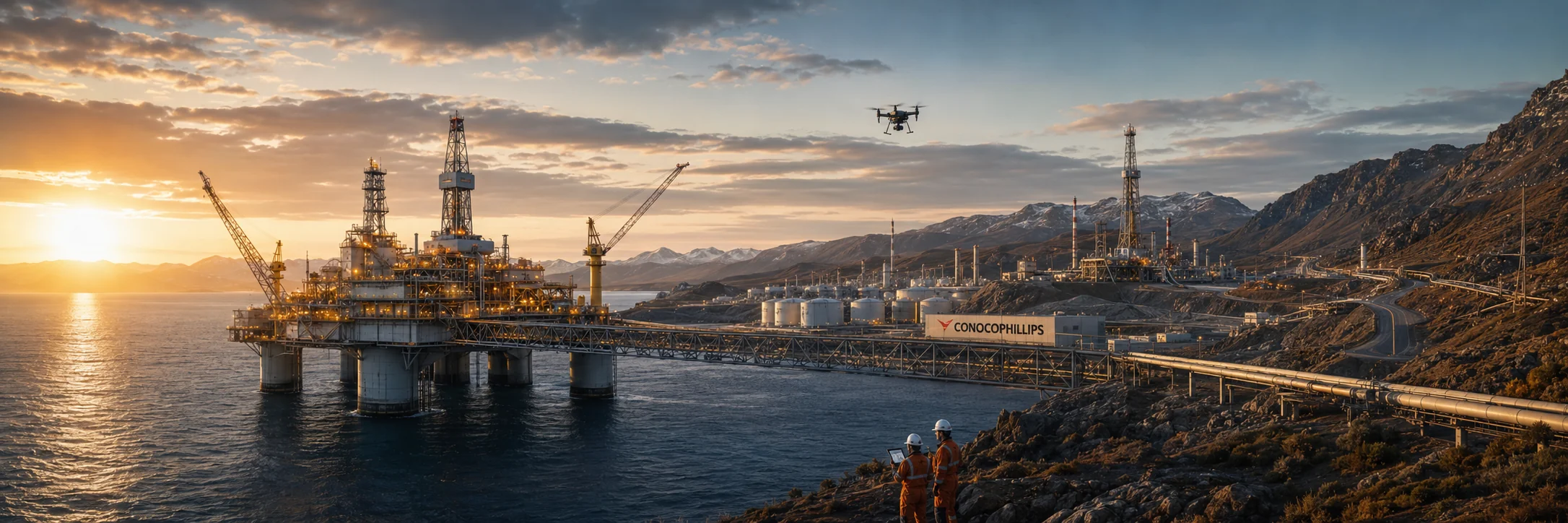
A structurally simple model of finding and extracting hydrocarbons at the lowest possible cost, reinforced by scale acquisitions in premier basins, creates returns that depend on cost discipline rather than commodity price assumptions.
A structural look at how the world's largest independent E&P company turned structural simplicity into the defining advantage in a commodity business where cost-of-supply determines survival.
Introduction
ConocoPhillips (cop) is the world's largest independent exploration and production company by production volume, proved reserves, and market capitalization within its peer group.
The word "independent" carries structural weight that distinguishes ConocoPhillips from every other oil company of comparable scale. Unlike the integrated majors — ExxonMobil (xom), Chevron (cvx), Shell, BP — ConocoPhillips does not refine crude oil into gasoline, manufacture petrochemicals, or operate retail fuel stations. Its business model is elemental: find hydrocarbons beneath the earth's surface, extract them, and sell the raw commodity.
This structural simplicity is not a limitation or a compromise. It is a deliberate architectural choice that concentrates the organization's capital, expertise, and management attention on the single activity where it holds the greatest competitive advantage — low-cost resource extraction at scale. Every dollar of capital expenditure, every engineering decision, every portfolio choice flows toward the same objective: producing oil and gas at the lowest cost per barrel available to a publicly traded company.
This structural clarity did not exist before 2012. For much of its history, ConocoPhillips operated as an integrated oil company, combining upstream exploration and production with downstream refining, marketing, and midstream operations. The decision to spin off the downstream business into Phillips 66 (psx) represented a fundamental architectural reorganization — a recognition that the integrated model, while providing natural hedging benefits during commodity price cycles, also diluted capital allocation focus and obscured the underlying economics of each business segment. The separation allowed ConocoPhillips to become a pure expression of upstream economics, where cost position relative to the commodity price is the only variable that ultimately determines profitability, survival, and the capacity to return capital to shareholders. Phillips 66, freed from upstream capital demands, could pursue its own optimization of refining margins and midstream throughput without competing for the same investment capital.
ConocoPhillips's story since the spinoff has been one of disciplined portfolio construction, relentless cost-of-supply optimization, and strategic consolidation through acquisitions that added scale without degrading portfolio quality. The company has systematically assembled a resource base concentrated in the lowest-cost basins in North America — the Permian, Eagle Ford, Bakken, and Alaska — supplemented by international assets in Norway, Canada, Australia, Malaysia, and Libya, plus growing LNG exposure. The Concho Resources acquisition in 2021 established Permian Basin dominance. The Marathon Oil acquisition in 2024 extended the consolidation logic across multiple basins. Understanding ConocoPhillips requires understanding a single structural principle: in a commodity business where the product is undifferentiated and the seller has no control over the price received, the lowest-cost producer possesses the most durable competitive position across full commodity cycles — surviving price environments that eliminate higher-cost competitors and accumulating market share through persistence rather than market power.
The Long-Term Arc
Which two companies formed ConocoPhillips's lineage?
ConocoPhillips's corporate ancestry traces through two distinct lineages that merged and then architecturally separated. Continental Oil Company — Conoco — was founded in 1875 as a kerosene distributor in Ogden, Utah, and grew over a century into a significant upstream operator with international exploration operations spanning the North Sea, Southeast Asia, North Africa, and the American Southwest. Phillips Petroleum, founded in 1917 by Frank Phillips in Bartlesville, Oklahoma, developed substantial natural gas processing and refining capabilities alongside its exploration activities, becoming one of the largest natural gas producers in the United States and a pioneer in natural gas liquids extraction. Both companies carried the operational DNA of the American petroleum industry's formative decades — a willingness to explore in frontier basins, technical proficiency in drilling and production, and the organizational structures required to operate across vast geographic distances.
The 2002 merger of Conoco and Phillips Petroleum created ConocoPhillips as the third-largest integrated oil company in the United States, behind only ExxonMobil (xom) and Chevron (cvx) in domestic production and refining capacity. The combination brought together Conoco's international exploration portfolio and deepwater capabilities with Phillips's substantial refining network and natural gas processing operations. The integrated model served a structural purpose that had been validated across the industry for decades. Owning refining capacity provided a captive outlet for upstream production, ensuring that crude oil produced from company-operated wells could be processed regardless of spot market conditions. Downstream earnings from refining, marketing, and chemicals could partially offset upstream losses during periods of low crude prices, dampening the earnings volatility inherent in commodity extraction.
But the logic of integration carried structural costs that became increasingly visible as capital markets evolved and the shale revolution reshaped North American production economics. Integrated companies allocated capital across fundamentally different businesses — upstream exploration with high geological risk and long development timelines, versus downstream refining with thin margins, different capital intensity patterns, and vulnerability to regulatory shifts. Investors seeking exposure to crude oil commodity prices received a blended product that neither purely tracked upstream economics nor provided the stability of refining margins. The conglomerate discount — where the combined market value of the businesses was less than what they might command separately — weighed on the stock. Analysts struggled to value a company that was simultaneously an exploration company, a refiner, a pipeline operator, and a chemical manufacturer, each with distinct competitive dynamics and capital requirements.
The 2008 financial crisis and the subsequent period of volatile commodity prices exposed these tensions acutely. ConocoPhillips's integrated structure made capital allocation decisions opaque to outsiders and difficult to optimize internally. Was the company investing enough in exploration to replace reserves? Were refining assets generating adequate returns on the capital they consumed? Were midstream operations better served as separate entities with their own access to capital markets? The structural answer — that the integrated model obscured these questions rather than resolving them — led to the decision that would define the company's modern identity and create the structural clarity that characterizes its operations today.
What did the Phillips 66 spinoff separate in 2012?
In May 2012, ConocoPhillips completed the spinoff of its downstream refining, midstream, chemicals, and marketing operations into Phillips 66 (psx). The transaction was not a divestiture or a sale — it was an architectural separation that created two focused companies from one blended entity, with existing shareholders receiving proportional ownership in both. ConocoPhillips retained the upstream exploration and production assets, the geological expertise, and the global portfolio of producing fields and development projects. Phillips 66 took the refineries, chemical plants, pipelines, natural gas gathering systems, and fuel marketing network — everything that processed, transported, and sold the raw hydrocarbons that the upstream produced.
The structural implications were immediate and profound. ConocoPhillips became the largest pure-play E&P company in the world by production volume — a position it has maintained and extended through subsequent acquisitions. Every dollar of capital expenditure now flowed exclusively toward finding and producing hydrocarbons. Every management decision related to the same fundamental question: where can we extract oil and gas at the lowest cost per barrel? The diversity of the integrated model — which had provided comfort through natural hedging — was replaced by structural clarity. Investors could now evaluate ConocoPhillips as a pure upstream vehicle, understanding exactly what they owned and how the company's financial results would track commodity prices. The separation also allowed Phillips 66 to optimize its own capital allocation without competing against upstream exploration budgets that operated under entirely different risk and return profiles.
This clarity carried corresponding risk. Without downstream earnings as a buffer, ConocoPhillips was more exposed to commodity price downturns than its integrated peers. Every dollar of revenue depended on the price of crude oil and natural gas — commodities over which the company had no pricing power. The natural hedge was gone, replaced by pure commodity exposure. The 2014-2016 oil price collapse, when crude fell from over $100 per barrel to below $30, tested the pure-play model to its structural limits. The company cut its dividend — a painful action that acknowledged the incompatibility of fixed capital return commitments with a commodity-driven revenue base — reduced capital expenditures by more than 50%, and divested non-core assets including properties in Nigeria, Indonesia, and the North Sea. These actions were painful but structurally coherent. A pure upstream company was adapting to the reality that its sole revenue source had declined by more than 70%, rather than obscuring the pain behind downstream earnings that would have made the situation appear less severe than it was.
The integrated majors, cushioned by refining margins that expanded as crude input costs fell, appeared more resilient during this period. But the comparison obscured a deeper structural reality: ConocoPhillips was forced to confront and resolve its cost structure precisely because it had no downstream earnings to mask inefficiencies. The upstream business had to become self-sustaining across a wider range of commodity prices, without the crutch of downstream income. This confrontation — driven by structural necessity rather than strategic choice — produced the capital discipline framework and cost-of-supply philosophy that have since become the company's defining competitive characteristics.
How did the oil price collapse reshape ConocoPhillips's capital allocation?
The oil price collapse of 2014-2016 catalyzed a transformation in ConocoPhillips's capital allocation philosophy that became the defining characteristic of its post-spinoff identity. Under the leadership of CEO Ryan Lance, the company developed a returns-focused framework that prioritized free cash flow generation over production growth — a departure from the E&P industry's historical tendency to reinvest aggressively during price upswings, chase production milestones that pleased analysts, and then scramble to cut costs during downturns when the growth investments proved uneconomic. The historical E&P playbook — grow production, fund growth with debt or equity, hope commodity prices validate the investment — had destroyed enormous shareholder value across the industry. ConocoPhillips's post-2016 framework explicitly rejected this approach.
The centerpiece of the new framework is the Variable Return of Capital program — known as VROC. Traditional oil company capital return programs relied on fixed dividends regardless of commodity prices. This created a ratchet effect: dividends raised during boom periods became unsustainable as commodity prices declined, eventually forcing painful cuts that damaged investor confidence. The cycle repeated across every major downturn, destroying value predictably.
ConocoPhillips's approach separated capital returns into three components operating at different frequencies. First, a base ordinary dividend set at a level sustainable through low commodity price environments — roughly $40 per barrel WTI or below — providing a floor of predictable income that the company can maintain through downturns without cutting. Second, share buybacks funded from free cash flow above the base dividend, reducing share count permanently and increasing per-share exposure to future cash flows. Third, a variable return of capital — the VROC itself — distributed as supplemental payments that scale directly with commodity prices and free cash flow generation. When oil prices are high and cash flow is abundant, shareholders receive larger variable distributions. When prices decline, the variable component contracts while the base dividend and a reduced pace of buybacks remain intact.
The VROC framework is structurally significant because it aligns capital returns with the inherent cyclicality of the commodity business rather than fighting against it. It acknowledges a structural reality that many oil companies have historically resisted: commodity prices are cyclical, cash flows are variable, and capital return programs should reflect these conditions rather than pretend they do not exist. The framework functions as a governor that automatically adjusts capital outflows to match cash generation, preventing the over-distribution during boom periods that forces under-investment or balance sheet deterioration during busts. The structural honesty of this design — treating cyclicality as a permanent feature rather than an aberration to be smoothed over — represents a departure from conventional oil industry capital allocation that has been adopted or imitated by several E&P peers since ConocoPhillips introduced it.
The operational side of capital discipline manifested in a strict cost-of-supply framework that governs every investment decision. ConocoPhillips ranks its entire portfolio of development opportunities — hundreds of potential drilling programs across multiple basins — by the WTI oil price required to generate a 10% return on investment. Projects that meet the cost-of-supply threshold advance into the capital budget. Projects that do not — regardless of their geological promise, strategic attractiveness, or the enthusiasm of the basin team — are deferred or abandoned. This framework functions as an automatic governor on capital spending, preventing the speculative overinvestment that has historically destroyed value in the E&P industry during periods of high commodity prices, industry optimism, and competitive pressure to grow. The discipline is impersonal and systematic, removing individual judgment and emotion from what are fundamentally economic calculations.
How did the shale revolution change the economics of extraction?
The shale revolution — the technological convergence of horizontal drilling and hydraulic fracturing that unlocked vast hydrocarbon resources in tight rock formations across North America — transformed ConocoPhillips's strategic landscape as profoundly as any corporate decision. Before the shale revolution reached commercial scale in the late 2000s, oil and gas exploration was characterized by high geological uncertainty, long development timelines, and binary outcomes — a well either found hydrocarbons in commercial quantities or it did not. The shale model inverted these characteristics. The resource was known to exist — it was trapped in rock formations whose hydrocarbon content had been identified decades earlier. The challenge was extracting it economically, which became possible as drilling technology improved and costs declined through scale and learning-curve effects.
ConocoPhillips's post-spinoff portfolio strategy has been systematic in its focus on assembling the lowest-cost unconventional resource base available to a publicly traded E&P company. The logic is structural and uncompromising: in a commodity business where the seller has no control over the price received, the cost of production is the only variable under management's control that determines profitability. A company that can produce oil profitably at $30 per barrel WTI survives price environments that bankrupt competitors with $50 breakeven costs. Cost position is not merely a financial advantage. It is the structural determinant of survival across full commodity cycles — the variable that separates companies that persist from companies that are acquired, restructured, or liquidated during inevitable downturns.
The Permian Basin — spanning West Texas and southeastern New Mexico — represents one of the most prolific hydrocarbon-producing regions on earth and the crown jewel of the North American shale landscape. ConocoPhillips holds substantial acreage in both the Delaware and Midland sub-basins, with multi-decade drilling inventory at breakeven costs well below $40 per barrel WTI. The Permian's structural advantage lies not merely in the volume of hydrocarbons present but in the stacked nature of the geology — multiple productive formations layered vertically, including the Wolfcamp, Bone Spring, Spraberry, and other zones, allowing operators to drill numerous wells from the same surface location and access different hydrocarbon-bearing intervals at different depths. This geological characteristic multiplies the productive potential of each acre, extending the drilling inventory on a given lease position far beyond what a single formation would provide. The Concho Resources acquisition in 2021 and the Marathon Oil acquisition in 2024 each added significant Permian acreage, making ConocoPhillips one of the basin's largest operators alongside ExxonMobil (xom), Chevron (cvx), and Diamondback Energy.
The Eagle Ford Shale in South Texas was one of the first unconventional plays that ConocoPhillips developed at scale following the shale revolution. The company holds one of the largest contiguous acreage positions in the formation, concentrated in the liquids-rich fairway where wells produce a valuable mix of crude oil, condensate, and natural gas liquids. Eagle Ford production exhibits lower decline rates than some other shale plays, providing a more stable base of output that requires less continuous drilling to maintain. The formation's maturity — it was among the earliest shale plays to reach full-scale development — means that the geology is well characterized, drilling techniques have been optimized through thousands of wells, and infrastructure for gathering, processing, and transportation is fully built out. These characteristics make Eagle Ford production among the most capital-efficient in the portfolio, requiring less incremental investment per barrel than newer or less developed plays.
The Bakken formation in North Dakota and Montana adds another layer of low-cost production to the portfolio. While the Bakken has higher per-well costs than the Permian due to remoter locations, harsher winter operating conditions, and longer trucking distances to gathering infrastructure, ConocoPhillips's large contiguous acreage position enables operational efficiencies — shared surface infrastructure, optimized multi-well pad drilling programs, longer lateral well designs, and centralized water management — that reduce costs well below the basin average. The Bakken also produces a light, sweet crude oil that commands premium pricing at refineries, partially offsetting the higher operating costs with better revenue per barrel.
Alaska represents a structurally distinct category within the portfolio — one that operates under fundamentally different economics and time horizons than the Lower 48 unconventional plays. ConocoPhillips is the largest oil producer in Alaska, operating legacy fields on the North Slope including Kuparuk, the Alpine complex, and various satellite developments, alongside the newer Willow project approved for development on federal land in the National Petroleum Reserve-Alaska. Alaska production operates at longer time horizons with different cost dynamics. The infrastructure requirements are substantial — Arctic operating conditions with extreme cold, seasonal access constraints, remote logistics requiring air and ice road support, environmental sensitivity requiring specialized operating practices, and pipeline access via the Trans-Alaska Pipeline System. But the resources are enormous and the production decline rates are significantly lower than shale wells — conventional Alaska fields produce at relatively stable rates for decades rather than the steep initial production followed by rapid decline that characterizes unconventional wells. Alaska assets function as a long-duration base load within the portfolio, providing stable production volumes that underpin the company's output for decades while the Lower 48 unconventional portfolio provides growth optionality and shorter-cycle capital deployment flexibility.
The Willow project deserves particular attention as a structural investment. Located on the North Slope, Willow is designed to produce up to 180,000 barrels of oil per day at peak output from an estimated 600 million barrels of recoverable oil. The project required federal approval that involved years of environmental review, legal challenges, and political debate, ultimately receiving approval from the Biden administration in 2023 with some modifications to the original development plan. Willow represents the kind of large-scale, long-duration investment that ConocoPhillips's conventional portfolio enables — a multi-billion-dollar commitment that will produce oil for 30 or more years, providing cash flows well into the 2050s. The project's economics are favorable at current oil prices, but its significance extends beyond any single price scenario. It extends ConocoPhillips's reserve life and production base on the North Slope, leveraging existing infrastructure and operational expertise in a region where the company has operated for decades.
What do ConocoPhillips's international assets add to the portfolio?
While the core of ConocoPhillips's strategy is anchored in North American unconventional production, the company maintains significant international operations that provide geographic diversification, fiscal regime diversification, and exposure to different commodity price structures and contract types. Operations in Norway — where ConocoPhillips is one of the largest foreign operators on the Norwegian Continental Shelf — contribute production from mature but still productive fields in the North Sea and Norwegian Sea. Canadian oil sands operations, including the Surmont facility in Alberta operated as a joint venture, provide long-duration heavy oil production that operates under different economics than light tight oil. Operations in Australia, Malaysia, Libya, Qatar, and other jurisdictions contribute production volumes and reserve depth that extend beyond the Lower 48 resource base, providing resilience against region-specific disruptions — whether regulatory, geological, or infrastructural.
The company's liquefied natural gas exposure represents a structural position worth examining separately from conventional oil and gas production because LNG occupies a fundamentally different position in global energy markets. ConocoPhillips holds equity interests in several LNG facilities, most notably Australia Pacific LNG (APLNG) in Queensland, Australia — a major LNG export facility that liquefies coal seam gas for shipment primarily to Asian markets. The company has also been developing its position in Gulf Coast LNG through the Port Arthur LNG project in Texas, which represents a significant expansion of its LNG capacity and exposure to growing global gas demand.
LNG occupies a structurally different market position than crude oil. Natural gas is more difficult to transport than oil — it requires liquefaction at cryogenic temperatures of approximately negative 260 degrees Fahrenheit, specialized double-hulled tanker vessels, and regasification terminals at the destination — which creates regional pricing differentials and long-term contract structures that do not exist in the globally fungible crude oil market. Asian LNG prices, European hub prices, and North American Henry Hub prices can diverge significantly, creating arbitrage opportunities for companies with liquefaction capacity that can direct cargoes to the highest-value market. These price differentials, combined with long-term supply contracts that provide revenue visibility over 15 to 20 year horizons, create a cash flow profile that is structurally different from the spot-market-driven economics of crude oil production.
LNG demand has grown structurally as countries — particularly in Asia and increasingly in Europe following the disruption of Russian pipeline gas supplies — seek to replace coal-fired power generation with lower-emission natural gas and to secure energy supply diversity. This demand growth operates on a different trajectory than crude oil demand, which faces longer-term pressure from transportation electrification as battery electric vehicles achieve cost parity with internal combustion engines across an expanding range of vehicle segments. LNG exposure provides ConocoPhillips with a revenue stream that may prove more durable than crude oil production under certain energy transition scenarios — particularly scenarios where natural gas serves as a bridge fuel during a multi-decade transition away from coal and toward renewables. The Port Arthur LNG development positions ConocoPhillips to capture growing demand from a facility located near abundant, low-cost Gulf Coast gas supply, with access to both Atlantic and Pacific shipping routes.
How did the Concho acquisition establish Permian dominance?
ConocoPhillips's 2021 acquisition of Concho Resources for approximately $9.7 billion in an all-stock transaction represented the first major post-spinoff deal that signaled the company's intent to pursue basin consolidation at scale. Concho was a pure-play Permian Basin operator with approximately 550,000 net acres concentrated in the Delaware and Midland sub-basins of West Texas and New Mexico. The acquisition transformed ConocoPhillips from a diversified E&P with Permian exposure into one of the dominant operators in the most prolific oil-producing basin in the United States.
The strategic rationale extended beyond simple production addition. Concho's acreage was adjacent to and contiguous with ConocoPhillips's existing Permian position, enabling the kind of operational synergies that are specific to unconventional oil and gas development. Longer lateral wells — horizontal wellbores that extend further through the productive formation — become possible when lease boundaries are consolidated. A well that might have terminated at 10,000 feet of lateral length due to a neighboring operator's lease boundary could now extend to 15,000 feet or more, accessing significantly more rock and producing proportionally more oil at only marginally higher drilling cost. The economics of unconventional development are highly sensitive to lateral length — longer laterals spread the fixed costs of drilling the vertical section and completing the well across more productive footage, reducing the cost per barrel of oil equivalent recovered.
The Concho deal established the acquisition template that ConocoPhillips would apply again three years later with Marathon Oil — geographic overlap with existing operations, portfolio-quality-consistent breakeven costs, operational synergies from acreage consolidation, and scale addition that reinforced competitive positioning without degrading the cost-of-supply profile. The deal was executed at a point in the commodity cycle — late 2020 into early 2021 — when oil prices were recovering from pandemic lows but had not yet reached the elevated levels of 2022, providing favorable acquisition economics. The all-stock structure avoided adding debt to the balance sheet, preserving financial flexibility that would prove valuable when the Marathon Oil opportunity emerged.
How did the Marathon Oil acquisition extend the consolidation strategy?
ConocoPhillips's 2024 acquisition of Marathon Oil for approximately $22.5 billion represented the natural extension of the company's portfolio-building strategy to its fullest expression. Marathon Oil's assets were concentrated in the same basins where ConocoPhillips already operated — the Eagle Ford, Bakken, Permian, and Oklahoma's STACK/SCOOP plays — plus an international position in Equatorial Guinea. The geographic overlap was not coincidental. It was the structural rationale for the transaction, just as it had been with Concho Resources.
The synergies from adjacent acreage consolidation are specific to the E&P business model. Longer lateral wells become possible when lease boundaries are eliminated. Shared infrastructure — gathering pipelines, processing facilities, water disposal wells — reduces per-barrel costs by spreading fixed investment across larger production volumes. Drilling rigs and completion crews can be optimized across a larger footprint without proportional overhead increases. Supply chain purchasing power grows with scale, reducing the cost of sand, chemicals, tubulars, and services.
The Marathon acquisition added approximately 2 billion barrels of oil equivalent in proved reserves and roughly 400,000 barrels of oil equivalent per day in production. These volumes, layered onto ConocoPhillips's existing base of approximately 1.7 million barrels of oil equivalent per day, reinforced the company's position as the largest independent E&P by a margin that no competitor could realistically close without a transformative transaction of their own. The cost-of-supply characteristics of Marathon's assets — concentrated in low-breakeven basins with well-characterized geology and existing infrastructure — were consistent with ConocoPhillips's portfolio quality standards. The acquisition added scale without degrading the portfolio's overall cost position, which was the critical test that any acquisition had to pass under the cost-of-supply framework.
The broader context of the Marathon deal is the consolidation wave that swept through the E&P industry in 2023-2024. ExxonMobil (xom) acquired Pioneer Natural Resources for approximately $60 billion, creating the largest Permian Basin operator. Chevron (cvx) agreed to acquire Hess for approximately $53 billion, targeting Hess's Guyana assets and Bakken position — though that deal faced arbitration challenges. Diamondback Energy acquired Endeavor Energy Resources. Numerous smaller transactions consolidated acreage across every major basin. This wave reflected a structural reality that had been building for years: the inventory of undrilled locations in premium basins is finite and declining, and the companies that secure the largest, lowest-cost drilling inventories will possess the most durable competitive positions as the industry matures and the easy-to-develop wells are exhausted. ConocoPhillips's acquisition of Marathon was both a competitive response to the ExxonMobil-Pioneer deal and a structural continuation of the portfolio strategy it had pursued since the Phillips 66 spinoff — a strategy that treated drilling inventory as a finite, depleting resource that must be replenished through acquisition when organic exploration cannot add comparable quality.
How does ConocoPhillips differ from the integrated majors?
Understanding ConocoPhillips's structural position requires contrasting it with the integrated oil majors — particularly ExxonMobil (xom) and Chevron (cvx) — that constitute its closest competitive peers by scale of upstream operations. The integrated majors operate across the full hydrocarbon value chain: upstream exploration and production, midstream transportation and logistics, downstream refining and marketing, and in some cases chemical manufacturing and specialty materials. ConocoPhillips competes in the upstream segment only. This difference is not merely a matter of business scope or corporate strategy. It creates fundamentally different financial profiles, capital allocation dynamics, risk characteristics, and investor bases.
The integrated model provides natural hedging that pure-play operators cannot replicate. When crude oil prices fall, refining margins often expand because input costs decline while finished product prices — gasoline, diesel, jet fuel — decline less rapidly, creating an internal offset that dampens earnings volatility. ExxonMobil's downstream segment generated substantial profits during the 2020 pandemic precisely because refining economics improved as crude prices collapsed. ConocoPhillips had no such buffer. Its earnings are a nearly direct function of the commodity price multiplied by production volume, minus the cost of extraction and the overhead of the organization. This exposure creates greater peak-to-trough earnings volatility than the integrated majors experience. During the 2020 pandemic-driven demand collapse, ConocoPhillips's revenue declined more sharply than ExxonMobil's or Chevron's, precisely because it lacked downstream earnings to partially offset the upstream collapse.
The trade-off is capital allocation clarity that the integrated model cannot match. ExxonMobil must allocate capital across upstream exploration projects, refinery maintenance turnarounds and capacity upgrades, chemical plant expansions, retail network investments, and new ventures in carbon capture and low-emission technologies. Each dollar has alternative uses across fundamentally different businesses with different return profiles, risk characteristics, and time horizons. ConocoPhillips faces a simpler — though not simple — allocation decision: which upstream projects offer the best risk-adjusted returns within the cost-of-supply framework? This focused allocation, combined with the VROC framework for returning excess capital, creates a more direct and transparent relationship between capital deployment and shareholder outcomes than the blended capital allocation of an integrated company allows.
The comparison also reveals different structural postures toward energy transition risk. The integrated majors have enormous sunk capital in downstream assets — refineries with 40-year operational lives, chemical complexes, distribution networks — that create inertia affecting strategic flexibility. ConocoPhillips, without downstream infrastructure, carries less embedded capital and faces fewer stranded-asset scenarios. Its transition risk is concentrated entirely in the upstream — the question of whether and when demand for its produced hydrocarbons will decline structurally. This concentration, paradoxically, may provide greater strategic clarity than the diffuse transition exposure of integrated majors managing upstream reserve life, downstream obsolescence, and alternative energy investments simultaneously.
Why did shale make the pure-play model viable?
The shale revolution did not merely provide ConocoPhillips with new drilling opportunities. It restructured the economics of the upstream business in ways that made the pure-play E&P model viable at a scale impossible in the conventional oil era. Before shale, upstream companies faced high exploration risk and long development timelines measured in years from discovery to first production. These characteristics favored integrated companies that could absorb exploration failures within a diversified earnings base.
Shale economics operate differently. The resource is known to exist — the geological formations have been mapped, the hydrocarbon content is well characterized, and the production behavior of wells in established plays is statistically predictable. The risk shifts from "will we find oil" to "can we extract it economically" — a manufacturing optimization problem rather than an exploration gamble. This shift favors operational discipline, cost management, and scale — exactly the competencies that ConocoPhillips has prioritized since the spinoff. A pure-play E&P company focused exclusively on optimizing extraction costs in well-characterized formations can outperform an integrated major that must divide management attention across multiple business segments, because the shale model rewards continuous operational improvement rather than geological discovery.
The shale model also introduced a shorter capital cycle that aligns with ConocoPhillips's VROC framework. Unconventional wells can be drilled, completed, and brought to production in weeks rather than the years required for deepwater platforms or LNG facilities. This shorter cycle allows capital spending to be adjusted rapidly in response to commodity price changes — spending can increase when prices rise and generating returns are attractive, and decrease when prices fall, preserving cash for shareholder returns. The flexibility is structural. It is embedded in the physics of the resource and the mechanics of the drilling process, not dependent on managerial discretion or foresight. This characteristic makes the pure-play shale E&P model fundamentally more capital-flexible than the conventional upstream model, and ConocoPhillips's framework exploits this flexibility systematically.