 CompanyGraph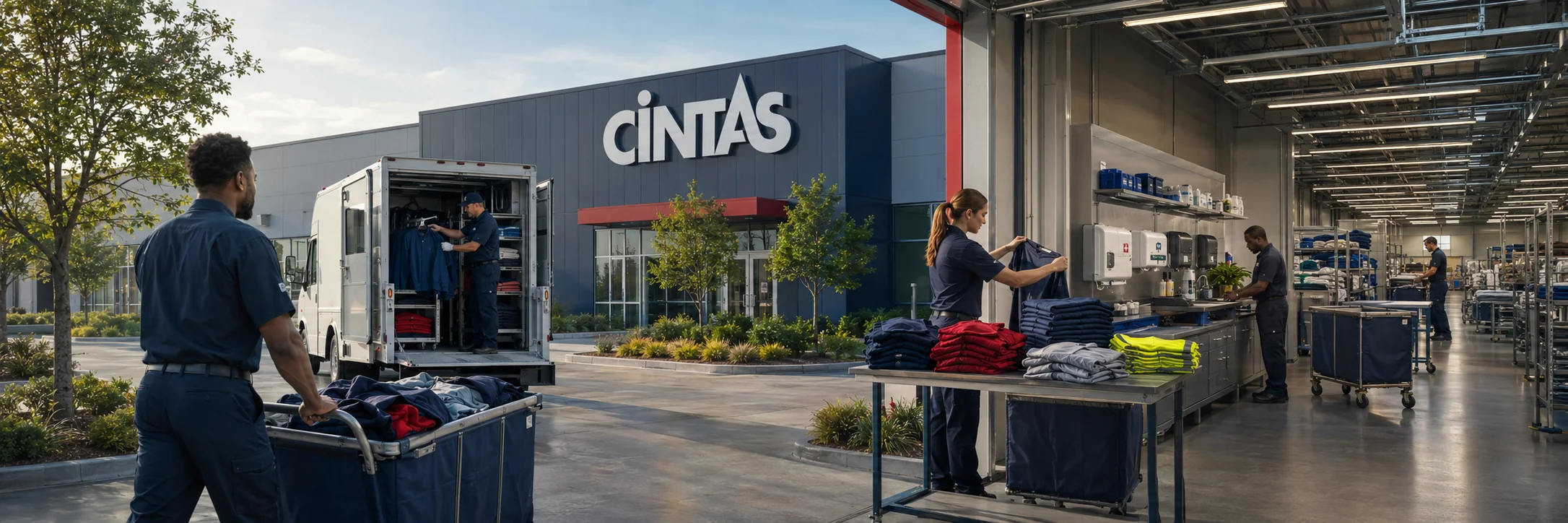
Cintas does not primarily supply clothing as a one-time object. Its route-service model keeps garments and workplace supplies identifiable, collected, cleaned, inspected, repaired, replaced, and returned on a recurring schedule. The useful output is a serviceable item at the workplace when needed. Route density, plant capacity, garment identity, customer reporting, and payment timing determine whether that loop can keep functioning.
A uniform is useful only at work
A work garment is not useful because it exists in a warehouse. It has to be the right size and design, remain serviceable and protective, and reach the right workplace before the next shift. Cintas's fiscal 2025 Form 10-K says approximately 95% of its revenue came from fees for route servicing Uniform Rental and Facility Services, First Aid and Safety Services, and Fire Protection Services customers at their business locations. The filing describes a recurring service, not just a garment sale.
This article uses uniform rental as the clearest physical example. The same logic extends to first-aid cabinets, safety supplies, and fire-protection work: the useful output is an available and suitable service at the customer's site, not a count of items somewhere in the network.
One garment enters a loop
A garment begins as fiber, yarn, fabric, trim, fasteners, labels, and sometimes protective treatments. It becomes useful only after those materials are cut and sewn into an item whose size, design, and condition match the work. The item is then assigned to a customer and often to a named wearer.
Cintas's published service description makes the loop concrete. A new program can assign 11 garments per wearer; each week the route representative picks up soiled garments and returns cleaned garments from the previous week. Cintas describes the pickup and return cycle. Its uniform materials describe scanning garments at the customer's site and at the plant, followed by inspection, repair, replacement, and size changes when required. The uniform overview describes those controls.
At the plant, sorting must keep customer and wearer identities connected to the cleaning method and return route. Washing, drying, finishing, folding, and packing consume water, heat, detergents, equipment capacity, and labor. A garment that is washed but mis-sorted, over-dried, damaged, or returned to the wrong wearer has not completed the service.
Routes carry time as well as clothing
The route is not only a delivery convenience. A driver must visit enough nearby customers to cover vehicle, labor, and plant costs while keeping the interval between pickup and return short enough for usable garments to come back before they are needed. A distant or low-volume account requires more transport and replacement inventory per wearer. Growth can add customers, but it also requires new plants, vehicles, service staff, records, and sorting capacity.
The 10-K's revenue description shows why Cintas sells a recurring process. About 95% of revenue comes from route-servicing contracts, while roughly 5% comes from direct sales. The contract pays for a service performed at a customer's location over time; it does not make the garment disposable or remove the need for a replacement pool.
Payment determines which corrections are reachable
Cintas must purchase or make garments, maintain replacements, operate laundry plants, fuel route vehicles, and pay service employees before a customer has completed the contract's payment cycle. A customer that delays reporting a missing garment can carry a shortage into the next visit. A customer that pays for a fixed wearer count may need a contract change before extra garments or daily service can be added.
The service model can make repair, size changes, and controlled laundering financially practical when the alternative would be for each customer to buy, store, wash, and replace garments alone. It does not make every intervention affordable. A remote account, an unusual protective specification, or a sudden workforce increase can require extra inventory, route mileage, or plant work that existing payment terms do not cover.
A scan is not the garment's whole condition
A garment tag or scan establishes an identity at a location and time. A wash record can establish that a defined process was run. A repair ticket records a reported defect and an action. A customer invoice records the contracted service and payment. A safety specification describes required properties. None alone proves that the garment fit the wearer, remained protective through a shift, or was free of a contaminant that the selected process could not remove.
Feedback is distributed. The wearer may notice a torn seam or chemical odor first. The service representative may see the item at pickup. The plant may detect a sorting or wash problem. The customer may see a team arriving without compliant garments. Correction becomes possible only when the observation reaches someone with identity information, replacement inventory, route authority, and money to change the next delivery.
What the service preserves
Cintas is best understood as a reusable-workwear and workplace-service network. Its capability is not simply owning garments or laundries. It is keeping garment identity, customer requirements, route timing, plant processing, inspection, repair, replacement, and payment connected often enough for the workplace function to recur. The model can preserve more of a garment's completed work than repeated disposal, but only while the loop keeps items identifiable, serviceable, and financially reachable.
CompanyGraph can map the relationships among textile suppliers, Cintas plants, route employees, customers, wearers, laundries, replacement inventory, and payment systems. It can show where garment identity, condition reports, contracts, and corrective authority cross organizational boundaries. It cannot by itself observe a garment's fit during a shift, a contaminant that a process failed to remove, or whether a workplace actually received the protection it required.
Inside CompanyGraph
The screen below shows companies with the recorded consistency this story is about: revenue and net income compounding over the trailing six years with a high growth-consistency reading.
Multi-Year Revenue And Profit Growth
A growth-consistency composite reads high while net income and revenue have both grown on a 6-year compound basis
Multi-Year Revenue And Profit Growth
→cagr income earnings
cagr income revenue
growth consistency
A match records the past sequence, not the system that produced it or its continuation.