 CompanyGraph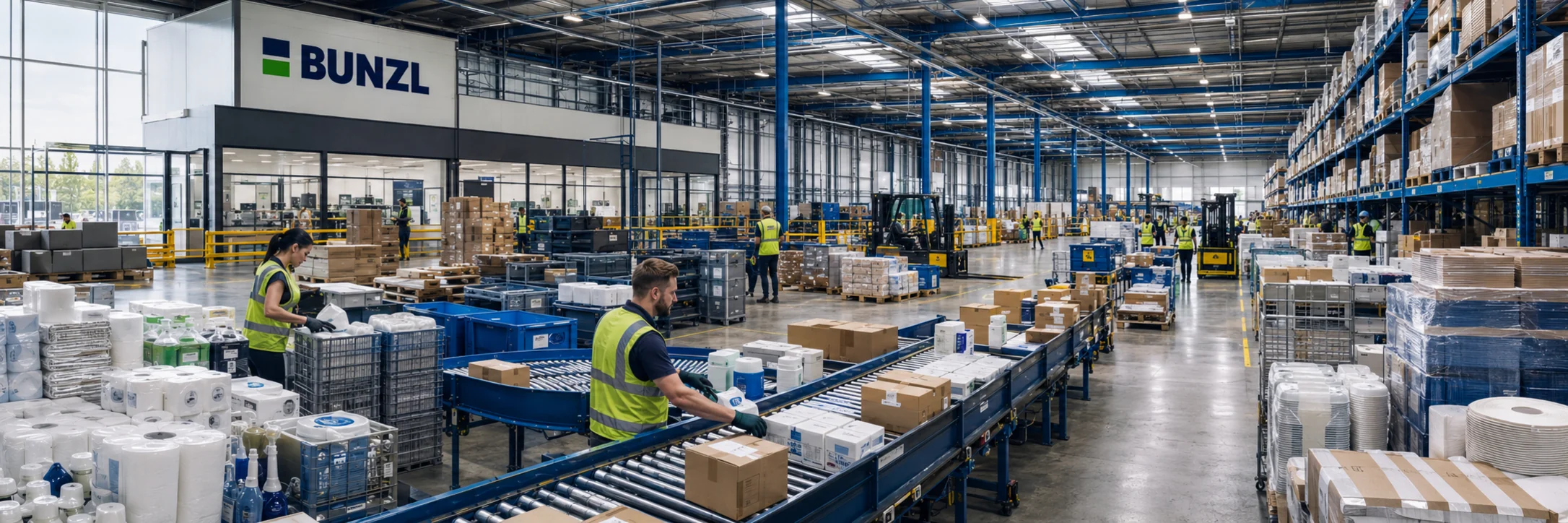
Bunzl turns fragmented supplier output into customer-ready supplies through procurement, inventory, mixed-case picking, credit, route planning, delivery, and support. A catalogue, delivery note, or sustainability claim cannot establish correct use or end-of-life results; specification, lot identity, customer conditions, money, and corrective feedback determine whether the supply keeps a business operating.
A restaurant, hospital, retailer, or workplace does not need a catalogue or a pallet count. It needs the right gloves, packaging, cleaning product, paper, equipment, or food-service item in the right quantity and condition, at the time staff can use it. Bunzl supplies that service through specialist distribution. It combines manufacturers, warehouses, credit, mixed orders, route planning, delivery, and customer support; it does not own every factory or control what happens after the customer uses the product.
Bunzl's company overview describes a one-stop-shop, on-time and in-full distribution service across countries and market sectors. Its 2025 annual report describes operating companies, supplier relationships, customer service, and own-brand products. The useful output is not the number of products handled. It is a supply that arrives with the specification, timing, documentation, and quantity the customer's work requires.
A customer task becomes a product specification
A customer starts with a task: serve food, clean a ward, protect goods, stock shelves, or keep a workplace operating. That task becomes product specifications, pack sizes, hygiene requirements, delivery windows, price, and replenishment rules. Manufacturers produce packaging, chemicals, gloves, paper, and equipment; Bunzl aggregates them, holds inventory, and delivers through local operating companies.
Distribution adds work a factory cannot see. A distributor forecasts demand, finances stock, receives pallets, checks quantities and damage, stores items, picks mixed orders, plans vehicle routes, and delivers to a customer whose demand can change daily. A clinic may need several suppliers combined into one delivery because receiving time and storage space are limited. The warehouse and route are part of the service.
Inventory turns into a workable delivery
A catalogue describes an offer. A purchase order states requested quantity and specification. A warehouse scan records receipt or movement. A pick list records what was selected. A delivery note records handover. An invoice records a financial transaction. Each observes a different boundary.
A delivery note can show that boxes reached a loading dock; it cannot prove that the product was stored correctly, approved for the intended use, or still performed after opening. A supplier certificate can establish a defined test or claim; it cannot describe every lot or customer condition. A sustainability report can describe an assessed supplier or product range; it cannot establish what happened after the customer discarded the item.
Cash and route density make small deliveries possible
Distribution ties up cash in inventory, warehouses, vehicles, fuel, labour, credit, and customer support. Bunzl pays suppliers before many customers pay invoices. A small restaurant or clinic cannot always buy a full pallet, so a mixed-case delivery makes a supply physically available that a direct manufacturer could not provide economically.
Payment terms and route density change what can be done. A customer with late invoices may lose credit or delivery frequency. A rural route may need consolidation or a higher delivery cost. A warehouse can stock a substitute only if it has space, customer approval, and money before the shortage. A cheaper package may increase breakage, storage, labour, or waste costs even when its purchase price is lower.
Acquisitions can add local warehouses, routes, and supplier relationships. They can also leave different product codes, credit terms, systems, and service standards that must be integrated. Scale helps only when inventory and corrective information remain coherent enough for the next delivery.
Private-label identity has to survive the handoffs
Bunzl may specify a product, choose a manufacturer, set packaging and documentation, and sell under its own brand. The label makes the item easier to order, but it does not erase the manufacturing, chemical, labour, transport, and disposal history behind it. A problem in formulation, packaging, or instructions must be traceable to the supplier and lot that can change it.
The same issue appears in cleaning and hygiene products. A chemical can be within its specification and still be misused on the wrong surface. Gloves can meet a certificate while tearing in a particular task. Packaging can be responsibly sourced and still arrive wet or be sent to a disposal route that cannot recover it. Product claims need the customer's actual conditions to remain visible.
Controls route a complaint back to correction
Supplier qualification, product testing, stock rotation, chemical handling, barcode reconciliation, vehicle checks, delivery confirmation, customer training, and complaint investigation address different risks. A customer complaint reports an observed problem; it does not identify whether the cause was manufacture, storage, picking, transport, or use.
Correction requires the item to be tied to a supplier, lot, warehouse, route, customer, and authority able to change the next order or process. The distributor may replace the item and report the issue. The manufacturer may need to change formulation, packaging, or instructions. The customer may need to change storage or training. A delivery record is useful evidence, but it is not the complete material history.
Distribution continues after the delivery
A routine supply remains part of the customer's work until it is used, cleaned, returned, reused, or discarded. The distributor may handle a recall, substitution, credit, or complaint after the truck leaves. The customer may need a different pack size or an approved alternative before the next shift. Waste handlers and recyclers receive materials whose original specification may no longer be visible.
Bunzl is therefore a coordination and working-capital system for routine supplies. CompanyGraph can map its operating companies, manufacturers, warehouses, routes, customer sectors, product and payment handoffs, and supplier-assessment relationships. It cannot by itself observe a hidden storage problem, a product used outside its instructions, a stale inventory record, or the authority available to approve a replacement.
Inside CompanyGraph
The screen below shows the statement shadow of velocity-run distribution: receivables, inventory, and payables turnover all in the upper portion of their ranges.
Three Turnover Ratios Elevated
Sales-to-receivables, COGS-to-inventory, and COGS-to-payables ratios all sit high on their mapped scales
Three Turnover Ratios Elevated
→inventory turnover
payables turnover
receivables turnover
A match records turnover ratios, not assortment quality, availability, or the supplier terms behind them.