 CompanyGraph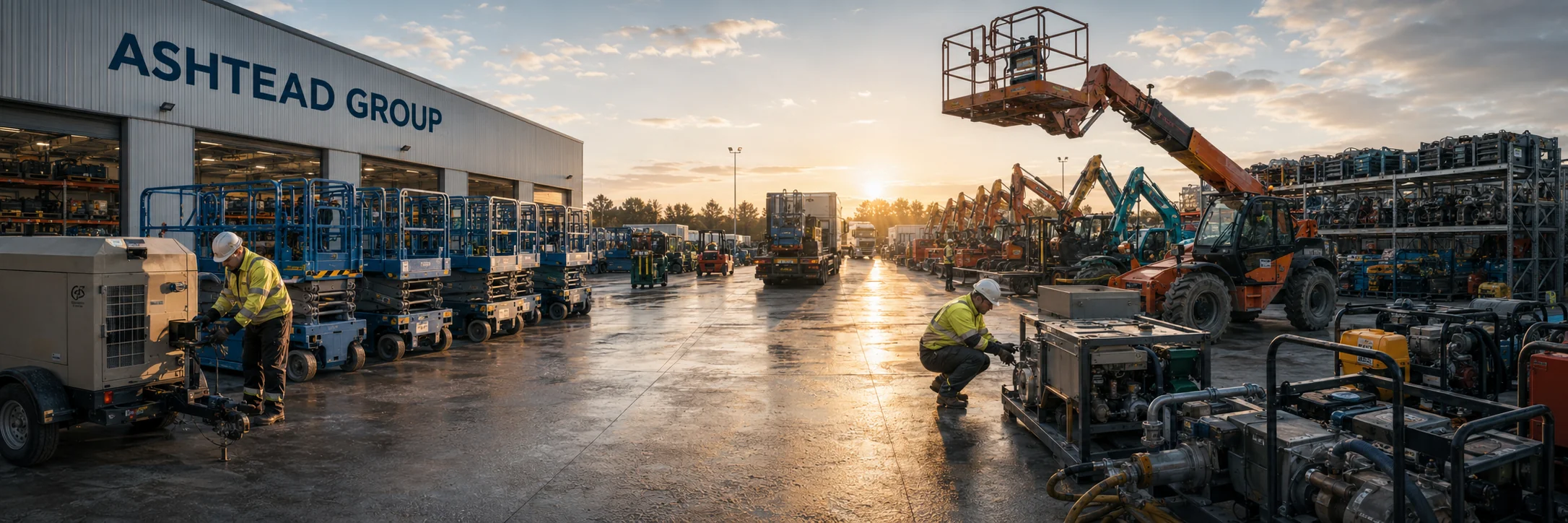
Ashtead turns a fleet of owned machines into temporary, maintained capability at the place and time a job requires it.
A job needs available work, not equipment ownership
A contractor may need a lift for three weeks, an excavator for a changing site, a pump during a flood, or a generator during a shutdown. The useful result is progress at the site. Owning a machine that sits idle between projects is only one way to obtain that result, and often an expensive one.
Ashtead is an international equipment-rental company trading under the Sunbelt Rentals brand. Its 2025 annual report describes the rental business; Sunbelt's service description shows how equipment, branches, technicians, and support connect to customer work. Fleet size alone does not establish that the required machine is at the required site.
A machine travels through a service cycle
Manufacturers build lifts, excavators, generators, pumps, tools, climate-control units, and attachments. Sunbelt buys or leases them, moves them to a branch, inspects them, maintains them, and sends them to a job site. The customer adds fuel, an operator, weather, ground conditions, attachments, and working hours. Return inspection begins another maintenance and allocation cycle.
The same model can be useful on one site and unusable on another. A machine may be too large for access, lack the right attachment, need a permit, have an unsuitable power rating, or be in the wrong branch. A breakdown changes the job's physical options immediately: repair, substitution, relocation, delay, or a different method.
Rental shifts burdens without removing them
Rental shifts purchase cost, idle time, maintenance, storage, insurance, and residual-value risk from the customer to the fleet owner. It does not remove those burdens. Ashtead must finance machines, branches, transport, technicians, parts, inspections, damage, and replacement. The customer may still pay delivery, fuel, an operator, damage, and downtime.
A rental contract states a time, price, equipment description, and responsibilities. It does not make an unavailable machine available or prove that site conditions will be safe. The rental company and customer share a working system whose failure can stop the job even when the invoice is correct.
Money determines which machine can reach the site
A contractor may need a lift before the first progress payment arrives. A branch may reserve and transport the machine before the project's schedule is certain. Ashtead must choose whether to hold fleet near a market, move it from another branch, buy new capacity, or accept idle time. The cash interval determines which choice is possible.
A low daily rate does not make a distant or unmaintained machine reachable. A higher rate may be practical if it prevents a larger project delay. A customer with limited working capital may choose a smaller machine, a shorter rental, or a less capable method, even when the technically best equipment exists elsewhere.
Inspection and maintenance create usable condition
Inspection checks defined items at a handoff. Preventive maintenance replaces fluids, filters, wear parts, and damaged components. Technicians test safety functions and may use telematics to monitor hours, location, alarms, and utilization. These activities turn a manufactured machine into a unit that can be dispatched with some evidence of condition.
Condition can change after dispatch. A missed defect, overloaded attachment, contaminated fuel, rough ground, or unrecorded repair can make a returned machine different from the one that left the branch. A clean inspection confirms a defined observation at one time, not the complete service history or remaining life.
Records observe different boundaries
An equipment listing describes intended capability. A rental contract records terms and responsibility. An inspection observes condition at a handoff. Telematics record location, hours, alarms, or utilization. A maintenance record describes performed work. A damage report records an event. None alone proves safe operation at the job site or remaining life after return.
A telematics record can show engine hours without showing whether a trained operator used the attachment correctly. A service invoice can show that a part was replaced without proving that the underlying failure was corrected. A rental agreement can allocate damage responsibility without observing what physically happened at the site.
Controls make failures actionable
Safety inspections, operator training, maintenance intervals, load limits, telematics, branch inventories, delivery checks, and damage procedures each address a defined risk. They do not guarantee that every job-site condition, operator decision, or repair is visible.
Feedback becomes corrective when the machine, attachment, operator, site condition, maintenance history, and contract can be connected to the person able to change training, fleet selection, repair, or rental terms. If a machine is returned without the failure being described, the next customer may inherit the same defect.
Retirement preserves different amounts of work
A machine can leave a rental fleet while still physically functioning because emissions rules, transport cost, parts availability, damage, or demand make continued rental uneconomic. A rebuild can preserve the engine, hydraulics, frame, or attachment after inspection. A transfer to another fleet can preserve the complete operating configuration if its condition and records remain known.
Material recovery preserves steel, aluminum, copper, rubber, and electronics but destroys the machine's tested configuration and the completed work embodied in its maintained service history. Ashtead's advantage therefore depends on keeping fleet, branches, technicians, customers, payments, and feedback connected across repeated rentals.
Two questions remain open: how much maintenance and condition evidence survives when machines move between branches and customers, and whether the next user can preserve a machine's function when its original records or attachments are missing. CompanyGraph can map fleet, branches, suppliers, technicians, customers, contracts, and repair handoffs. It cannot by itself observe hidden damage, unsafe operation, or which party still has the money and authority to correct a failure.
Inside CompanyGraph
The screen below shows companies currently in the recorded posture this story turns on: capital spending elevated against operating cash flow and running above depreciation, capital committed ahead of its returns.
Industry-Benchmarked Capex/OCF Elevated And Capex Above Depreciation
Two observations co-occur: industry-benchmarked Capex/OCF in elevated range, and Capex/Depreciation ratio above 1.0
A match shows the spending pattern, not whether the spending is building advantage or chasing it.