 CompanyGraph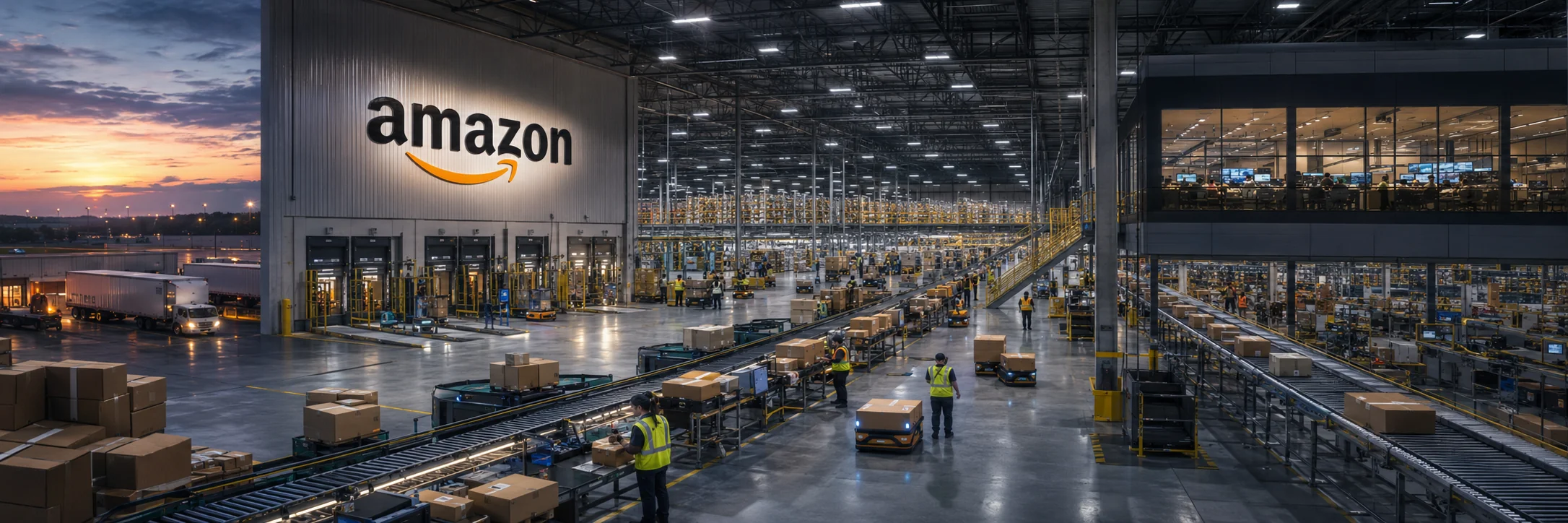
Amazon supplies a usable delivery, a completed seller transaction, or a working cloud workload through different paths that share money, data, infrastructure, and rules.
A purchase begins as a claim, not a product
A customer usually encounters Amazon as a search result, product page, price, delivery promise, and checkout button. None of those is the item itself. The page joins a description to an identity, a seller, an apparent stock position, a price, and a proposed route to the customer. The useful result is a product that arrives in usable condition and can perform the purpose for which it was bought.
Amazon's 2025 Form 10-K separates online-store sales from third-party seller services, advertising, subscriptions, and AWS. It reports $269.287 billion of online-store sales, $172.162 billion of third-party seller services, $68.635 billion of advertising services, $49.619 billion of subscription services, and $128.725 billion of AWS sales in 2025. Those are different services and accounting boundaries, not interchangeable measures of customer benefit. Amazon's 2025 Form 10-K shows how the company records them.
Inventory has to become a delivered object
After checkout, several physical events still have to occur. The item may be Amazon's own inventory or a third-party seller's. It may already be near the customer or waiting in a distant facility. A worker or automated system must identify the unit, pick it, pack it, and route it through sortation and transportation. A carrier event can end with a delivery scan while the item is damaged, missing, misdescribed, or unusable.
The route does not end at the door. A return can preserve the object while losing freshness, packaging integrity, resale value, or the customer's time. A replacement or refund requires money, inventory, a new shipping path, and someone with authority to act. The original order record can connect the customer to a seller and a payment, but it does not by itself establish what happened to the object in a home, vehicle, warehouse, or return stream.
Amazon can occupy different positions in the same sale
Amazon may sell its own stock, host a third-party listing, collect payment, provide advertising, store seller-owned inventory through Fulfillment by Amazon, or move a parcel through its delivery network. These are not merely different labels for one operation. When a seller uses FBA, the seller retains ownership of the inventory even while Amazon stores and fulfills it. Amazon's filing states this explicitly.
That division changes both evidence and authority. Amazon can know that a unit entered a facility, that a label was printed, or that a carrier event occurred. The seller may know the product's manufacturing lot, instructions, or defect history. A customer may be the first person to discover that the object does not match the listing. A refund can repair the customer's financial position without identifying whether the cause was catalog error, seller substitution, warehouse handling, carrier damage, or misuse.
The marketplace expands selection without requiring Amazon to own every unit. It also expands the number of people who can change the result: seller, brand, catalog team, fulfillment operator, carrier, customer-service agent, and customer. The service is complete only when the relevant identity and authority survive those handoffs.
Faster delivery is a geography decision
Speed is not produced by a promise on the product page. It depends on where inventory is placed, how much local labor and transport capacity exists, which items can share a route, and whether the building and network can absorb the peak. Amazon's 2024 shareholder letter attributed faster delivery to regionalizing the fulfillment network, improving placement algorithms, and adding same-day fulfillment centers. The 2025 letter describes adding perishables to same-day delivery in more than 2,300 towns and cities, which requires temperature control and a different handling discipline from ordinary parcels. The 2025 shareholder letter describes the company's account of these changes.
Regionalization can shorten transport and reduce the number of handoffs, but it also duplicates facilities, inventory, equipment, and training across regions. A local stockout can coexist with abundant units elsewhere. A same-day promise can fail because the right item is in the wrong building, because a carrier window closed, or because a perishable item no longer meets its handling conditions. Speed therefore depends on utilization as well as capacity.
Prime changes the clocks around the order
Prime is a paid membership, a set of delivery and media benefits, and a customer expectation about convenience. Amazon's filing describes Prime benefits and shipping offers as worldwide marketing tools, while fulfillment costs remain physical expenses. A membership fee can arrive before a particular order, but the promised service still requires inventory, pick capacity, transport, customer support, and a response when the promise fails.
The timing also affects sellers. A product that is visible and eligible for a fast-delivery program can reach more customers, but eligibility may require particular fulfillment performance, fees, inventory placement, or service choices. The Federal Trade Commission's 2023 complaint alleges that Amazon conditioned Prime eligibility on use of FBA and that seller fees could make several Amazon services difficult to avoid. Those are allegations in ongoing litigation, not established findings. They nevertheless identify a concrete mechanism: a platform rule can change which physical route a seller can afford.
An internal tool became a cloud service
AWS is not simply another name for Amazon's retail technology. In 2006, Amazon launched S3 as storage for the internet and described it as giving developers access to the scalable storage infrastructure Amazon used for its own global websites. EC2 and later services exposed more of the underlying capacity through APIs. The original S3 announcement records that transition from internal infrastructure to an external service.
The physical path is still substantial. Power, cooling, buildings, servers, storage media, networks, spare parts, technicians, software, and security controls have to remain available in a region. A customer does not receive a generic quantity called cloud. The customer receives a configured service with a location, identity permissions, data, performance, and an operating history.
A cloud service is not a finished workload
AWS's shared-responsibility model draws a boundary between security of the cloud and security in the cloud. AWS operates the infrastructure, hardware, networking, and facilities. Depending on the service, the customer remains responsible for guest operating systems, applications, identity and access management, data classification, encryption choices, and monitoring. AWS's shared-responsibility documentation explains that the boundary varies by service.
An AWS availability metric can establish that a service endpoint responded under a defined measurement. It cannot establish that a customer's permissions were correct, that a backup can be restored, or that the customer's application produced the intended business result. A compliance report can document controls operated by AWS; it does not transfer every customer obligation to AWS. The same distinction appears in retail: a delivery scan, a seller rating, and an invoice each observe a limited state.
Money determines which route remains possible
Amazon's 2025 cash capital expenditure was $128.3 billion, primarily for technology infrastructure and fulfillment capacity. The filing also reports that fulfillment cost varies with unit size and weight, seller use of FBA, network expansion, productivity, inventory availability, and the use of third-party providers. Capital arrives before a new building, data-center connection, cold-storage line, or delivery route can earn its full revenue.
The seller faces a different clock. Inventory must be purchased, prepared, transported into a fulfillment center, stored, advertised, and sometimes refunded before the seller knows whether the listing will convert. FBA can reduce the seller's own warehouse and delivery work, but it introduces storage, fulfillment, advertising, and return charges. A small seller with little working capital may self-fulfill more slowly, accept stockouts, or leave the market even when customers want the product. A larger seller can fund inventory and advertising long enough to gain the history that makes the listing visible.
Money also decides the correction. Re-shipping a damaged item, refunding a customer, isolating a suspect batch, retaining staff for an AWS incident, or adding redundant capacity all consume cash before the original cause is fully known. Amazon can assign a policy or issue a credit, but it cannot make a replacement item appear where inventory, transport, or a qualified seller is absent.
Records observe different parts of the result
A product page communicates a claim. An inventory record says that a quantity is assigned to a location or seller. A warehouse scan says that a package or unit was observed during a handling event. A carrier scan says that a transport event occurred. A delivery scan does not prove successful use. A refund proves that money was returned; it does not prove whether the product was defective, misdescribed, damaged, or simply unwanted.
For AWS, a resource record, access log, service metric, backup report, and compliance document answer different questions. An API call can be logged without showing whether a user had legitimate authority. A healthy instance can run a vulnerable application. AWS's infrastructure control can be effective while the customer's encryption or access policy is wrong. Evidence becomes useful when the identity, time, condition, and person able to act remain connected.
Controls can reduce failure without proving the whole chain
Amazon states that it uses policies and processes intended to prevent non-delivery, materially different goods, unlawful products, counterfeit goods, and stolen goods, and that its A-to-z Guarantee may reimburse customers within limits. These controls matter, but they are not a complete inspection of every unit or seller. The Federal Trade Commission's action against Bountiful alleged that a supplement marketer merged newer products into variation relationships so that they borrowed ratings and reviews from established products. The case shows how a strong-looking record can communicate a claim that does not describe the exact product experience. The FTC's Bountiful action describes the allegation and its remedy.
Feedback often arrives after the sale or after the workload is running. A complaint may be the first signal of damage or misdescription. A return may expose a packaging or catalog problem. A seller appeal may show that an enforcement signal was wrong. An AWS incident may require the customer to change application configuration rather than AWS hardware. Detection, reporting, investigation, and correction are separate events, and the useful signal must retain enough identity to reach the person who can change the next state.
Amazon's advantage is a set of connected paths
Amazon's scale is not explained by a single flywheel. Several mechanisms interact. Fulfillment density can reduce distance and time when local inventory and demand are sufficient. The marketplace can add selection without Amazon owning each unit. Advertising can sell visibility to sellers and vendors. Prime can make delivery and content benefits part of one payment relationship. AWS can expose infrastructure first built for Amazon's own systems. The 10-K also warns that poor demand forecasts can leave fulfillment or data-center capacity excessive or insufficient, so scale creates fixed obligations as well as advantages.
The paths can reinforce one another, but they can also conflict. A seller may gain reach while losing margin to fees. Faster delivery may require duplicate buildings and more inventory. An AWS customer may value shared infrastructure while retaining responsibility for configuration and recovery. Regulatory intervention may change the relationship between Prime eligibility, FBA, advertising, and marketplace access. A service is therefore not complete when Amazon records revenue; it is complete when the customer, seller, carrier, or cloud user receives the intended result and a failure can still reach an authorized correction.
Two questions remain open: how much of Amazon's speed advantage depends on keeping regional fixed capacity highly utilized, and how will responsibility be assigned when a failure is visible but the physical cause sits with a seller, carrier, or AWS customer outside Amazon's direct control? CompanyGraph can map the listings, sellers, inventory paths, fulfillment sites, carriers, payment states, AWS services, and handoffs. It cannot by itself observe the condition of a parcel in a home, a seller's undisclosed stock, a customer's cloud configuration, or the practical authority and money available at the moment of correction.
Inside CompanyGraph
The screen below shows companies currently in the recorded posture this story turns on: capital spending elevated against operating cash flow and running above depreciation, capital committed ahead of its returns.
Industry-Benchmarked Capex/OCF Elevated And Capex Above Depreciation
Two observations co-occur: industry-benchmarked Capex/OCF in elevated range, and Capex/Depreciation ratio above 1.0
A match shows the spending pattern, not whether the spending is building advantage or chasing it.