 CompanyGraph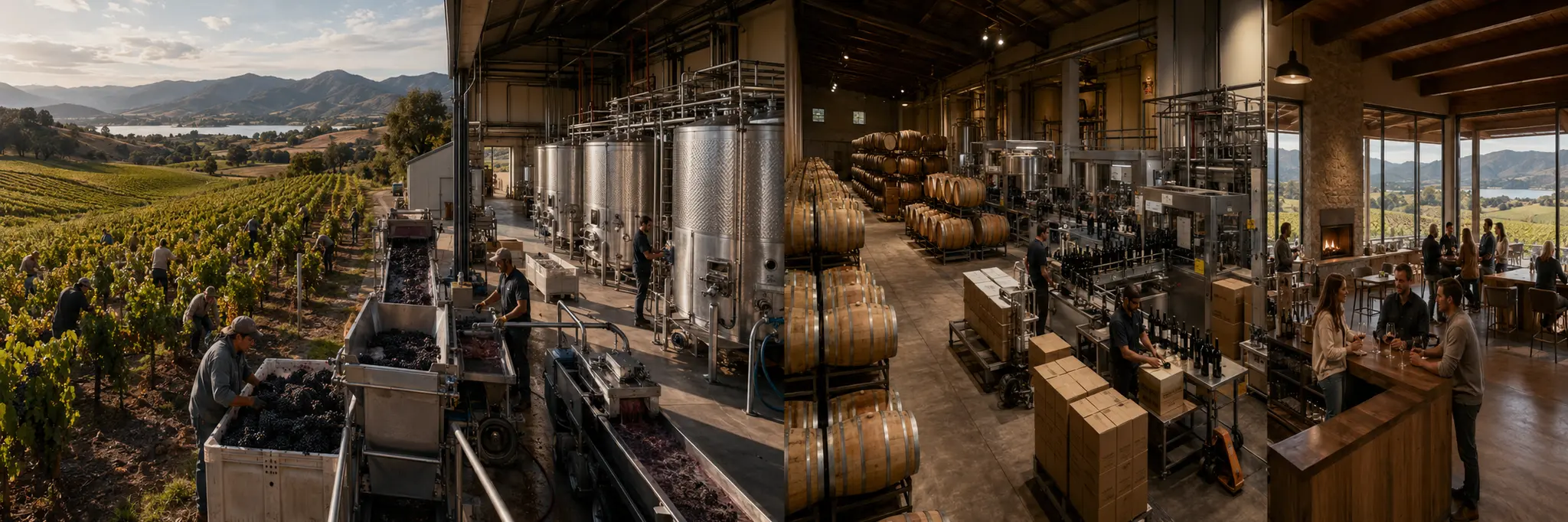
How owning multiple stages of a value chain creates different structural properties than relying on independent suppliers and partners.
Introduction
Vertical integration eliminates market transactions between value chain stages by bringing multiple stages under single ownership. A company that manufactures components and assembles the final product does not need to negotiate supply contracts with external suppliers. A company that operates its own retail stores does not need to convince a retailer to carry its products. Market transactions are replaced by internal coordination.
Most products move through a value chain of distinct stages: raw material extraction, component manufacturing, assembly, distribution, and retail. At each stage, value is added, and typically each stage is operated by a different company.
These companies transact with each other through market mechanisms: purchase orders, contracts, negotiations. Each transaction involves finding counterparties, negotiating terms, monitoring quality, and managing the relationship. These transaction costs are the friction of market-based coordination.
Understanding vertical integration structurally means examining when internal coordination is more efficient than market transactions, what advantages ownership across stages provides, and what costs and constraints the integrated structure imposes.
Core Business Model
Revenue comes from selling the final product or service, but the margin profile reflects the value captured across multiple stages. An integrated company captures the margins at each stage it owns, rather than paying those margins to external suppliers or distributors. The integrated margin structure can be more favorable than the margin available at any single stage, though it requires the capital and expertise to operate across all owned stages.
The cost structure reflects the operations of multiple business stages. Each stage has its own cost drivers, capital requirements, and operational complexity. The integrated company bears all of these, which increases total capital requirements and operational breadth relative to a focused single-stage competitor. The offsetting benefit is the elimination of transaction costs between stages and the ability to optimize across stages in ways that independent companies cannot.
Control over quality, timing, and supply is the primary operational motivation. An integrated company does not depend on external suppliers' quality standards, production schedules, or allocation decisions. It controls the inputs to each stage, reducing the risk of supply disruption, quality variation, or timing mismatches. This control is most valuable when the inputs are critical, the quality requirements are exacting, or the supply market is unreliable.
Information flows more freely within an integrated company than between independent companies. When the manufacturer knows what retail customers are buying in real time, it can adjust production accordingly. When the designer knows what manufacturing constraints exist, designs can be optimized for production. This informational integration enables coordination that market transactions cannot easily replicate.
Low Volatility With OCF Coverage And Growth Consistency
One-year volatility is low, the OCF/Net Income ratio is elevated, and the growth-consistency composite is elevated
Structural Patterns
- Transaction Cost Elimination — Market transactions between stages involve search, negotiation, monitoring, and enforcement costs. Vertical integration eliminates these costs by replacing market transactions with internal coordination. The savings are most significant where transactions are frequent, complex, or require relationship-specific investments.
- Quality Control Through Ownership — Owning the supply chain allows direct control over quality at each stage. This is particularly valuable when the final product's quality depends critically on input quality and when monitoring external suppliers' quality is costly or unreliable.
- Supply Security — Ownership of supply stages eliminates dependency on external suppliers' willingness and ability to provide inputs. This security is most valuable during supply shortages, competitive conflicts, or periods of market instability.
- Margin Capture Across Stages — Rather than paying margins to external participants at each stage, the integrated company captures the full value chain margin. This can improve total profitability when the combined margins exceed the additional costs of operating multiple stages.
- Flexibility Constraints — Vertical integration reduces flexibility to change suppliers or exit stages. An integrated company cannot easily switch to a better supplier for a stage it operates internally. It must maintain competence across all owned stages, even when some become less competitive than external alternatives.
- Capital Intensity Increase — Operating multiple stages requires capital investment at each stage. The total capital requirement is higher than for a single-stage business, increasing the scale of investment needed and the risk if any stage underperforms.
Example Scenarios
A consumer electronics company that designs its own chips, builds its own devices, develops its own operating system, and operates its own retail stores demonstrates comprehensive vertical integration. Each stage is coordinated internally: chip design optimizes for the device, the device optimizes for the operating system, and the retail experience is designed specifically for the product line. No external negotiation or coordination is needed between these stages. The result is a tightly integrated product experience that modular competitors find difficult to match, achieved at the cost of operating in chip design, manufacturing, software development, and retail simultaneously.
An oil company that operates extraction, refining, and distribution illustrates vertical integration in commodity industries. Owning the entire chain from wellhead to gas station provides security of supply at each stage and captures margins across the full chain. When crude oil prices rise, the extraction business benefits while the refining business may suffer from higher input costs, and vice versa. The integrated structure provides natural hedging: shifts between stages partially offset each other, reducing the company's net exposure to price swings at any single stage.
A fashion brand that designs, manufactures in owned factories, and sells through owned stores demonstrates vertical integration as a differentiation strategy. Control over manufacturing enables rapid response to design changes and quality standards that outsourced production might not achieve. Owned retail provides direct customer feedback and eliminates dependency on department store buyers' decisions about what to stock. The integration serves the brand's positioning by ensuring consistency across every stage of the customer experience.
Durability and Risks
The model's durability depends on whether the coordination advantages of integration continue to exceed the efficiency advantages of specialization. When technology, standards, or market conditions make external coordination cheaper and more effective, the integration advantage diminishes. The trend toward modularization in many industries reflects the growing efficiency of market-based coordination relative to internal coordination.
Operational complexity increases with each stage owned. Management must maintain competence across diverse operational domains, and the organizational attention required is substantial. When one stage falls behind industry best practices, the entire integrated system may underperform a modular competitor who sources each stage from the best available specialist.
Capital allocation within an integrated company faces structural challenges. Each stage competes for investment with other stages, and the investment decision is made internally rather than by market mechanisms. Capital may flow to stages based on organizational politics rather than economic return, creating inefficiencies that market-based allocation would not.
Disruption at any single stage affects the entire chain. A technology shift that makes one owned stage obsolete requires the integrated company to restructure its entire value chain, not just switch to a new supplier. The interconnection that creates coordination advantages in stable conditions creates vulnerability during periods of rapid change.
What Investors Can Learn
- Assess the coordination advantage — The value of integration depends on whether internal coordination produces meaningfully better outcomes than market-based coordination. When external markets are efficient and reliable, the integration advantage may be modest.
- Evaluate stage competitiveness individually — Each stage of the integrated chain should be competitive with external specialists. If internal stages fall behind best-in-class external alternatives, the integration may reduce rather than enhance total value.
- Consider flexibility costs — Vertical integration reduces the ability to quickly adopt new suppliers, technologies, or approaches at any stage. The flexibility cost should be weighed against the coordination benefit.
- Watch for industry modularization — When industry standards, interfaces, and practices evolve to reduce the coordination friction between stages, the advantage of integration diminishes because the problem it solves becomes less significant.
- Examine capital allocation across stages — How investment is distributed across the integrated stages reveals whether capital is flowing to highest-return uses or whether organizational dynamics are directing it suboptimally.